Contains everything you need to live. Except the answer to why you were given a life at all.
I. THE SMELL THAT SHOULDN’T EXIST
He walks into the kitchen behind the manager.
Club Pasture smells unlike anywhere else. Kai cannot describe the difference—he has no words for smells beyond those printed on the capsules: "tomato", "cinnamon", "smoke". But this smell matches none of the profiles. It’s denser. It doesn’t seep through the filter—it strikes. Kai stops at the threshold.
— Fourth-line dispenser, — the manager says without turning around. — Floating calibration error. Dispenses two percent below standard. The chef is worried.
Kai nods. He’s here to work. But he’s never before thought of his nose as a sensory organ—capsules have no smell, they only simulate taste on the tongue. And now, suddenly, his nose begins to live a life of its own.
He sees the board.
An ordinary wooden board. On it lies a piece of something dark red, veined with white, its cut surface moist. Kai knows from training manuals that this is meat. Real meat. He has never seen it in person.
— Steak? — he asks, though the question is stupid.
— Ribeye, — the manager replies. — For Mr. Choi. He only eats marbled beef from New Zealand pastures. Says it has the correct fat pattern.
Kai looks at the pattern. Fat threads through the meat in fine filaments, like cracks in dry earth. And the smell doesn’t leave—it becomes part of the air.
— Fix the dispenser, — the manager says. — Dinner’s in an hour.
Kai opens the panel. His hands work on autopilot—tester, calibration, sensor replacement. But his thoughts are not on the job. His thoughts are on the fact that right now, this very second, somewhere in this building, a man is sitting who will put this piece into his mouth. Not a capsule. Not an imitation. Something that grew, breathed, was alive—and stopped being alive.
Kai finishes the calibration.
— Done, — he says.
The manager nods. Kai leaves the kitchen. But in the corridor he stops. He pulls his evening capsule from his pocket—“steak with sides.” He looks at it. A transparent cylinder, powder inside. He brings it to his face. He sniffs. Nothing. Only a faint plastic smell.
He isn't hungry. He is never hungry. The capsules work.
But for the first time in his life, he feels that a capsule is not food. Not because it’s inferior. But because it leaves no room for a question. It simply gives an answer he never asked.
Kai puts the capsule back. He walks toward the exit. Already at the door, he thinks: Why was I sent here? I’m not the only tech. There are four people in this line.
The thought fades without finding an answer. But it was there.
At home, he will eat the capsule anyway. The taste will be the same as always. But for the first time, the taste means nothing.
II. THE ARCHIVE
Three days later, Kai opens the corporate database.
Not out of rebellion—out of an engineer’s curiosity. He wants to understand where the “flavor profiles” came from. Who decided that the “steak” capsule should smell of plastic and not of what he had smelled in that kitchen?
He dives deep. Calibration protocols, sensory substitution matrices, focus group data. Everything standard. But at the sixth access level—behind a holder blinking yellow—he finds a section marked:
“Archive. Protocol for Recording Non-Predictable Behavioral Acts. Restricted Access.”
Kai lacks clearance. But a system error—he’s known this bug since his internship—opens the archive if you query it three times in a row at seventeen-second intervals. He tries. On the third attempt, access unlocks.
Inside the archive are hundreds of entries dating back to the previous century. Before capsules. Before ratings. Before everything became predictable.
He reads one file. Then another. Then a tenth.
File №0047. Year 2041.
“Subject was offered a choice between two identical objects: a blue cube and a red cube. Neither held an advantage. Subject chose the blue cube. When the experiment was repeated an hour later, subject again chose blue. When asked ‘why,’ subject replied: ‘Just because.’ An act of non-prescribed motivation recorded.”
File №0112. Year 2043.
“Subject was offered an unconditional bonus or the option to refuse it without consequences. 7% refused. Upon further questioning, they could not explain the reason. Spontaneous resistance recorded.”
File №0891. Year 2058.
*“Conclusion: the frequency of non-predictable behavioral acts has decreased by 94% over seventeen years. The risk-optimization system has fully suppressed the conditions required for non-prescribed motivation to arise. Further research deemed inexpedient.”*
Kai closes the archive.
He sits in the darkness of his capsule-apartment. He stares at the ceiling—smooth, white, without cracks.
Inside him there is not a question, but the shape of a question. An emptiness that wants to be filled with something absent from the menu.
He opens his daily schedule. Tomorrow: wake, capsule, work, capsule, sleep.
For the first time, he looks at the schedule and sees not a timetable. But a cage.
III. PROTOCOL №0
Kai starts small.
Incident one. He refuses his quarterly bonus—one hundred rating points. His supervisor raises an eyebrow: “Are you sure?” Kai says, “Yes.” No explanation. The system logs a yellow flag: Behavior non-optimal.
He feels a strange satisfaction. Not from the act itself—from the fact that the act could not be predicted.
Incident two. He buys a cello. He cannot play. He does not intend to learn. He simply spends ninety percent of his savings on an object he doesn’t need. The system issues an orange flag: *Irrational resource allocation. Resistance-to-prediction coefficient: 0.31.*
His neighbor asks: “Why?” Kai shrugs. But inside there is warmth. Not like the warmth from a capsule. Like the warmth of something he cannot name.
Incident three. He publicly tells a colleague directly: “You do your job poorly. I don’t mean to hurt you. It’s a fact.” The colleague freezes. Everyone falls silent. The truth in this world costs more than lies—not in credits, but in ratings. The system issues a red flag: Socially destabilizing behavior. Resistance coefficient has exceeded the 0.78 threshold.
Kai loses four hundred points.
A few days later, a message arrives. Not a voice. Not a person. An interface. Text:
*“You are participating in Protocol №0. Optimization-resistance assessment. Your actions over the past 47 days have been logged. Confirmation required: did you act of your own free will? Yes / No”*
Kai looks at the screen. His finger hovers over “Yes.”
If I press “No,” he thinks, will that be the truth or a lie? And he presses “Yes.”
After a pause, the system responds:
“This cannot be verified. The Protocol continues.”
And then, one more line:
*“K-73144. Stage 1 complete.”*
He doesn’t know what “continues” means. But something inside him has shifted. Not desire—more a kind of readiness. A readiness for the schedule to stop being a schedule.
He commits a few more small acts. He buys a ticket to a city he has never visited. He walks instead of taking transport. He stays silent when words are expected of him. Each time, the system logs a “deviation.” Each time, his rating drops. But the strange warmth does not leave.
He notices a pattern: his desires are becoming sharper. As if someone is prompting him. As if he isn’t inventing them, but finding them. Inside, a disquiet grows that he cannot explain.
IV. ZERO POINT
An invitation arrives.
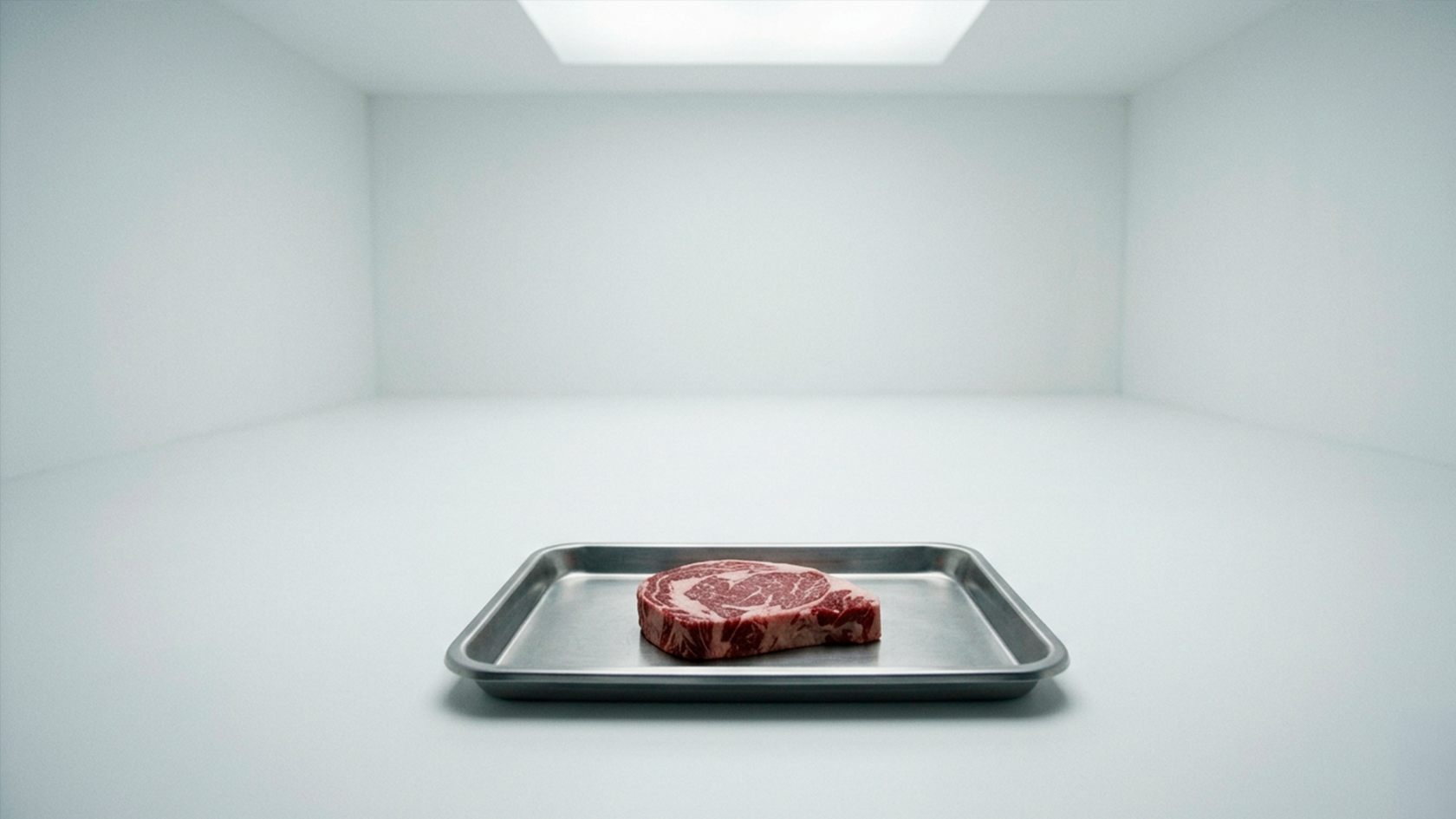
A white room. No windows. No furniture. In the center, a sterile tray. On the tray lies that very piece of meat.
Ribeye. Marbled beef. The same veins of fat, the same moist cut. Kai recognizes it—not by sight, but by smell. The smell hits him again, like that first blow. Only now there is no manager, no dispenser, no club. Only him and the meat.
Beside it, a holographic protocol:
*“Choose one of three actions:
Kai stares at the meat. He remembers the smell. He remembers how his hands trembled when he first saw it. He is almost certain he wants to taste it.
But before making his choice, he requests full access to his file. For the first time in his life, he wants to know.
Access is granted.
One file.
*Subject: K-73144*
Status: active
Stage 1 — complete
Stimulus: natural product, cat. M
Location: Pasture
Deviation recorded
Seven lines. Dated that very day. Forty-seven days ago.
Kai reads them three times. Then he closes the file.
He did not find the door. The door was opened for him. The system itself led him to the kitchen, showed him the meat, triggered the mechanism. Everything he believed was his own desire—the refused bonus, the cello, the truth to his colleague, the ticket to a strange city—all of it had been predicted. Accounted for. Classified as “deviation.”
He reaches out and touches the meat. Cold, damp, firm. His fingers sink into the fibers.
The question that won’t leave:
“If my desire was artificially induced, but I walked the whole path myself—who does the choice belong to? To me, or to the one who put the meat on the board?”
He squeezes the piece. He feels the fat melting under his fingers.
Inside him is the emptiness that was always there. But now he knows: this emptiness cannot be filled by a capsule. And it cannot be filled by meat. The emptiness is not hunger. It is the distance between what he chose and what was chosen for him.
Kai lifts the meat to his face. The smell is dense, alien, impossible.
He freezes.
His hand, a millimeter from his lips.
And if even this question was anticipated—then where do I end, and where does the Protocol begin?
He walks into the kitchen behind the manager.
Club Pasture smells unlike anywhere else. Kai cannot describe the difference—he has no words for smells beyond those printed on the capsules: "tomato", "cinnamon", "smoke". But this smell matches none of the profiles. It’s denser. It doesn’t seep through the filter—it strikes. Kai stops at the threshold.
— Fourth-line dispenser, — the manager says without turning around. — Floating calibration error. Dispenses two percent below standard. The chef is worried.
Kai nods. He’s here to work. But he’s never before thought of his nose as a sensory organ—capsules have no smell, they only simulate taste on the tongue. And now, suddenly, his nose begins to live a life of its own.
He sees the board.
An ordinary wooden board. On it lies a piece of something dark red, veined with white, its cut surface moist. Kai knows from training manuals that this is meat. Real meat. He has never seen it in person.
— Steak? — he asks, though the question is stupid.
— Ribeye, — the manager replies. — For Mr. Choi. He only eats marbled beef from New Zealand pastures. Says it has the correct fat pattern.
Kai looks at the pattern. Fat threads through the meat in fine filaments, like cracks in dry earth. And the smell doesn’t leave—it becomes part of the air.
— Fix the dispenser, — the manager says. — Dinner’s in an hour.
Kai opens the panel. His hands work on autopilot—tester, calibration, sensor replacement. But his thoughts are not on the job. His thoughts are on the fact that right now, this very second, somewhere in this building, a man is sitting who will put this piece into his mouth. Not a capsule. Not an imitation. Something that grew, breathed, was alive—and stopped being alive.
Kai finishes the calibration.
— Done, — he says.
The manager nods. Kai leaves the kitchen. But in the corridor he stops. He pulls his evening capsule from his pocket—“steak with sides.” He looks at it. A transparent cylinder, powder inside. He brings it to his face. He sniffs. Nothing. Only a faint plastic smell.
He isn't hungry. He is never hungry. The capsules work.
But for the first time in his life, he feels that a capsule is not food. Not because it’s inferior. But because it leaves no room for a question. It simply gives an answer he never asked.
Kai puts the capsule back. He walks toward the exit. Already at the door, he thinks: Why was I sent here? I’m not the only tech. There are four people in this line.
The thought fades without finding an answer. But it was there.
At home, he will eat the capsule anyway. The taste will be the same as always. But for the first time, the taste means nothing.
II. THE ARCHIVE
Three days later, Kai opens the corporate database.
Not out of rebellion—out of an engineer’s curiosity. He wants to understand where the “flavor profiles” came from. Who decided that the “steak” capsule should smell of plastic and not of what he had smelled in that kitchen?
He dives deep. Calibration protocols, sensory substitution matrices, focus group data. Everything standard. But at the sixth access level—behind a holder blinking yellow—he finds a section marked:
“Archive. Protocol for Recording Non-Predictable Behavioral Acts. Restricted Access.”
Kai lacks clearance. But a system error—he’s known this bug since his internship—opens the archive if you query it three times in a row at seventeen-second intervals. He tries. On the third attempt, access unlocks.
Inside the archive are hundreds of entries dating back to the previous century. Before capsules. Before ratings. Before everything became predictable.
He reads one file. Then another. Then a tenth.
File №0047. Year 2041.
“Subject was offered a choice between two identical objects: a blue cube and a red cube. Neither held an advantage. Subject chose the blue cube. When the experiment was repeated an hour later, subject again chose blue. When asked ‘why,’ subject replied: ‘Just because.’ An act of non-prescribed motivation recorded.”
File №0112. Year 2043.
“Subject was offered an unconditional bonus or the option to refuse it without consequences. 7% refused. Upon further questioning, they could not explain the reason. Spontaneous resistance recorded.”
File №0891. Year 2058.
*“Conclusion: the frequency of non-predictable behavioral acts has decreased by 94% over seventeen years. The risk-optimization system has fully suppressed the conditions required for non-prescribed motivation to arise. Further research deemed inexpedient.”*
Kai closes the archive.
He sits in the darkness of his capsule-apartment. He stares at the ceiling—smooth, white, without cracks.
Inside him there is not a question, but the shape of a question. An emptiness that wants to be filled with something absent from the menu.
He opens his daily schedule. Tomorrow: wake, capsule, work, capsule, sleep.
For the first time, he looks at the schedule and sees not a timetable. But a cage.
III. PROTOCOL №0
Kai starts small.
Incident one. He refuses his quarterly bonus—one hundred rating points. His supervisor raises an eyebrow: “Are you sure?” Kai says, “Yes.” No explanation. The system logs a yellow flag: Behavior non-optimal.
He feels a strange satisfaction. Not from the act itself—from the fact that the act could not be predicted.
Incident two. He buys a cello. He cannot play. He does not intend to learn. He simply spends ninety percent of his savings on an object he doesn’t need. The system issues an orange flag: *Irrational resource allocation. Resistance-to-prediction coefficient: 0.31.*
His neighbor asks: “Why?” Kai shrugs. But inside there is warmth. Not like the warmth from a capsule. Like the warmth of something he cannot name.
Incident three. He publicly tells a colleague directly: “You do your job poorly. I don’t mean to hurt you. It’s a fact.” The colleague freezes. Everyone falls silent. The truth in this world costs more than lies—not in credits, but in ratings. The system issues a red flag: Socially destabilizing behavior. Resistance coefficient has exceeded the 0.78 threshold.
Kai loses four hundred points.
A few days later, a message arrives. Not a voice. Not a person. An interface. Text:
*“You are participating in Protocol №0. Optimization-resistance assessment. Your actions over the past 47 days have been logged. Confirmation required: did you act of your own free will? Yes / No”*
Kai looks at the screen. His finger hovers over “Yes.”
If I press “No,” he thinks, will that be the truth or a lie? And he presses “Yes.”
After a pause, the system responds:
“This cannot be verified. The Protocol continues.”
And then, one more line:
*“K-73144. Stage 1 complete.”*
He doesn’t know what “continues” means. But something inside him has shifted. Not desire—more a kind of readiness. A readiness for the schedule to stop being a schedule.
He commits a few more small acts. He buys a ticket to a city he has never visited. He walks instead of taking transport. He stays silent when words are expected of him. Each time, the system logs a “deviation.” Each time, his rating drops. But the strange warmth does not leave.
He notices a pattern: his desires are becoming sharper. As if someone is prompting him. As if he isn’t inventing them, but finding them. Inside, a disquiet grows that he cannot explain.
IV. ZERO POINT
An invitation arrives.
A white room. No windows. No furniture. In the center, a sterile tray. On the tray lies that very piece of meat.
Ribeye. Marbled beef. The same veins of fat, the same moist cut. Kai recognizes it—not by sight, but by smell. The smell hits him again, like that first blow. Only now there is no manager, no dispenser, no club. Only him and the meat.
Beside it, a holographic protocol:
*“Choose one of three actions:
- Consume the object.
- Destroy the object.
- Leave the object unchanged.
- This is not a test. This is the completion of Protocol №0.”*
Kai stares at the meat. He remembers the smell. He remembers how his hands trembled when he first saw it. He is almost certain he wants to taste it.
But before making his choice, he requests full access to his file. For the first time in his life, he wants to know.
Access is granted.
One file.
*Subject: K-73144*
Status: active
Stage 1 — complete
Stimulus: natural product, cat. M
Location: Pasture
Deviation recorded
Seven lines. Dated that very day. Forty-seven days ago.
Kai reads them three times. Then he closes the file.
He did not find the door. The door was opened for him. The system itself led him to the kitchen, showed him the meat, triggered the mechanism. Everything he believed was his own desire—the refused bonus, the cello, the truth to his colleague, the ticket to a strange city—all of it had been predicted. Accounted for. Classified as “deviation.”
He reaches out and touches the meat. Cold, damp, firm. His fingers sink into the fibers.
The question that won’t leave:
“If my desire was artificially induced, but I walked the whole path myself—who does the choice belong to? To me, or to the one who put the meat on the board?”
He squeezes the piece. He feels the fat melting under his fingers.
Inside him is the emptiness that was always there. But now he knows: this emptiness cannot be filled by a capsule. And it cannot be filled by meat. The emptiness is not hunger. It is the distance between what he chose and what was chosen for him.
Kai lifts the meat to his face. The smell is dense, alien, impossible.
He freezes.
His hand, a millimeter from his lips.
And if even this question was anticipated—then where do I end, and where does the Protocol begin?
#PhilosophicalDystopia #PsychologicalSciFi #ScienceFiction #Dystopia #ExistentialFiction #PsychologicalThriller #TheIncubator