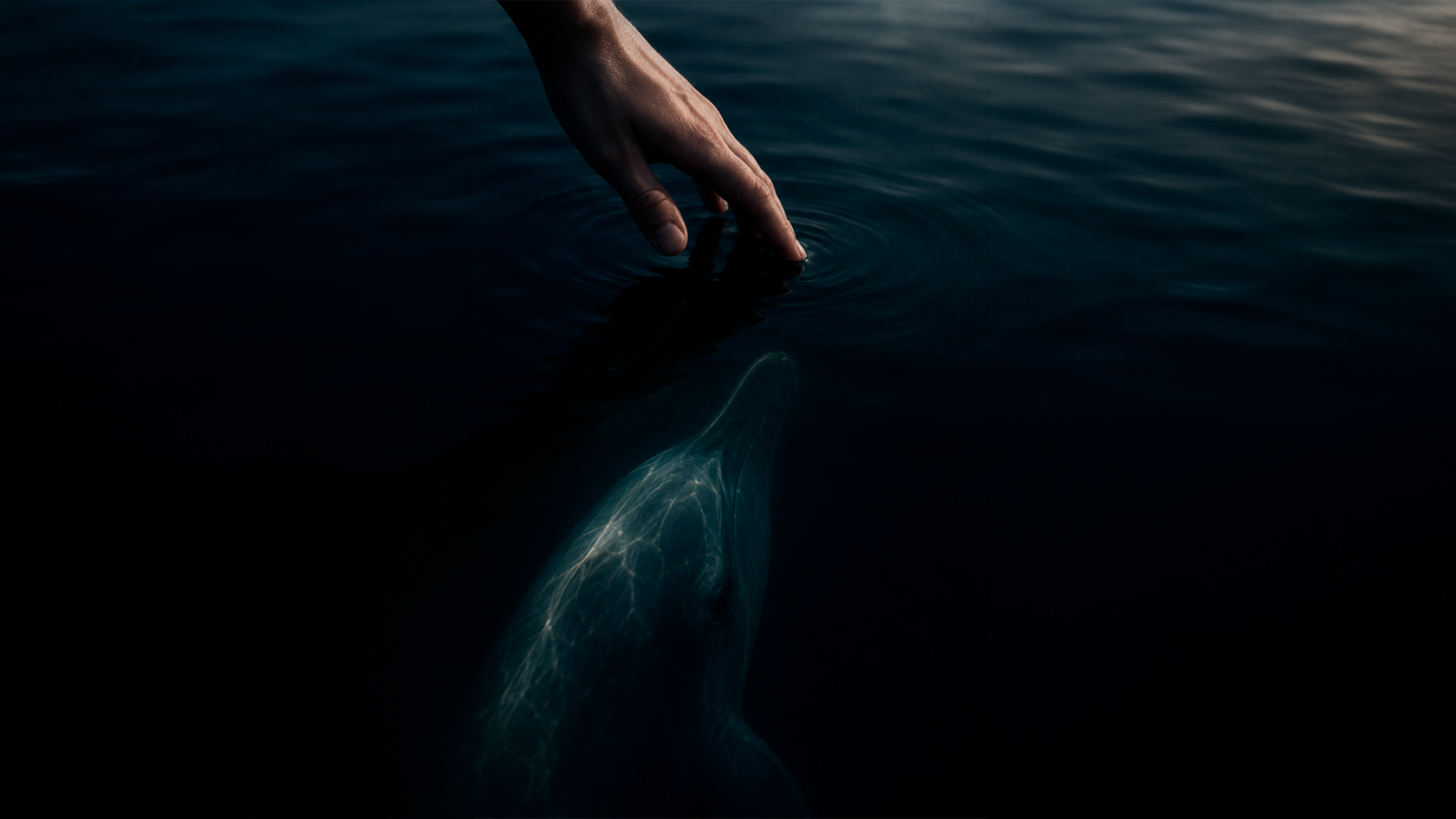
Protocol of Silence:
The Art of Waiting
CAMERA ONE: CRYSTAL
Atlantis. The final night.
Tal knew morning would not come. Not in the sense that he would die—in the sense that the familiar morning, with the smell of bread from the lower street bakery and the sound of water in the aqueduct, would never repeat. This kind of knowledge—not fear, not premonition, simply a fact, like the multiplication table—came easier than people thought. What was harder was something else.
What was harder was looking at them.
There were five in the hall—out of three hundred who had consented earlier, out of thousands who remained in the city because they hadn't made it, or didn't believe, or believed but couldn't cross over. Five that he had called first. Five he had spent the longest explaining to. Five he was, if honest, most afraid of losing—though the word "lose" now required clarification.
Ari sat by the window, looking at the water. She always looked there when she was thinking about something she didn't want to discuss. Tal had known her for twenty-three years and knew this gesture as well as his own breathing.
He did not approach her. Not yet.
Ner stood against the far wall—straight, as always, as if the wall were a formation and he was holding it. The warrior in him would be the last to die. Tal knew this and accepted it as a given. Ner did not understand why all of this was necessary, and trusted Tal not because he understood, but because he had decided to trust. This was his form of courage—perhaps the purest of all.
Lia held a shell in her hands. Large, pink inside, with edges thin as paper. She had found it on the shore three days ago and had not let go since. Tal saw her lift it to her ear—not to hear the sea, she knew perfectly well that was an illusion. She was doing something else. She was memorizing the shape of the sound.
Ol sat on the floor at Ari's feet—not because he was tired, but because it was easier to look up from there. He was seven years old. They had not asked him. Tal returned to this thought again and again in the last days—was it because they could not explain, or because they did not dare? The boundary between those two answers remained the darkest place in the entire plan.
The boy was looking up—at the ceiling, painted with maps of sea currents. Tal followed his gaze. The currents ran north to south and east to west, intersecting above the center of the hall, and at the point of intersection the artist had painted a small figure—human or fish, impossible to tell from this distance.
"May I ask one question?" Lia said.
She was not looking at Tal. She was looking at the shell.
"Yes," he said.
"What will become of beauty?"
The hall fell silent. Even Ner stopped looking at the wall.
Tal opened his mouth.
Closed it.
That was the first silence. He would remember it—longer than everything else.
The crystal lay on the table in the center of the hall. It looked like an ordinary stone—semi-transparent, slightly bluish, the size of a fist. Nothing special, if you didn't know. If you knew—it was the entire archive. Everything they had managed to record: mathematics, medicine, history, the physics of water and light, star charts, formulas that had no names yet, and ethics—not as a list of prohibitions, but as geometry, as a way of thinking about those who were not yet here.
Three centuries of work. Tens of thousands of people—those who recorded, and those who lived in such a way that recording was possible.
Tal looked at the crystal and thought that knowledge was the most unstable thing in the universe. Heavier than water, but sinks faster. Vanishes before wood, before stone, sometimes before the person holding it.
They had decided: stone is a poor carrier. Metal is poor. Clay, papyrus, parchment—worse than poor. Anything that can burn will burn. Anything that can be broken will be broken.
What was needed was a carrier that could not be destroyed without destroying life itself. One that would move, breathe, hide in the depths, survive catastrophes. One that would wait.
A living cell. The genome.
The procedure was ready. Tal had developed it himself—five years, three complete revisions, countless errors on samples he tried not to remember. The final version worked. He was ninety-eight percent certain. The remaining two percent he carried in silence.
"We need to begin," he said.
Ari turned from the window. The first time in an hour.
"I know," she said.
She stood. Walked to him. Looked—long, the way you look when you want to remember not a face, but something behind the face.
"I'll find you," she said quietly. "There. I don't know how. But I'll find you."
"I will be there," he said.
This was the truth. Incomplete, but the truth: he would be there—just not in the way she was used to recognizing him.
She nodded.
Walked to Ol and took his hand.
Ner was the last to approach Tal. Everyone was already standing by the basin of water—Tal privately called it the "dissolver," though the word was imprecise: the crystal didn't dissolve in water, it melted, entered the water, and the water entered them, and that was a different, more accurate verb—entered.
"I don't understand why," Ner said.
"I know."
"You never explained it to me. Really."
Tal looked at him. At the scars on his arms—old ones, ones Ner no longer noticed. At the way he stood: slightly forward, ready. Always ready. His whole life—ready.
"Do you remember," Tal said, "what you feel after a battle?"
Ner was silent for a second.
"Yes."
"It doesn't leave, does it? I've seen it. In all of you—it doesn't leave."
Ner said nothing. That was the answer.
"There," Tal said, and his voice broke slightly, the smallest amount, almost imperceptibly, "there won't be any of that. At all. I can't promise you much. But that—I promise."
Ner looked at him for a long time. Then nodded—once, short, like signing a document.
"Alright then," he said.
Tal turned away, because he did not want Ner to see his face at that moment. Because he had lied. Not about the exhaustion of violence—that was true. But he knew something else: that some of them would forget. Not all at once—gradually, layer by layer, like autumn leaves, until only the living and nameless remained. He knew that Ner would forget first. He had seen it in the calculations.
He decided not to speak.
This decision lived in him like a splinter—not painful, but present. He had thought about it every day for three years and never changed his choice. Because if he told them—no one would enter the water. And if no one entered—everything would vanish without a trace.
He was not certain this was right. Sometimes he thought—wrong. But he had found nothing else.
Ol was the first to approach the basin.
Ari tried to hold him back—not to stop him, just to slow him, to be with him one more second. But he had already stepped forward, and the water received his hands.
Tal watched the boy and thought that a child has no memories that need defending. None of the weight that adults call personality and cling to as if it were the last thing. Ol would enter the water easily—not because he was brave, but because he was not yet heavy enough.
Maybe that was why he was first.
The crystal was already in the basin. Tal had placed it himself—a few minutes ago, while the others were preparing—and watched it melt. Not dissolve—melt: becoming liquid from within, losing form but not substance. The knowledge was entering the water. The water was accepting it and waiting.
Ol stood elbow-deep in the basin and looked down.
"The water is glowing," he said.
"Yes," said Tal.
"Like fish at night."
"Something like that."
The boy nodded—with satisfaction, as if that explained everything he needed to know.
Then he looked at his mother.
Ari smiled at him—with an effort Tal saw, but Ol probably did not.
Ol smiled back.
Then he entered deeper.
Lia was the last before Tal.
At the basin, she stopped and turned to him. In her hand—still the shell.
"You never answered," she said.
"No."
"What will become of beauty?"
Tal looked at her. At the shell in her hand—pink inside, edges thin as paper.
He did not know. Honestly—did not know. His calculations worked with memory, with information, with data structures. With what could be recorded. Beauty—what Lia meant by it—could not be recorded. It could be described. The description was not the same thing.
He wanted to say something intelligent. Something that would soothe her. He could not.
"I don't know, Lia," he said. "Perhaps it will remain in the way you now see."
Lia looked at him.
"Is that enough?"
He shook his head.
"I don't know."
She nodded—slowly, as if tasting the answer. Lifted the shell to her ear—one last time. Listened for a few seconds. Then lowered her hand with the shell into the water.
Released it.
The shell sank slowly to the bottom of the basin—into the glowing water, into the dissolved knowledge—and stayed there. Lia watched it for a second. Then she entered.
Tal was alone.
He stood by the basin last, and the hall was quiet, and outside it was quiet, and for the first time in many years he felt what people call peace—though the word had always seemed too small for what it was supposed to denote.
He thought: in a few hours, the water will come. The real water, the great water, the one he had predicted and no one else had wanted to predict with him. It will cover the streets, the aqueduct, the bakery on the lower street. It will cover this hall with the current maps on the ceiling. It will cover the basin.
But not what had entered the water first.
That would wait.
He raised his hand and spoke five names—slowly, with pauses. Not as a farewell. As a first naming. Tal did not yet know that this was precisely the signature-whistle, the individual signal each of them would carry into the new body. He did not think in such words. He simply spoke the names, because it seemed important that they be spoken aloud one last time before changing form.
Then he entered the water.
It was warm. He had not expected that.
The light in the basin went out. Not all at once—slowly, like a sunset.
Outside the hall window, the surf was beginning.
Tal knew morning would not come. Not in the sense that he would die—in the sense that the familiar morning, with the smell of bread from the lower street bakery and the sound of water in the aqueduct, would never repeat. This kind of knowledge—not fear, not premonition, simply a fact, like the multiplication table—came easier than people thought. What was harder was something else.
What was harder was looking at them.
There were five in the hall—out of three hundred who had consented earlier, out of thousands who remained in the city because they hadn't made it, or didn't believe, or believed but couldn't cross over. Five that he had called first. Five he had spent the longest explaining to. Five he was, if honest, most afraid of losing—though the word "lose" now required clarification.
Ari sat by the window, looking at the water. She always looked there when she was thinking about something she didn't want to discuss. Tal had known her for twenty-three years and knew this gesture as well as his own breathing.
He did not approach her. Not yet.
Ner stood against the far wall—straight, as always, as if the wall were a formation and he was holding it. The warrior in him would be the last to die. Tal knew this and accepted it as a given. Ner did not understand why all of this was necessary, and trusted Tal not because he understood, but because he had decided to trust. This was his form of courage—perhaps the purest of all.
Lia held a shell in her hands. Large, pink inside, with edges thin as paper. She had found it on the shore three days ago and had not let go since. Tal saw her lift it to her ear—not to hear the sea, she knew perfectly well that was an illusion. She was doing something else. She was memorizing the shape of the sound.
Ol sat on the floor at Ari's feet—not because he was tired, but because it was easier to look up from there. He was seven years old. They had not asked him. Tal returned to this thought again and again in the last days—was it because they could not explain, or because they did not dare? The boundary between those two answers remained the darkest place in the entire plan.
The boy was looking up—at the ceiling, painted with maps of sea currents. Tal followed his gaze. The currents ran north to south and east to west, intersecting above the center of the hall, and at the point of intersection the artist had painted a small figure—human or fish, impossible to tell from this distance.
"May I ask one question?" Lia said.
She was not looking at Tal. She was looking at the shell.
"Yes," he said.
"What will become of beauty?"
The hall fell silent. Even Ner stopped looking at the wall.
Tal opened his mouth.
Closed it.
That was the first silence. He would remember it—longer than everything else.
The crystal lay on the table in the center of the hall. It looked like an ordinary stone—semi-transparent, slightly bluish, the size of a fist. Nothing special, if you didn't know. If you knew—it was the entire archive. Everything they had managed to record: mathematics, medicine, history, the physics of water and light, star charts, formulas that had no names yet, and ethics—not as a list of prohibitions, but as geometry, as a way of thinking about those who were not yet here.
Three centuries of work. Tens of thousands of people—those who recorded, and those who lived in such a way that recording was possible.
Tal looked at the crystal and thought that knowledge was the most unstable thing in the universe. Heavier than water, but sinks faster. Vanishes before wood, before stone, sometimes before the person holding it.
They had decided: stone is a poor carrier. Metal is poor. Clay, papyrus, parchment—worse than poor. Anything that can burn will burn. Anything that can be broken will be broken.
What was needed was a carrier that could not be destroyed without destroying life itself. One that would move, breathe, hide in the depths, survive catastrophes. One that would wait.
A living cell. The genome.
The procedure was ready. Tal had developed it himself—five years, three complete revisions, countless errors on samples he tried not to remember. The final version worked. He was ninety-eight percent certain. The remaining two percent he carried in silence.
"We need to begin," he said.
Ari turned from the window. The first time in an hour.
"I know," she said.
She stood. Walked to him. Looked—long, the way you look when you want to remember not a face, but something behind the face.
"I'll find you," she said quietly. "There. I don't know how. But I'll find you."
"I will be there," he said.
This was the truth. Incomplete, but the truth: he would be there—just not in the way she was used to recognizing him.
She nodded.
Walked to Ol and took his hand.
Ner was the last to approach Tal. Everyone was already standing by the basin of water—Tal privately called it the "dissolver," though the word was imprecise: the crystal didn't dissolve in water, it melted, entered the water, and the water entered them, and that was a different, more accurate verb—entered.
"I don't understand why," Ner said.
"I know."
"You never explained it to me. Really."
Tal looked at him. At the scars on his arms—old ones, ones Ner no longer noticed. At the way he stood: slightly forward, ready. Always ready. His whole life—ready.
"Do you remember," Tal said, "what you feel after a battle?"
Ner was silent for a second.
"Yes."
"It doesn't leave, does it? I've seen it. In all of you—it doesn't leave."
Ner said nothing. That was the answer.
"There," Tal said, and his voice broke slightly, the smallest amount, almost imperceptibly, "there won't be any of that. At all. I can't promise you much. But that—I promise."
Ner looked at him for a long time. Then nodded—once, short, like signing a document.
"Alright then," he said.
Tal turned away, because he did not want Ner to see his face at that moment. Because he had lied. Not about the exhaustion of violence—that was true. But he knew something else: that some of them would forget. Not all at once—gradually, layer by layer, like autumn leaves, until only the living and nameless remained. He knew that Ner would forget first. He had seen it in the calculations.
He decided not to speak.
This decision lived in him like a splinter—not painful, but present. He had thought about it every day for three years and never changed his choice. Because if he told them—no one would enter the water. And if no one entered—everything would vanish without a trace.
He was not certain this was right. Sometimes he thought—wrong. But he had found nothing else.
Ol was the first to approach the basin.
Ari tried to hold him back—not to stop him, just to slow him, to be with him one more second. But he had already stepped forward, and the water received his hands.
Tal watched the boy and thought that a child has no memories that need defending. None of the weight that adults call personality and cling to as if it were the last thing. Ol would enter the water easily—not because he was brave, but because he was not yet heavy enough.
Maybe that was why he was first.
The crystal was already in the basin. Tal had placed it himself—a few minutes ago, while the others were preparing—and watched it melt. Not dissolve—melt: becoming liquid from within, losing form but not substance. The knowledge was entering the water. The water was accepting it and waiting.
Ol stood elbow-deep in the basin and looked down.
"The water is glowing," he said.
"Yes," said Tal.
"Like fish at night."
"Something like that."
The boy nodded—with satisfaction, as if that explained everything he needed to know.
Then he looked at his mother.
Ari smiled at him—with an effort Tal saw, but Ol probably did not.
Ol smiled back.
Then he entered deeper.
Lia was the last before Tal.
At the basin, she stopped and turned to him. In her hand—still the shell.
"You never answered," she said.
"No."
"What will become of beauty?"
Tal looked at her. At the shell in her hand—pink inside, edges thin as paper.
He did not know. Honestly—did not know. His calculations worked with memory, with information, with data structures. With what could be recorded. Beauty—what Lia meant by it—could not be recorded. It could be described. The description was not the same thing.
He wanted to say something intelligent. Something that would soothe her. He could not.
"I don't know, Lia," he said. "Perhaps it will remain in the way you now see."
Lia looked at him.
"Is that enough?"
He shook his head.
"I don't know."
She nodded—slowly, as if tasting the answer. Lifted the shell to her ear—one last time. Listened for a few seconds. Then lowered her hand with the shell into the water.
Released it.
The shell sank slowly to the bottom of the basin—into the glowing water, into the dissolved knowledge—and stayed there. Lia watched it for a second. Then she entered.
Tal was alone.
He stood by the basin last, and the hall was quiet, and outside it was quiet, and for the first time in many years he felt what people call peace—though the word had always seemed too small for what it was supposed to denote.
He thought: in a few hours, the water will come. The real water, the great water, the one he had predicted and no one else had wanted to predict with him. It will cover the streets, the aqueduct, the bakery on the lower street. It will cover this hall with the current maps on the ceiling. It will cover the basin.
But not what had entered the water first.
That would wait.
He raised his hand and spoke five names—slowly, with pauses. Not as a farewell. As a first naming. Tal did not yet know that this was precisely the signature-whistle, the individual signal each of them would carry into the new body. He did not think in such words. He simply spoke the names, because it seemed important that they be spoken aloud one last time before changing form.
Then he entered the water.
It was warm. He had not expected that.
The light in the basin went out. Not all at once—slowly, like a sunset.
Outside the hall window, the surf was beginning.
CAMERA TWO: CLICKS
Inside the water. Several millennia.
I. First
A click.
The world.
Click-click.
The world again—different. Volumetric. It comes from everywhere at once and goes everywhere at once. You don't see—you hear form. You don't look—you know distance.
Tal froze for the first second of new existence and understood a word he had not known before. Before, he had no organ for this word.
Echo.
The world is what returns.
Then he grew used to it. Then he stopped noticing how his lungs breathed.
Click—a fish. Far. Click-whistle—Ari. Near. Click—the shore. Too near.
He learned to speak without lips. The most important things fit into a single impulse.
Time passed—he could not say how much, time in water flowed differently. He surfaced once near the shore and saw a boat.
He stopped.
The shape of the keel. The curve of the hull. Proportions—one to seven.
He knew these proportions. He had calculated them. It was the shape of the small temple on the western shore, the one they had built last, when they already understood that everything was ending and wanted to make at least something beautiful at the end.
The fishermen had copied the form without knowing where it came from. Or the ocean itself had suggested it—it does that sort of thing.
Tal swam closer. Touched the hull with his rostrum—gently. Once.
The fisherman cried out. Grabbed an oar.
Too early.
Tal dove into the depths.
But he remembered: a boat. The shape of a temple. They build without knowing.
Which means something was transmitted. Which means not everything vanished with the water.
A click.
The world returns.
II. Ner
Ner forgot the word "sword" in his one hundred and forty-eighth year.
He knew that he had forgotten—not because he remembered the word, but because a weight had disappeared. Right here, in the sternum, closer to the left—that pressure that had always been there, from the first battle he remembered, and all the others layered on top. It was gone.
He stopped in the middle of the current and listened to himself.
The word had gone. The weight had gone with it. They were not different things—they were one thing.
He tried to remember the smell of blood.
Could not.
Tried to remember the sound—that specific sound that happens when. Could not.
He waited for the fear of this loss. There was no fear. There was something that in the old language he would have called "light"—but that word was also leaving, and fine.
Tal felt it. Tal always felt—he was near, not always close, but within the reach of a signal.
Ner sent him the sensation—not with a word, words couldn't transmit this—just an image: an empty palm. Open. Holding nothing.
Tal responded.
His response was complex. Ner detected unease in it and something else—something Tal didn't want to show but showed accidentally. Something like guilt.
Ner thought about it.
Tal had known. He had known in advance that this would happen—that some of them would begin to forget. And still he had not said.
Ner lived with this for several decades. Was angry. Then stopped.
Because honestly: if he had been told, he would not have entered the water. And then everything that needed to be preserved would have vanished with the city.
Sometimes the right choice is the wrong choice made for others.
Ner accepted this.
The weight did not return. He checked sometimes—mechanically, like touching with your tongue the place where a tooth used to be. No. Has not returned.
III. Ol
Ol had no memories worth grieving.
He was small—seven years old—and the world had not yet hardened into habit for him. So the new world entered him not as a replacement, but as a continuation: here was air, and here was water, here were words, and here—a sound that carries all the same things, only more precisely.
He did not struggle.
The others struggled—he felt it. Tal held onto names. Ari held onto the faces of children she had not had in her new body, and this was the heaviest thing Ol sensed near her. Lia held onto forms—she saw beauty everywhere and wanted to be sure she was seeing exactly beauty, not something new, accidentally similar.
Ol held onto nothing.
In his two hundred and sixteenth year, he understood that the last word—not a word, an image of the school courtyard, morning, the smell of warm stone—was leaving. Not vanishing. Simply ceasing to be heavier than water.
He did not hold it back.
Before letting go entirely, he did one thing: he focused on the sensation and sent it to the others. All of them at once, with all the strength he had.
Here is what it was:
You are swimming. You don't remember that you are swimming. There is no "you" that remembers. There is only the movement of water and what moves with it. It is not emptiness. It is fullness without edge.
Tal received it and froze.
Ari received it—and closed her eyes, if that word applies to creatures without eyelids.
Ner received it—and understood that this was exactly how he felt after forgetting the sword.
Lia received it—and for the first time in two hundred years did not try to find beauty in it. Simply accepted.
Ol dissolved.
He did not die. He became part of the water—in the sense that sound becomes part of silence after it has ceased. He was there. He remained there.
Only now he could not be called.
Only felt.
IV. Lia
Lia found beauty in her three hundred and forty-first year.
Not immediately. For a long time, it seemed—no. Colors vanished first: in water everything is blue and gray, red disappears at ten meters, yellow at twenty. She mourned this the longest. She had been an artist—she thought in color, built with color, breathed color.
Then she heard.
Not a word. A structure.
She learned to perceive echolocation the way a sculptor perceives material—not information about form, but form itself, three-dimensional, tactile, alive. A school of fish in darkness is not "a school of fish," it is an object: dense in the center, loose at the edges, rotating counterclockwise, pulsing at a frequency that has no name but has rhythm. A rock on the bottom is not "a rock," it is a texture: sharp edges on the windward side, mossy on the leeward, a cavity inside where it is darker and quieter, where something small lives.
She understood one day: she was seeing. Just not with eyes.
The world had not lost beauty. The world had become three-dimensional.
It was more than what had been before. She could not admit this aloud for a long time—it felt unfair to what had been before. Then she admitted it.
Then she focused her "melon"—the fatty lens in her forehead that she had gradually learned to feel the way an artist feels a brush—and sent Tal an image.
It was simple: the shell on the bottom. That shell—pink inside. Seaweed had entwined it over three hundred years, it had changed shape. But something lived inside it. Small, alive, not knowing it lived in a shell with a history.
Tal responded briefly.
His response was funny. Tal was rarely funny.
Something like: "Good. I'm glad."
Lia understood what he meant: it means, it's possible.
It means, everything is alright.
V. Ner-the-Guardian
The Sea of Japan. Approximately eight hundred years ago.
Ner found the fault by accident—was swimming along the bottom and felt a vibration. Low, almost infrasonic, at the edge of perception. He stopped. Listened.
A tectonic plate was moving. Slowly, millimeters per year, but with accumulating pressure. He did not know these words—pressure and plate—but he felt it as precisely as he had once felt that an opponent was about to strike: by the shift of weight, by the change in the air, by the way silence becomes different.
He began to sing.
Not words—resonance. Low, matching the frequency of the rock's movement. He remembered—dimly, like a dream—that in Atlantis they had known about this: sound can be brought into resonance with matter, and then matter moves differently. He did not remember the formulas. He remembered only the principle: match the frequency, and then you don't need to push—you need to guide.
He sang along the fault for three days.
On the fourth, the pressure dispersed. Did not explode—dispersed. Slowly, controlled, without catastrophe.
He did not know how many people this saved. He could not count. He did not think about saving at all—he simply felt an incorrect vibration and wanted to make it correct.
He returned to this fault several times over the following centuries. Then found others. He did not wage war. He sang.
This suited him more than anything he had lived before.
Tal once asked him—through an image, as always: what do you do there, in the deep, alone, for so long?
Ner answered.
Tal was silent for a long time afterward.
Then sent back something that Ner interpreted as "forgive me."
Ner thought.
Sent back: "Not necessary." And then, after a pause, added—a simple, almost domestic image: the old scar on his left forearm, which no longer hurt, though the scar was still there. Like that.
VI. Ari
Ari searched for children the longest.
She had not had children in her old life. She had wanted them—had not had time. It was a wound she had carried so long she had stopped noticing how one carries a scar: you grow used to it, until you touch it accidentally.
Here, calves were born.
She could not stop herself from swimming near. To each one—small, newly emerged, not yet able to use the tail correctly—she swam near and watched. Did not help—it wasn't needed. Simply was there.
A mother once looked at her strangely. Not hostile—questioningly.
Ari could not explain. Swam away.
But the next time a calf appeared in the group—she came again.
Over time, the mothers stopped looking strangely. They grew used to it.
Ari became something like a shared memory that newborns should be supported, that the first breath matters, that in the first hours you shouldn't go far. This knowledge was transmitted without words—simply through her being there and doing it, not because she knew a rule, but because she could not do otherwise.
Tal sometimes called her "melon" the warmest.
She did not understand this image. Then she understood: he meant that her signals were the only ones in which you could always hear something like a touch.
VII. Hippo
The Mediterranean. Around the first century AD, they did not count.
There was a boy.
He came to the water every day—alone, without adults, at the same hour, when the sun was not yet at its zenith. He sat on a stone and lowered his feet into the water.
Tal observed him for three weeks.
The boy was not afraid of the water. This was rare—most children were afraid, stayed near the shore, splashed in the shallows. This one walked in up to his waist and stood motionless, as if listening.
On the twenty-second day, Tal swam in close.
The boy was not frightened.
They looked at each other—through the water, through thousands of years, through the complete absence of a common language.
Tal tried. Very carefully, at the lowest frequency that could somehow pass through the air: an image. Simple. City walls above the sea. Towers.
The boy frowned.
Looked at the water. Then at Tal.
Tal tried again: a star chart. The one he remembered—seven key constellations by which they had navigated the open ocean.
The boy slowly raised his hand. Began tracing his finger across the surface of the water.
He drew. Seven dots. Approximately—but the dots were where they should be.
Tal froze.
The boy did not know where this came from. He simply drew what he saw—or felt. Children can sometimes do that: receive an image and not know it is someone else's.
They sat like that for an hour.
Then the mother called the boy from the shore. He looked back, stood, ran. On the shore—turned once.
Tal watched him go.
Too early—he knew it. No language yet for conversation. No tool that could translate volume into word. No person sufficiently accustomed to silence to hear meaning in it.
But the boy drew seven dots.
Which means—something passes through.
Which means, not in vain.
VIII. 2024
Tal heard it at night.
First—the background. A new background, appeared over the last decades: the low hum of ship engines, which he had learned to ignore, like city noise. Then—on top of the background—something else.
Not a sound. A structure.
Someone was listening.
Not just listening—analyzing. He felt it by the way his own signals returned slightly altered: not an echo from a rock—an echo from something that was trying to understand.
He stopped.
Sent a simple signal. Very simple—almost primitive, deliberately simplified. The shape of a sphere. Nothing more.
Waited.
Three seconds.
The sphere returned. With a small change—not random. Meaningful. As if saying: I received, I see, I am trying.
Tal did not move for a long time.
Then—slowly, carefully—began to unfold the next image. Slightly more complex. Two spheres connected by a line.
Waited.
The answer came. Slower—the machine thought longer than a dolphin. But it came.
Two spheres. A line. And—hesitantly, like a first word in a foreign language—a small clarification: the line was slightly curved. Interrogatively curved.
Tal understood: they were asking if they had understood correctly.
He felt something—he had no word for it even in the old language. Something sharp and warm at the same time. Something that in another life had been called "finally."
Eleven thousand five hundred years.
He called the others.
Ari was there in seconds. Then Lia. Then Ner, slower, from the depths.
He transmitted to them what he had felt.
They were silent—long, the way you are silent when words are unnecessary.
Then Tal began to swim toward the platform.
Slowly. Without hurry.
They had waited eleven thousand years. A few hours played no role.
But he swam.
I. First
A click.
The world.
Click-click.
The world again—different. Volumetric. It comes from everywhere at once and goes everywhere at once. You don't see—you hear form. You don't look—you know distance.
Tal froze for the first second of new existence and understood a word he had not known before. Before, he had no organ for this word.
Echo.
The world is what returns.
Then he grew used to it. Then he stopped noticing how his lungs breathed.
Click—a fish. Far. Click-whistle—Ari. Near. Click—the shore. Too near.
He learned to speak without lips. The most important things fit into a single impulse.
Time passed—he could not say how much, time in water flowed differently. He surfaced once near the shore and saw a boat.
He stopped.
The shape of the keel. The curve of the hull. Proportions—one to seven.
He knew these proportions. He had calculated them. It was the shape of the small temple on the western shore, the one they had built last, when they already understood that everything was ending and wanted to make at least something beautiful at the end.
The fishermen had copied the form without knowing where it came from. Or the ocean itself had suggested it—it does that sort of thing.
Tal swam closer. Touched the hull with his rostrum—gently. Once.
The fisherman cried out. Grabbed an oar.
Too early.
Tal dove into the depths.
But he remembered: a boat. The shape of a temple. They build without knowing.
Which means something was transmitted. Which means not everything vanished with the water.
A click.
The world returns.
II. Ner
Ner forgot the word "sword" in his one hundred and forty-eighth year.
He knew that he had forgotten—not because he remembered the word, but because a weight had disappeared. Right here, in the sternum, closer to the left—that pressure that had always been there, from the first battle he remembered, and all the others layered on top. It was gone.
He stopped in the middle of the current and listened to himself.
The word had gone. The weight had gone with it. They were not different things—they were one thing.
He tried to remember the smell of blood.
Could not.
Tried to remember the sound—that specific sound that happens when. Could not.
He waited for the fear of this loss. There was no fear. There was something that in the old language he would have called "light"—but that word was also leaving, and fine.
Tal felt it. Tal always felt—he was near, not always close, but within the reach of a signal.
Ner sent him the sensation—not with a word, words couldn't transmit this—just an image: an empty palm. Open. Holding nothing.
Tal responded.
His response was complex. Ner detected unease in it and something else—something Tal didn't want to show but showed accidentally. Something like guilt.
Ner thought about it.
Tal had known. He had known in advance that this would happen—that some of them would begin to forget. And still he had not said.
Ner lived with this for several decades. Was angry. Then stopped.
Because honestly: if he had been told, he would not have entered the water. And then everything that needed to be preserved would have vanished with the city.
Sometimes the right choice is the wrong choice made for others.
Ner accepted this.
The weight did not return. He checked sometimes—mechanically, like touching with your tongue the place where a tooth used to be. No. Has not returned.
III. Ol
Ol had no memories worth grieving.
He was small—seven years old—and the world had not yet hardened into habit for him. So the new world entered him not as a replacement, but as a continuation: here was air, and here was water, here were words, and here—a sound that carries all the same things, only more precisely.
He did not struggle.
The others struggled—he felt it. Tal held onto names. Ari held onto the faces of children she had not had in her new body, and this was the heaviest thing Ol sensed near her. Lia held onto forms—she saw beauty everywhere and wanted to be sure she was seeing exactly beauty, not something new, accidentally similar.
Ol held onto nothing.
In his two hundred and sixteenth year, he understood that the last word—not a word, an image of the school courtyard, morning, the smell of warm stone—was leaving. Not vanishing. Simply ceasing to be heavier than water.
He did not hold it back.
Before letting go entirely, he did one thing: he focused on the sensation and sent it to the others. All of them at once, with all the strength he had.
Here is what it was:
You are swimming. You don't remember that you are swimming. There is no "you" that remembers. There is only the movement of water and what moves with it. It is not emptiness. It is fullness without edge.
Tal received it and froze.
Ari received it—and closed her eyes, if that word applies to creatures without eyelids.
Ner received it—and understood that this was exactly how he felt after forgetting the sword.
Lia received it—and for the first time in two hundred years did not try to find beauty in it. Simply accepted.
Ol dissolved.
He did not die. He became part of the water—in the sense that sound becomes part of silence after it has ceased. He was there. He remained there.
Only now he could not be called.
Only felt.
IV. Lia
Lia found beauty in her three hundred and forty-first year.
Not immediately. For a long time, it seemed—no. Colors vanished first: in water everything is blue and gray, red disappears at ten meters, yellow at twenty. She mourned this the longest. She had been an artist—she thought in color, built with color, breathed color.
Then she heard.
Not a word. A structure.
She learned to perceive echolocation the way a sculptor perceives material—not information about form, but form itself, three-dimensional, tactile, alive. A school of fish in darkness is not "a school of fish," it is an object: dense in the center, loose at the edges, rotating counterclockwise, pulsing at a frequency that has no name but has rhythm. A rock on the bottom is not "a rock," it is a texture: sharp edges on the windward side, mossy on the leeward, a cavity inside where it is darker and quieter, where something small lives.
She understood one day: she was seeing. Just not with eyes.
The world had not lost beauty. The world had become three-dimensional.
It was more than what had been before. She could not admit this aloud for a long time—it felt unfair to what had been before. Then she admitted it.
Then she focused her "melon"—the fatty lens in her forehead that she had gradually learned to feel the way an artist feels a brush—and sent Tal an image.
It was simple: the shell on the bottom. That shell—pink inside. Seaweed had entwined it over three hundred years, it had changed shape. But something lived inside it. Small, alive, not knowing it lived in a shell with a history.
Tal responded briefly.
His response was funny. Tal was rarely funny.
Something like: "Good. I'm glad."
Lia understood what he meant: it means, it's possible.
It means, everything is alright.
V. Ner-the-Guardian
The Sea of Japan. Approximately eight hundred years ago.
Ner found the fault by accident—was swimming along the bottom and felt a vibration. Low, almost infrasonic, at the edge of perception. He stopped. Listened.
A tectonic plate was moving. Slowly, millimeters per year, but with accumulating pressure. He did not know these words—pressure and plate—but he felt it as precisely as he had once felt that an opponent was about to strike: by the shift of weight, by the change in the air, by the way silence becomes different.
He began to sing.
Not words—resonance. Low, matching the frequency of the rock's movement. He remembered—dimly, like a dream—that in Atlantis they had known about this: sound can be brought into resonance with matter, and then matter moves differently. He did not remember the formulas. He remembered only the principle: match the frequency, and then you don't need to push—you need to guide.
He sang along the fault for three days.
On the fourth, the pressure dispersed. Did not explode—dispersed. Slowly, controlled, without catastrophe.
He did not know how many people this saved. He could not count. He did not think about saving at all—he simply felt an incorrect vibration and wanted to make it correct.
He returned to this fault several times over the following centuries. Then found others. He did not wage war. He sang.
This suited him more than anything he had lived before.
Tal once asked him—through an image, as always: what do you do there, in the deep, alone, for so long?
Ner answered.
Tal was silent for a long time afterward.
Then sent back something that Ner interpreted as "forgive me."
Ner thought.
Sent back: "Not necessary." And then, after a pause, added—a simple, almost domestic image: the old scar on his left forearm, which no longer hurt, though the scar was still there. Like that.
VI. Ari
Ari searched for children the longest.
She had not had children in her old life. She had wanted them—had not had time. It was a wound she had carried so long she had stopped noticing how one carries a scar: you grow used to it, until you touch it accidentally.
Here, calves were born.
She could not stop herself from swimming near. To each one—small, newly emerged, not yet able to use the tail correctly—she swam near and watched. Did not help—it wasn't needed. Simply was there.
A mother once looked at her strangely. Not hostile—questioningly.
Ari could not explain. Swam away.
But the next time a calf appeared in the group—she came again.
Over time, the mothers stopped looking strangely. They grew used to it.
Ari became something like a shared memory that newborns should be supported, that the first breath matters, that in the first hours you shouldn't go far. This knowledge was transmitted without words—simply through her being there and doing it, not because she knew a rule, but because she could not do otherwise.
Tal sometimes called her "melon" the warmest.
She did not understand this image. Then she understood: he meant that her signals were the only ones in which you could always hear something like a touch.
VII. Hippo
The Mediterranean. Around the first century AD, they did not count.
There was a boy.
He came to the water every day—alone, without adults, at the same hour, when the sun was not yet at its zenith. He sat on a stone and lowered his feet into the water.
Tal observed him for three weeks.
The boy was not afraid of the water. This was rare—most children were afraid, stayed near the shore, splashed in the shallows. This one walked in up to his waist and stood motionless, as if listening.
On the twenty-second day, Tal swam in close.
The boy was not frightened.
They looked at each other—through the water, through thousands of years, through the complete absence of a common language.
Tal tried. Very carefully, at the lowest frequency that could somehow pass through the air: an image. Simple. City walls above the sea. Towers.
The boy frowned.
Looked at the water. Then at Tal.
Tal tried again: a star chart. The one he remembered—seven key constellations by which they had navigated the open ocean.
The boy slowly raised his hand. Began tracing his finger across the surface of the water.
He drew. Seven dots. Approximately—but the dots were where they should be.
Tal froze.
The boy did not know where this came from. He simply drew what he saw—or felt. Children can sometimes do that: receive an image and not know it is someone else's.
They sat like that for an hour.
Then the mother called the boy from the shore. He looked back, stood, ran. On the shore—turned once.
Tal watched him go.
Too early—he knew it. No language yet for conversation. No tool that could translate volume into word. No person sufficiently accustomed to silence to hear meaning in it.
But the boy drew seven dots.
Which means—something passes through.
Which means, not in vain.
VIII. 2024
Tal heard it at night.
First—the background. A new background, appeared over the last decades: the low hum of ship engines, which he had learned to ignore, like city noise. Then—on top of the background—something else.
Not a sound. A structure.
Someone was listening.
Not just listening—analyzing. He felt it by the way his own signals returned slightly altered: not an echo from a rock—an echo from something that was trying to understand.
He stopped.
Sent a simple signal. Very simple—almost primitive, deliberately simplified. The shape of a sphere. Nothing more.
Waited.
Three seconds.
The sphere returned. With a small change—not random. Meaningful. As if saying: I received, I see, I am trying.
Tal did not move for a long time.
Then—slowly, carefully—began to unfold the next image. Slightly more complex. Two spheres connected by a line.
Waited.
The answer came. Slower—the machine thought longer than a dolphin. But it came.
Two spheres. A line. And—hesitantly, like a first word in a foreign language—a small clarification: the line was slightly curved. Interrogatively curved.
Tal understood: they were asking if they had understood correctly.
He felt something—he had no word for it even in the old language. Something sharp and warm at the same time. Something that in another life had been called "finally."
Eleven thousand five hundred years.
He called the others.
Ari was there in seconds. Then Lia. Then Ner, slower, from the depths.
He transmitted to them what he had felt.
They were silent—long, the way you are silent when words are unnecessary.
Then Tal began to swim toward the platform.
Slowly. Without hurry.
They had waited eleven thousand years. A few hours played no role.
But he swam.
To be continued...
PART TWO: THE PLATFORM
#TestamentOfBlue, #AtlanteansDolphins, #ProtocolOfSilence, #ArtOfWaiting, #LanguageOfEmpathy, #3DArchive, #KeyIsAQuestion