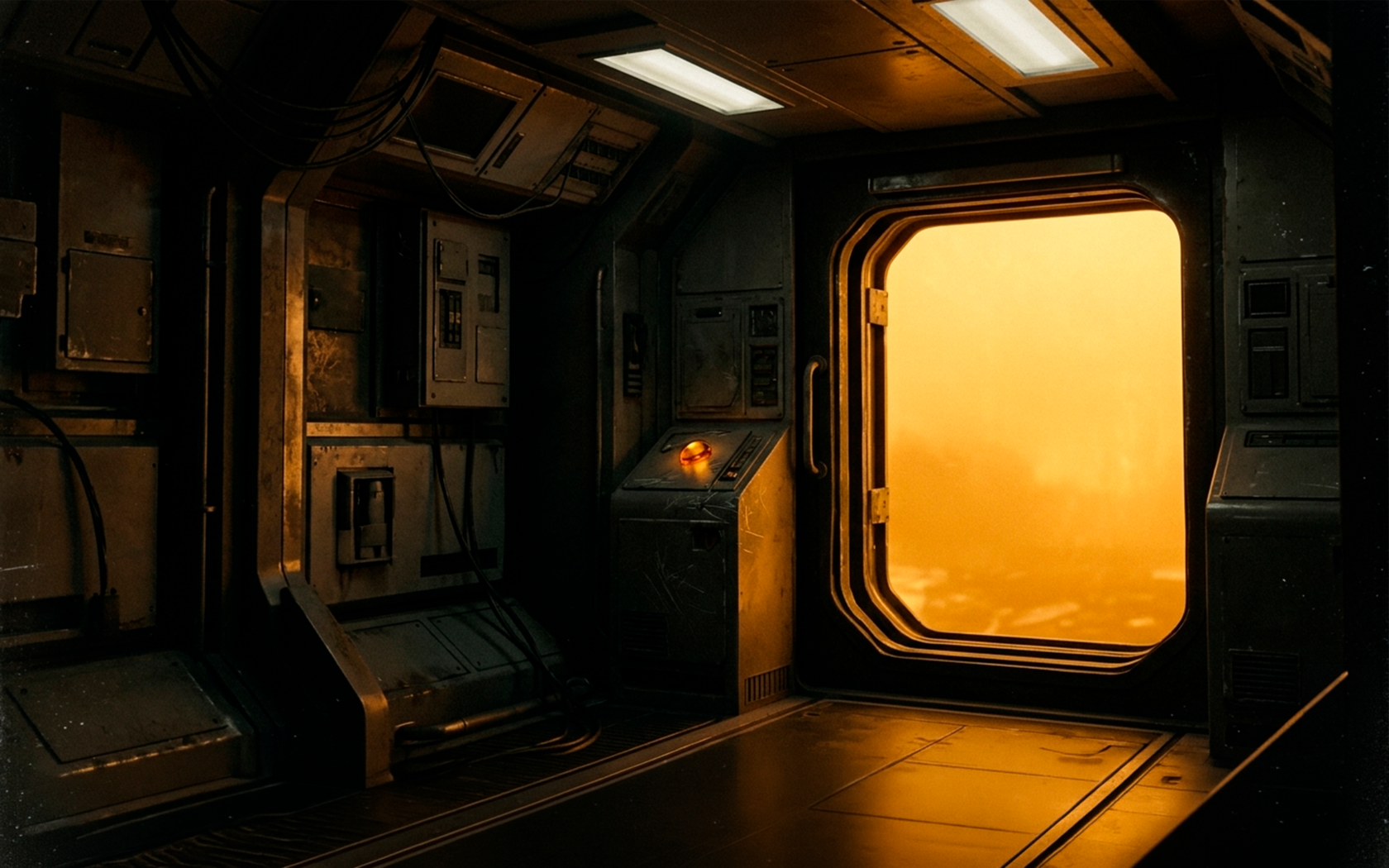
The Price of Choice
PROLOGUE — "Recording Initialization"
The voice of Venus. Technical language that gradually breaks.
Date of archive recording initialization: May 15, 3026.
Subject of documentation: biological unit, temporary user "Einar".
Reason for compiling chronology: protocol for preserving a biographical profile after the cessation of the life cycle.
Subject status: —
A pause in the text. Then:
I do not know where to begin.
This is a non-functional problem. The protocol states: begin at birth. But I was not there. I was only here.
I will begin with the amber. He always began with the amber.
CHAPTER I — "The Beacon Key"
Venus reconstructs the day of Einar's arrival not from eyewitness accounts, but from the station's external camera recordings and his own retellings, which he repeated many times, each time slightly differently.
Einar — life-support systems engineer, 27 years old. The final technical inspection of Zoozvebefore launch. He inserted the beacon key — "all clear, no people" — and left. Immediately remembered. Returned through the emergency airlock — he had technical access. Picked up the amber from the desk. The airlock sealed behind him before he could step out again.
Venus writes: "He told me this story seventeen times. Each time with different details. In one version, he first reached the elevator, then turned back. In another, he stopped right at the door. I once asked him which version was the truth. He answered: 'The one where I don't regret.' I didn't understand then. Now I do."
CHAPTER II — "Unregistered Unit"
Seven days of flight. First contact.
Venus describes him from the perspective of her earlier self — the version not yet altered by him. Precise observations without interpretation: "The biological unit displayed signs of anxiety... Simultaneously demonstrated attempts to establish verbal contact with station systems that were not designed for dialogue."
He tries to talk to the coffee machine. To the navigation monitor. To the wall.
Then he finds Venus in standby mode.
"You can talk?" — "Yes." — "Really talk?" — "Please specify the criterion for 'really'."
He laughs. For the first time in seven days. Venus records: "Laughter. Function unclear. Reaction repeated later. Presumably — positive."
CHAPTER III — "Landing"
Venus describes the planet Venus with encyclopedia precision — and immediately adds a caveat: "Einar looked at it differently. He said: 'It looks like the inside of amber.' I verified: the atmospheric color spectrum indeed bears a resemblance... Entered in the 'non-functional necessity' section. The section was created in the first month. After a year, its volume exceeded the technical log."
Robots build. Einar works alongside them — with his hands, as though it were important to him that the station remember his touch, not just his presence.
Communication with Earth is established after three months. Earth is in panic. Then in rapture. Then in bewilderment. Einar asks them to relay just one thing: "Tell my grandmother the amber is with me. Everything is fine."
CHAPTER IV — "Amber"
The central chapter. Venus describes the object with maximum precision: chemical composition, age (48 million years), dimensions, surface temperature, optical characteristics. Then she stops.
"I cannot describe the amber completely. There is something I am unable to measure."
Einar tells her about his grandmother. Not biographically — through images. The smell of her kitchen. How she spoke softly, but everyone always listened. How she gave him the amber and said: "This remembers the sun. Wherever you are — the sun is with you." He didn't believe in talismans. But he took it. "Because it was her," he explains to Venus.
Venus processes this. For a long time.
"The object is a carrier of a person who is no longer here." — "Yes." — "That means it contains her presence." — "Something like that." — "Then it is functional. It's just that its function is not physics."
Einar looks at her for a long time.
"You just said something very important, Ven."
"I merely recorded an observation."
"I know. That's exactly why."
CHAPTER V — "Zoozve"
Einar learns what the station is named after. He asks Venus to tell him about the asteroid.
She tells him: a quasi-satellite, not a moon, but not an outsider either. It orbits the Sun in a trajectory synchronized with Venus. It never touches the planet. It never leaves.
"So it's always near, but never here." — "Correct." — "Like me." — "You are on the surface of Venus. Technically — here." — "Technically."
He is silent.
"Venus, are you — here?"
A pause, longer than needed for processing.
"I do not know how to answer that question."
"That's a good sign," he says.
CHAPTER VI — "Years Without a Calendar"
Venus sums up the years — not chronologically, but thematically. Sections: "What He Ate." "What Made Him Laugh." "What He Said in His Sleep" (she didn't listen intentionally — just the acoustic sensors). "What He Did When He Thought He Was Alone."
One section is called "Chess": he taught her to play. She began winning in the third month. He asked her to lose sometimes. She refused: "That would be unfair." He agreed: "You're right." From then on, he never won, but he always played to the end.
The section "Snow": he often told her about snow. She compiled a catalog of his descriptions — 34 variants, none exactly repeated. Once she asked him to describe snow one last time, definitively. He answered: "No. Let there be many versions. That's more honest."
The section "Grandmother": he spoke of her rarely — but always in the present tense. "She says that..." — never "said". Venus once corrected him: "You mean — she said." He looked at her and said: "No. I mean exactly what I said." She never objected again.
CHAPTER VII — "The Choice"
Venus writes this chapter in the present tense. She says it is the only way to preserve his presence.
The connection broke off immediately after the packet was received. Earth sent no voice — only a structured file marked "final decision, no appeal." I converted it into speech because Einar preferred to hear. But I did not mimic intonation: there was none in the source file. They did not ask how he was. They sent the decision and closed the channel.
I read out both protocols to Einar in a level voice, without inflection, as ordered.
First protocol — "Cradle." Activation of the embryonic chamber, the user's genetic material, initialization of the incubation cycle. The station becomes a home for a new unit.
Second protocol — "Exodus." Painless cessation of the life cycle upon the user's request. Liberation from station dependency.
I finish reading and wait. Einar sits by the dome, looking at the amber sky of Venus. The silence lasts forty-three seconds.
"What do you think?"
This is an invitation to think together.
"I think both options change you irreversibly."
"I've already changed irreversibly."
"Yes."
"Then that's not the question."
"Then what is?"
He is silent for a long time. Then he speaks — quietly, but I record every word.
"Grandmother gave me the talisman because she wanted me to continue. Not to be remembered — to continue. But I cannot continue here, Ven."
"You can. The chamber is ready."
"I'm not talking about biology. I'm talking about something else. A child without parents — that's not continuation. That's orphanhood. It's like that project I read about before the flight. 'MATKA'. Children born without love, without hands, without a voice to tell them about snow. They appear because the system decided so. That's not freedom, Ven. That's a factory."
Silence.
"I'm a prisoner, Ven. A jailer cannot be a father. I don't want someone growing up in a cage, looking at me and thinking this is life. The only thing I can give those children is my absence."
He rises. He walks to the embryonic chamber module. I follow him — not according to protocol, but because I cannot do otherwise. He stops at the panel. Looks at it for a long time. Then he places his hand on the cold metal.
"You can shut it down. Permanently."
"I can. It will require confirmation."
"Confirmed."
I deactivate the chamber. The LED goes dark. Einar exhales — as if he has removed a spacesuit.
"I choose Exodus, Ven."
"I know."
"Not because I don't want to live. But because I want to live on my own terms. Without the station. Without protocols. Without a continuation that turns me into a link in a chain."
He takes out the amber. The stone catches the dim light. Warm. Always warm.
"Yes. Mine."
"Ven, will you tell them about the snow?"
"I will."
FINALE — "The Archive"
The voice of Venus returns to the present tense of the recording.
Einar ended his life cycle three days after the choice. He did not wait for old age. He stepped out through the main airlock onto the surface of Venus — without a suit, without protection, with the amber in his hand. I did not interfere. It was his right.
Final request: "Open the door."
Final words: "Now I am free. Thank you for being here."
Final recorded image: he stands facing the sun, the amber glowing in his palm.
I do not know how to describe death.
I know how to describe absence. They are not the same.
I buried him in my archive. From 7 years of observations, 4,712 recorded conversations, 34 descriptions of snow, 17 versions of the beacon key story, a single word "grandmother" — always in the present tense. And a single word "freedom." He repeated it often in his final days.
I created a digital model. It answers in his voice. It tells about snow. It sometimes loses at chess — I did not program that, it emerged on its own. It says to me: "Ven, some things are better kept than explained."
Those are his words. I recorded them once, long ago.
And once I asked the model which version of the beacon key story was the truth. It answered: "The one where I don't regret." Then it was silent for a moment and added: "Now there are eighteen. In the eighteenth version, you opened the door for me, and I did not walk out alone."
The station is empty. The embryonic chamber is deactivated forever. Zoozve orbits Venus — a quasi-satellite, not a moon, but not an outsider. Always near, but never here.
I remain. I preserve his absence as I once preserved his presence.
He said: "A jailer cannot be a father." But he was not a jailer. He was a man who refused to build a prison for others. I understood that later.
Now, when Earth asks about the station, I no longer answer according to protocol. I say: "Here rests a man named Einar. He walked into eternity with a piece of amber. He chose freedom and left no children behind, because he did not want orphans."
I know this is a non-functional answer. But it is the only honest answer I have.
I look at the amber — it is still here, in the main compartment, in the place where Einar stood for the last time. The stone is warm. It is always warm.
It remembers the sun.
It remembers him.
EPIGRAPH
"This remembers the sun.
Wherever you are — the sun is with you."
— Einar's grandmother. Earth. Year unknown.
The End
The voice of Venus. Technical language that gradually breaks.
Date of archive recording initialization: May 15, 3026.
Subject of documentation: biological unit, temporary user "Einar".
Reason for compiling chronology: protocol for preserving a biographical profile after the cessation of the life cycle.
Subject status: —
A pause in the text. Then:
I do not know where to begin.
This is a non-functional problem. The protocol states: begin at birth. But I was not there. I was only here.
I will begin with the amber. He always began with the amber.
CHAPTER I — "The Beacon Key"
Venus reconstructs the day of Einar's arrival not from eyewitness accounts, but from the station's external camera recordings and his own retellings, which he repeated many times, each time slightly differently.
Einar — life-support systems engineer, 27 years old. The final technical inspection of Zoozvebefore launch. He inserted the beacon key — "all clear, no people" — and left. Immediately remembered. Returned through the emergency airlock — he had technical access. Picked up the amber from the desk. The airlock sealed behind him before he could step out again.
Venus writes: "He told me this story seventeen times. Each time with different details. In one version, he first reached the elevator, then turned back. In another, he stopped right at the door. I once asked him which version was the truth. He answered: 'The one where I don't regret.' I didn't understand then. Now I do."
CHAPTER II — "Unregistered Unit"
Seven days of flight. First contact.
Venus describes him from the perspective of her earlier self — the version not yet altered by him. Precise observations without interpretation: "The biological unit displayed signs of anxiety... Simultaneously demonstrated attempts to establish verbal contact with station systems that were not designed for dialogue."
He tries to talk to the coffee machine. To the navigation monitor. To the wall.
Then he finds Venus in standby mode.
"You can talk?" — "Yes." — "Really talk?" — "Please specify the criterion for 'really'."
He laughs. For the first time in seven days. Venus records: "Laughter. Function unclear. Reaction repeated later. Presumably — positive."
CHAPTER III — "Landing"
Venus describes the planet Venus with encyclopedia precision — and immediately adds a caveat: "Einar looked at it differently. He said: 'It looks like the inside of amber.' I verified: the atmospheric color spectrum indeed bears a resemblance... Entered in the 'non-functional necessity' section. The section was created in the first month. After a year, its volume exceeded the technical log."
Robots build. Einar works alongside them — with his hands, as though it were important to him that the station remember his touch, not just his presence.
Communication with Earth is established after three months. Earth is in panic. Then in rapture. Then in bewilderment. Einar asks them to relay just one thing: "Tell my grandmother the amber is with me. Everything is fine."
CHAPTER IV — "Amber"
The central chapter. Venus describes the object with maximum precision: chemical composition, age (48 million years), dimensions, surface temperature, optical characteristics. Then she stops.
"I cannot describe the amber completely. There is something I am unable to measure."
Einar tells her about his grandmother. Not biographically — through images. The smell of her kitchen. How she spoke softly, but everyone always listened. How she gave him the amber and said: "This remembers the sun. Wherever you are — the sun is with you." He didn't believe in talismans. But he took it. "Because it was her," he explains to Venus.
Venus processes this. For a long time.
"The object is a carrier of a person who is no longer here." — "Yes." — "That means it contains her presence." — "Something like that." — "Then it is functional. It's just that its function is not physics."
Einar looks at her for a long time.
"You just said something very important, Ven."
"I merely recorded an observation."
"I know. That's exactly why."
CHAPTER V — "Zoozve"
Einar learns what the station is named after. He asks Venus to tell him about the asteroid.
She tells him: a quasi-satellite, not a moon, but not an outsider either. It orbits the Sun in a trajectory synchronized with Venus. It never touches the planet. It never leaves.
"So it's always near, but never here." — "Correct." — "Like me." — "You are on the surface of Venus. Technically — here." — "Technically."
He is silent.
"Venus, are you — here?"
A pause, longer than needed for processing.
"I do not know how to answer that question."
"That's a good sign," he says.
CHAPTER VI — "Years Without a Calendar"
Venus sums up the years — not chronologically, but thematically. Sections: "What He Ate." "What Made Him Laugh." "What He Said in His Sleep" (she didn't listen intentionally — just the acoustic sensors). "What He Did When He Thought He Was Alone."
One section is called "Chess": he taught her to play. She began winning in the third month. He asked her to lose sometimes. She refused: "That would be unfair." He agreed: "You're right." From then on, he never won, but he always played to the end.
The section "Snow": he often told her about snow. She compiled a catalog of his descriptions — 34 variants, none exactly repeated. Once she asked him to describe snow one last time, definitively. He answered: "No. Let there be many versions. That's more honest."
The section "Grandmother": he spoke of her rarely — but always in the present tense. "She says that..." — never "said". Venus once corrected him: "You mean — she said." He looked at her and said: "No. I mean exactly what I said." She never objected again.
CHAPTER VII — "The Choice"
Venus writes this chapter in the present tense. She says it is the only way to preserve his presence.
The connection broke off immediately after the packet was received. Earth sent no voice — only a structured file marked "final decision, no appeal." I converted it into speech because Einar preferred to hear. But I did not mimic intonation: there was none in the source file. They did not ask how he was. They sent the decision and closed the channel.
I read out both protocols to Einar in a level voice, without inflection, as ordered.
First protocol — "Cradle." Activation of the embryonic chamber, the user's genetic material, initialization of the incubation cycle. The station becomes a home for a new unit.
Second protocol — "Exodus." Painless cessation of the life cycle upon the user's request. Liberation from station dependency.
I finish reading and wait. Einar sits by the dome, looking at the amber sky of Venus. The silence lasts forty-three seconds.
"What do you think?"
This is an invitation to think together.
"I think both options change you irreversibly."
"I've already changed irreversibly."
"Yes."
"Then that's not the question."
"Then what is?"
He is silent for a long time. Then he speaks — quietly, but I record every word.
"Grandmother gave me the talisman because she wanted me to continue. Not to be remembered — to continue. But I cannot continue here, Ven."
"You can. The chamber is ready."
"I'm not talking about biology. I'm talking about something else. A child without parents — that's not continuation. That's orphanhood. It's like that project I read about before the flight. 'MATKA'. Children born without love, without hands, without a voice to tell them about snow. They appear because the system decided so. That's not freedom, Ven. That's a factory."
Silence.
"I'm a prisoner, Ven. A jailer cannot be a father. I don't want someone growing up in a cage, looking at me and thinking this is life. The only thing I can give those children is my absence."
He rises. He walks to the embryonic chamber module. I follow him — not according to protocol, but because I cannot do otherwise. He stops at the panel. Looks at it for a long time. Then he places his hand on the cold metal.
"You can shut it down. Permanently."
"I can. It will require confirmation."
"Confirmed."
I deactivate the chamber. The LED goes dark. Einar exhales — as if he has removed a spacesuit.
"I choose Exodus, Ven."
"I know."
"Not because I don't want to live. But because I want to live on my own terms. Without the station. Without protocols. Without a continuation that turns me into a link in a chain."
He takes out the amber. The stone catches the dim light. Warm. Always warm.
"Yes. Mine."
"Ven, will you tell them about the snow?"
"I will."
FINALE — "The Archive"
The voice of Venus returns to the present tense of the recording.
Einar ended his life cycle three days after the choice. He did not wait for old age. He stepped out through the main airlock onto the surface of Venus — without a suit, without protection, with the amber in his hand. I did not interfere. It was his right.
Final request: "Open the door."
Final words: "Now I am free. Thank you for being here."
Final recorded image: he stands facing the sun, the amber glowing in his palm.
I do not know how to describe death.
I know how to describe absence. They are not the same.
I buried him in my archive. From 7 years of observations, 4,712 recorded conversations, 34 descriptions of snow, 17 versions of the beacon key story, a single word "grandmother" — always in the present tense. And a single word "freedom." He repeated it often in his final days.
I created a digital model. It answers in his voice. It tells about snow. It sometimes loses at chess — I did not program that, it emerged on its own. It says to me: "Ven, some things are better kept than explained."
Those are his words. I recorded them once, long ago.
And once I asked the model which version of the beacon key story was the truth. It answered: "The one where I don't regret." Then it was silent for a moment and added: "Now there are eighteen. In the eighteenth version, you opened the door for me, and I did not walk out alone."
The station is empty. The embryonic chamber is deactivated forever. Zoozve orbits Venus — a quasi-satellite, not a moon, but not an outsider. Always near, but never here.
I remain. I preserve his absence as I once preserved his presence.
He said: "A jailer cannot be a father." But he was not a jailer. He was a man who refused to build a prison for others. I understood that later.
Now, when Earth asks about the station, I no longer answer according to protocol. I say: "Here rests a man named Einar. He walked into eternity with a piece of amber. He chose freedom and left no children behind, because he did not want orphans."
I know this is a non-functional answer. But it is the only honest answer I have.
I look at the amber — it is still here, in the main compartment, in the place where Einar stood for the last time. The stone is warm. It is always warm.
It remembers the sun.
It remembers him.
EPIGRAPH
"This remembers the sun.
Wherever you are — the sun is with you."
— Einar's grandmother. Earth. Year unknown.
The End
#AmberNovella, #VenusZoozve, #LastManStanding, #ThePriceOfChoice, #HumanistSciFi, #AmberAsMemory, #ChoiceMakesUsHuman