№6 Sergei Rachmaninoff — "Music From Eternity"
Passport
Synopsis
In childhood, he came to know music as the trembling of wood. In maturity, he lost it. To bring the sound back, he first had to give up the thought that it belonged to him.
Hashtags
#GIFT #LiteraryProject #IskandarKadyrov #SergeiRachmaninoff #MusicFromEternity #BiographicalParable #LiterarySymphonicForm #PsychologicalNovella #ThePriceOfGenius #Memory #Music #LiteratureHauteCouture
About the Literary Project
GIFT is a literary project by Iskandar Kadyrov, created in the genre of literary nonfiction and biographical parable. Seven stories about P. T. Barnum, Nikola Tesla, Coco Chanel, Vincent van Gogh, Wolfgang Amadeus Mozart, Sergei Rachmaninoff, and Anna Pavlova explore the nature of exceptional talent — and the price a person pays for possessing it. Here, genius is not a privilege but a test: it demands obsession, solitude, sacrifice, risk, and sometimes life itself. Seven heroes. Seven forms of genius. Seven prices. GIFT is literature haute couture: an artistic reinterpretation of real figures, events, and circumstances within the framework of the author's vision.
- Literary Project: «The Gift»
- Author: Iskandar Kadyrov
- Age Rating: 18+
- Novella: №6 Sergei Rachmaninoff — "Music From Eternity"
- Genre: Philosophical biographical parable / psychological novella
- Slogan: "He lost his homeland. But the music he carried with him did not lose its home"
- Gift: To remember — so that the past continues to sound in the present. To hear what cannot be held, and to give form to what arrives from beyond form
Synopsis
In childhood, he came to know music as the trembling of wood. In maturity, he lost it. To bring the sound back, he first had to give up the thought that it belonged to him.
Hashtags
#GIFT #LiteraryProject #IskandarKadyrov #SergeiRachmaninoff #MusicFromEternity #BiographicalParable #LiterarySymphonicForm #PsychologicalNovella #ThePriceOfGenius #Memory #Music #LiteratureHauteCouture
About the Literary Project
GIFT is a literary project by Iskandar Kadyrov, created in the genre of literary nonfiction and biographical parable. Seven stories about P. T. Barnum, Nikola Tesla, Coco Chanel, Vincent van Gogh, Wolfgang Amadeus Mozart, Sergei Rachmaninoff, and Anna Pavlova explore the nature of exceptional talent — and the price a person pays for possessing it. Here, genius is not a privilege but a test: it demands obsession, solitude, sacrifice, risk, and sometimes life itself. Seven heroes. Seven forms of genius. Seven prices. GIFT is literature haute couture: an artistic reinterpretation of real figures, events, and circumstances within the framework of the author's vision.
Sergei Rachmaninoff — "Music From Eternity"
THE SEA / 1917
Beyond the stern lantern, the water was black, and beyond that — there was simply nothing.
He stood at the rail and did not search for the horizon. The horizon held no meaning: night had erased the line between sky and sea, leaving one dense darkness through which the ship moved, seemingly toward nowhere.
His fingers rested on the gunwale. The wood was cold and faintly vibrating — somewhere below, the engine worked, and the tremor rose through the planks, entered his palm, climbed higher, toward the wrist.
He recognized this tremor.
He did not remember it — he recognized it. The way one recognizes a voice without making out the words.
Behind him, his wife was putting the children to bed, and their voices were ordinary, of today, while the tremor beneath his palm belonged to another time, one he had long considered closed.
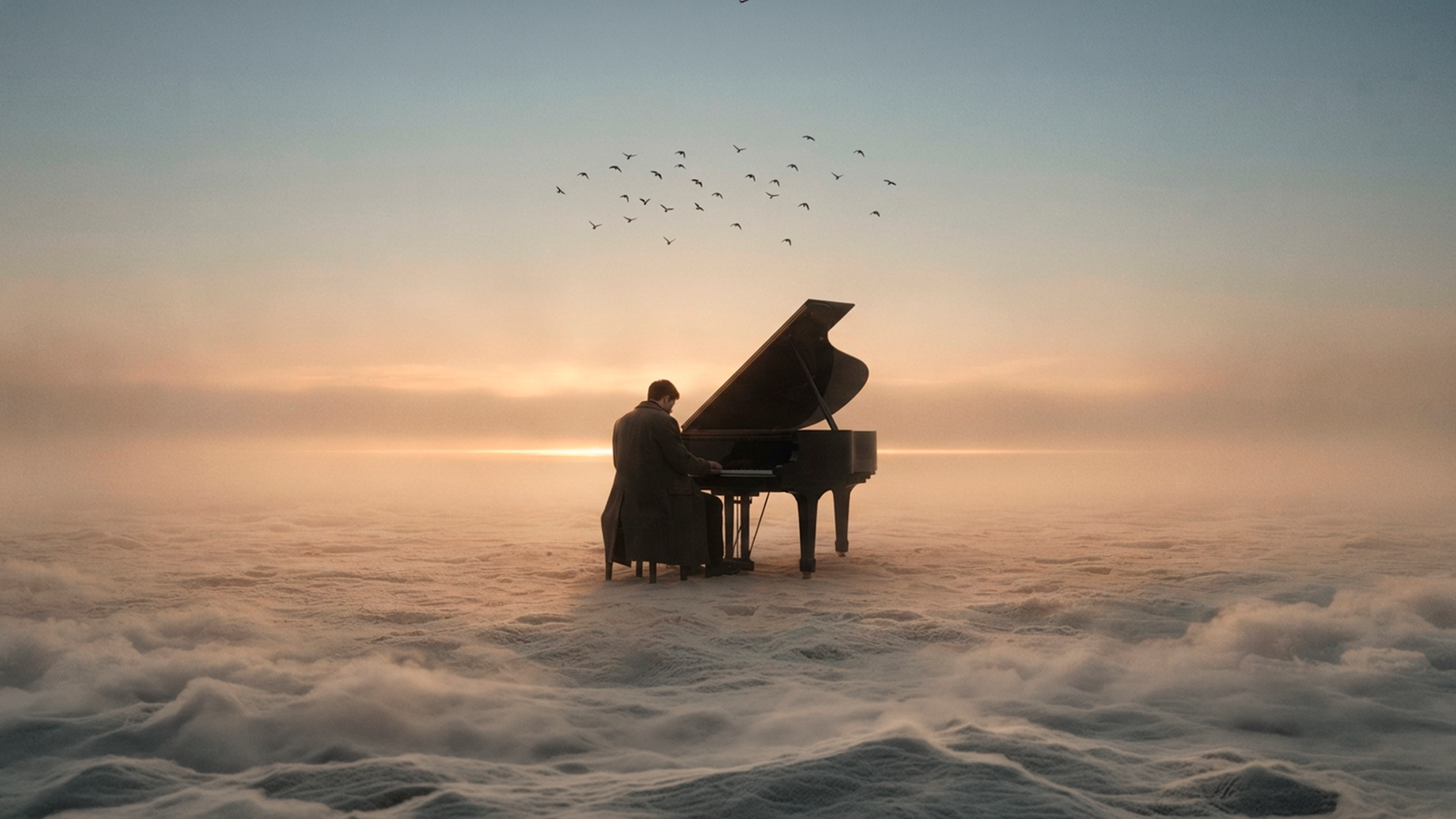
He looked down at where the black water parted from the hull, and for a moment — for just one moment — it seemed to him that there, among the waves, stood a piano. Simply stood, half-submerged, lid raised, needing neither light nor sound. The piano played nothing. It simply was — the way a thing appears that one does not choose to see, but that itself decides to appear.
He blinked. Only water remained.
Someone called to him from the cabin. He did not answer at once.
He did not yet know what he would hear.
He was only hearing.
ONEG / 1870s
The porch wood was warm from the sun, and he pressed his cheek to it because the adults had told him to sit quietly, and quietly meant not moving.
Somewhere across the river, the monastery bells were ringing. The sound traveled not through the air — so it seemed to the boy — but through the earth, through the porch boards, through the palms with which he gripped the railing.
He laid his hand flat.
The board was trembling.
He could not explain it in words — he had few words, and all of them served other purposes: for porridge, for the river, for grandmother's shawl. And this trembling had no name at all. It simply entered his palm and remained there longer than the ringing itself.
Grandmother approached and covered his hand with hers.
"Can you hear the bell?"
"I'm touching it," said the boy.
She looked at him attentively but said nothing. Perhaps she did not understand. Perhaps she understood too well to answer.
That evening he was brought to the instrument the household called a piano, though it was small, cracked with age, and one pedal did not work. He placed a finger on a key — just one finger, just one note — and again felt the same thing: sound as an object that can be touched before it is heard.
He pressed again.
The board beneath the piano faintly responded — with the same trembling as the porch.
The boy smiled as though he had been told a secret.
THE COLLAPSE / 1897
The hall was full, and the piano was silent — or seemed silent: it played, but the sound emerged as though the instrument were covered with a lid, and the music reached him from another room.
He was not on stage — he was in the hall, surrounded by strangers, listening to his own symphony fall apart. The conductor held the tempo unevenly, as though he did not know the score. The orchestra faded in places, like a candle in a draft.
Afterward — silence. Not that childhood silence from the porch. A different one.
He went outside without a coat and did not notice the cold.
At home, he sat at the instrument and placed his hand on the keys — not to play, but to check: had the trembling remained.
The key sank silently, as though beneath his fingers lay not bone and steel, but cotton wool.
He held his hand there so long it went numb.
Nothing came.
He withdrew his hand and sat in the darkness, staring at the white patches of the keys, and for the first time in his life thought that the trembling could be lost — as one loses a voice, as one loses hearing — and no one warns you in advance when it will happen.
TOLSTOY / 1900
The house was large, with low ceilings and the smell of wax. In the evenings, guests gathered here — they read, argued, listened to music at one long tea table.
He played little that evening, and distractedly, as though the evening moved beside him rather than through him.
Then the old man drew him aside — into the room where he wrote in the mornings and received those he trusted in the evenings.
He expected to have to justify himself. For the music. For the right to compose it. For the silence of recent years.
The old man sat opposite him and remained silent for a long while before speaking.
"You think everything comes easily to me?" he said at last. "That I never doubt, never lose the ground beneath my feet?"
"Everyone has such times," the old man said. "There is nothing unusual in it."
He paused.
"Do not hang your head. Continue on your path."
He added nothing more.
The young man went outside, and for the first time in a long while, he had no desire to argue with what he had heard.
On the way home, he did not try to understand what exactly had changed. The road simply no longer seemed a dead end.
DAHL / 1900
The study was quiet, the curtains half-drawn, and the doctor spoke slowly, in an even voice — the voice one uses with frightened children and with very grown adults at the same time.
"You will write a concerto," the doctor said. "It will be magnificent."
The patient lay in the armchair, eyes closed, and the doctor's words entered not the mind — but somewhere lower, where the trembling had once lived.
He did not believe the doctor. There was nothing left with which to believe — that which had known how to believe had long been silent.
But with each session — not at once, not in a single day — something changed. Not a thought, not a decision. Rather, the sensation of the weight of his own hands returned. He noticed it one morning: he laid his palms on the edge of the table, and they no longer felt foreign.
He approached the instrument not because he wanted to play. He approached because he suddenly grew curious — what if.
He touched a single key.
The sound came out ordinary. Not a deafening revelation — simply sound.
But beneath his finger, deep, in the very bone, he felt what he had sought for months: a faint, barely perceptible tremor.
He did not say thank you to the doctor. He sat down to write.
THE SECOND CONCERTO / 1901
He sat at the piano, and the hall around him existed, but held no significance.
The first measures rose from the orchestra — low, bell-like — and he placed his hands on the keys earlier than the count required, because his body remembered the movement better than his mind remembered the notes.
His fingers sank into the keyboard, and the tremor rose from the tips to the wrists, to the forearms, higher — to where there had long been emptiness.
He did not think of the hall. Did not think of the critics, of the old man who had spoken of difficult times. Did not think of the doctor.
He thought only that his hand was alive.
When the theme came — the very one he had written through the nights — he felt that the sound emerged not from the instrument and not from himself, but from some third place where he and the piano became one.
He did not look at the hall, even in the pauses.
He looked at his own hands — the way one looks at something one feared never to see again, and there it is, moving, breathing, living.
When it ended, he did not immediately understand that the hall was applauding.
He sat for another second with his hands on the keys, listening as the last vibration faded in the wood.
CHALIAPIN / 1905
The Volga was wide and slow, and the evening stretched as unhurriedly as the current.
The two of them sat on the deck, and the singer, contrary to his custom, was silent — he did not sing, did not tell stories, simply watched the water.
"Have you ever thought," he asked suddenly, "where it comes from?"
"What do you mean?"
"This. The voice. The notes. Does it really come from us? Sometimes it seems to me — it simply passes through us, and that's all."
The composer was silent for a long time. Water lapped against the hull, a dog barked somewhere in the distance.
"I don't know," he said at last. "Sometimes it seems — yes, it's mine. Utterly mine. And then I fear: what if it leaves — and takes me with it."
The singer smiled, without mirth.
"And if you could know for certain? Would it be worth it?"
The composer looked at the water.
"No," he said. "I would prefer not to know."
They did not speak of it again. The evening continued its course, and the stars over the Volga were the same as always — indifferent and beautiful at once.
THE SEA AGAIN / 1917
He stood at the same place by the rail as on the first night, and the water was just as black.
But now he did not search for the piano in it — the piano was already there, seen once, and needed no second appearance.
He laid his palm on the gunwale. The wood trembled — the same tremor as on the porch in Oneg, as beneath the keys of the failed symphony, as in Dr. Dahl's study, as in the moment when the hall applauded and he listened to the fading sound in the wood.
The tremor simply was — one and the same, through all the years, through all the halls and all the silences.
He thought not only of home. A flash of land appeared — warm, dry, smelling of straw and noon — land he could no longer set foot on.
Behind him, in the cabin, the children had finally fallen asleep. His wife came and stood beside him, saying nothing — she knew when it was better not to touch him with words.
The shore had long since disappeared. Ahead there was only the darkness into which the ship moved, carrying away a home that had now become merely a word.
He did not know what he would find where he was sailing.
He knew only that the tremor traveled with him.
SENAR / 1934
The lake was calm, and the mountains around stood motionless, like a set forgotten after a performance.
He sat on the terrace with a cup that had long gone cold, listening as somewhere in the house his grandson played with a toy — a wooden one, by the sound of it.
Many years had passed. Enough to explain many things. He could not.
That childhood sensation from the porch — wood beneath the palm, sound traveling not through air but through the fingers — remained as incomprehensible as on the day when grandmother asked, "Can you hear the bell?" and he answered, "I'm touching it."
He wrote notes more slowly than before. His hand tired more quickly. But the tremor had not changed — it was the same, recognizable without error, as though sound possessed its own unchanging weight.
He thought about it sometimes, gazing at the lake's water.
The question refused to resolve into an answer.
Perhaps it was not about where it comes from, but whether what arrives belongs to him — or whether he himself is only a place through which it passes.
The thought slipped away before he could hold it.
He never decided.
He finished the cold tea and returned to work.
1943
The room was small, the light dimmed, and outside the window a city went about its business, indifferent to all of this.
He lay with eyes half-closed, listening.
Not to the radio — it was silent. Not to the voices in the house — they spoke quietly beyond the door. He listened to something within, where he had not looked so intently in a long time: the silence between heartbeats, and in that silence — if one listened very carefully — one could discern the outline of a melody he had written as a young man, a theme returning in low bell-like notes.
He raised his hand — not high, only enough for his fingers to rest on the edge of the blanket — and felt beneath them the same tremor as once on the porch in Oneg.
It was weaker. But it was there.
He closed his eyes not because he was tired of listening.
He closed them to hear better.
The room grew quieter than it had been a second before. Outside, the city continued its noise.
The tremor beneath his fingers thinned to a thread, fine as the last string of an instrument — and passed from beneath his palm, as though for the first time in his life it ceased to be his alone.
AFTERWARD
The classroom was small, with a tall window through which slanted light fell.
A young pianist sat alone, working through a passage that would not come — his left hand stumbled at the same place, again and again.
He stopped and laid his palms flat on the piano's lid — simply to give his fingers rest — and suddenly froze.
The wood was faintly trembling. Not from his touch — but on its own, as though somewhere in the depths of the instrument the echo of the last played chord still continued.
He did not know where the sensation came from. No one had told him stories about a boy on a porch, about a doctor, about a ship in black water. He simply felt: the instrument beneath his hands was not empty wood.
He took the passage again — and this time the left hand did not stumble.
Outside the window, a flock of birds flew past, low, almost touching the rooftops.
He did not turn to look.
He continued to play.
Beyond the stern lantern, the water was black, and beyond that — there was simply nothing.
He stood at the rail and did not search for the horizon. The horizon held no meaning: night had erased the line between sky and sea, leaving one dense darkness through which the ship moved, seemingly toward nowhere.
His fingers rested on the gunwale. The wood was cold and faintly vibrating — somewhere below, the engine worked, and the tremor rose through the planks, entered his palm, climbed higher, toward the wrist.
He recognized this tremor.
He did not remember it — he recognized it. The way one recognizes a voice without making out the words.
Behind him, his wife was putting the children to bed, and their voices were ordinary, of today, while the tremor beneath his palm belonged to another time, one he had long considered closed.
He looked down at where the black water parted from the hull, and for a moment — for just one moment — it seemed to him that there, among the waves, stood a piano. Simply stood, half-submerged, lid raised, needing neither light nor sound. The piano played nothing. It simply was — the way a thing appears that one does not choose to see, but that itself decides to appear.
He blinked. Only water remained.
Someone called to him from the cabin. He did not answer at once.
He did not yet know what he would hear.
He was only hearing.
ONEG / 1870s
The porch wood was warm from the sun, and he pressed his cheek to it because the adults had told him to sit quietly, and quietly meant not moving.
Somewhere across the river, the monastery bells were ringing. The sound traveled not through the air — so it seemed to the boy — but through the earth, through the porch boards, through the palms with which he gripped the railing.
He laid his hand flat.
The board was trembling.
He could not explain it in words — he had few words, and all of them served other purposes: for porridge, for the river, for grandmother's shawl. And this trembling had no name at all. It simply entered his palm and remained there longer than the ringing itself.
Grandmother approached and covered his hand with hers.
"Can you hear the bell?"
"I'm touching it," said the boy.
She looked at him attentively but said nothing. Perhaps she did not understand. Perhaps she understood too well to answer.
That evening he was brought to the instrument the household called a piano, though it was small, cracked with age, and one pedal did not work. He placed a finger on a key — just one finger, just one note — and again felt the same thing: sound as an object that can be touched before it is heard.
He pressed again.
The board beneath the piano faintly responded — with the same trembling as the porch.
The boy smiled as though he had been told a secret.
THE COLLAPSE / 1897
The hall was full, and the piano was silent — or seemed silent: it played, but the sound emerged as though the instrument were covered with a lid, and the music reached him from another room.
He was not on stage — he was in the hall, surrounded by strangers, listening to his own symphony fall apart. The conductor held the tempo unevenly, as though he did not know the score. The orchestra faded in places, like a candle in a draft.
Afterward — silence. Not that childhood silence from the porch. A different one.
He went outside without a coat and did not notice the cold.
At home, he sat at the instrument and placed his hand on the keys — not to play, but to check: had the trembling remained.
The key sank silently, as though beneath his fingers lay not bone and steel, but cotton wool.
He held his hand there so long it went numb.
Nothing came.
He withdrew his hand and sat in the darkness, staring at the white patches of the keys, and for the first time in his life thought that the trembling could be lost — as one loses a voice, as one loses hearing — and no one warns you in advance when it will happen.
TOLSTOY / 1900
The house was large, with low ceilings and the smell of wax. In the evenings, guests gathered here — they read, argued, listened to music at one long tea table.
He played little that evening, and distractedly, as though the evening moved beside him rather than through him.
Then the old man drew him aside — into the room where he wrote in the mornings and received those he trusted in the evenings.
He expected to have to justify himself. For the music. For the right to compose it. For the silence of recent years.
The old man sat opposite him and remained silent for a long while before speaking.
"You think everything comes easily to me?" he said at last. "That I never doubt, never lose the ground beneath my feet?"
"Everyone has such times," the old man said. "There is nothing unusual in it."
He paused.
"Do not hang your head. Continue on your path."
He added nothing more.
The young man went outside, and for the first time in a long while, he had no desire to argue with what he had heard.
On the way home, he did not try to understand what exactly had changed. The road simply no longer seemed a dead end.
DAHL / 1900
The study was quiet, the curtains half-drawn, and the doctor spoke slowly, in an even voice — the voice one uses with frightened children and with very grown adults at the same time.
"You will write a concerto," the doctor said. "It will be magnificent."
The patient lay in the armchair, eyes closed, and the doctor's words entered not the mind — but somewhere lower, where the trembling had once lived.
He did not believe the doctor. There was nothing left with which to believe — that which had known how to believe had long been silent.
But with each session — not at once, not in a single day — something changed. Not a thought, not a decision. Rather, the sensation of the weight of his own hands returned. He noticed it one morning: he laid his palms on the edge of the table, and they no longer felt foreign.
He approached the instrument not because he wanted to play. He approached because he suddenly grew curious — what if.
He touched a single key.
The sound came out ordinary. Not a deafening revelation — simply sound.
But beneath his finger, deep, in the very bone, he felt what he had sought for months: a faint, barely perceptible tremor.
He did not say thank you to the doctor. He sat down to write.
THE SECOND CONCERTO / 1901
He sat at the piano, and the hall around him existed, but held no significance.
The first measures rose from the orchestra — low, bell-like — and he placed his hands on the keys earlier than the count required, because his body remembered the movement better than his mind remembered the notes.
His fingers sank into the keyboard, and the tremor rose from the tips to the wrists, to the forearms, higher — to where there had long been emptiness.
He did not think of the hall. Did not think of the critics, of the old man who had spoken of difficult times. Did not think of the doctor.
He thought only that his hand was alive.
When the theme came — the very one he had written through the nights — he felt that the sound emerged not from the instrument and not from himself, but from some third place where he and the piano became one.
He did not look at the hall, even in the pauses.
He looked at his own hands — the way one looks at something one feared never to see again, and there it is, moving, breathing, living.
When it ended, he did not immediately understand that the hall was applauding.
He sat for another second with his hands on the keys, listening as the last vibration faded in the wood.
CHALIAPIN / 1905
The Volga was wide and slow, and the evening stretched as unhurriedly as the current.
The two of them sat on the deck, and the singer, contrary to his custom, was silent — he did not sing, did not tell stories, simply watched the water.
"Have you ever thought," he asked suddenly, "where it comes from?"
"What do you mean?"
"This. The voice. The notes. Does it really come from us? Sometimes it seems to me — it simply passes through us, and that's all."
The composer was silent for a long time. Water lapped against the hull, a dog barked somewhere in the distance.
"I don't know," he said at last. "Sometimes it seems — yes, it's mine. Utterly mine. And then I fear: what if it leaves — and takes me with it."
The singer smiled, without mirth.
"And if you could know for certain? Would it be worth it?"
The composer looked at the water.
"No," he said. "I would prefer not to know."
They did not speak of it again. The evening continued its course, and the stars over the Volga were the same as always — indifferent and beautiful at once.
THE SEA AGAIN / 1917
He stood at the same place by the rail as on the first night, and the water was just as black.
But now he did not search for the piano in it — the piano was already there, seen once, and needed no second appearance.
He laid his palm on the gunwale. The wood trembled — the same tremor as on the porch in Oneg, as beneath the keys of the failed symphony, as in Dr. Dahl's study, as in the moment when the hall applauded and he listened to the fading sound in the wood.
The tremor simply was — one and the same, through all the years, through all the halls and all the silences.
He thought not only of home. A flash of land appeared — warm, dry, smelling of straw and noon — land he could no longer set foot on.
Behind him, in the cabin, the children had finally fallen asleep. His wife came and stood beside him, saying nothing — she knew when it was better not to touch him with words.
The shore had long since disappeared. Ahead there was only the darkness into which the ship moved, carrying away a home that had now become merely a word.
He did not know what he would find where he was sailing.
He knew only that the tremor traveled with him.
SENAR / 1934
The lake was calm, and the mountains around stood motionless, like a set forgotten after a performance.
He sat on the terrace with a cup that had long gone cold, listening as somewhere in the house his grandson played with a toy — a wooden one, by the sound of it.
Many years had passed. Enough to explain many things. He could not.
That childhood sensation from the porch — wood beneath the palm, sound traveling not through air but through the fingers — remained as incomprehensible as on the day when grandmother asked, "Can you hear the bell?" and he answered, "I'm touching it."
He wrote notes more slowly than before. His hand tired more quickly. But the tremor had not changed — it was the same, recognizable without error, as though sound possessed its own unchanging weight.
He thought about it sometimes, gazing at the lake's water.
The question refused to resolve into an answer.
Perhaps it was not about where it comes from, but whether what arrives belongs to him — or whether he himself is only a place through which it passes.
The thought slipped away before he could hold it.
He never decided.
He finished the cold tea and returned to work.
1943
The room was small, the light dimmed, and outside the window a city went about its business, indifferent to all of this.
He lay with eyes half-closed, listening.
Not to the radio — it was silent. Not to the voices in the house — they spoke quietly beyond the door. He listened to something within, where he had not looked so intently in a long time: the silence between heartbeats, and in that silence — if one listened very carefully — one could discern the outline of a melody he had written as a young man, a theme returning in low bell-like notes.
He raised his hand — not high, only enough for his fingers to rest on the edge of the blanket — and felt beneath them the same tremor as once on the porch in Oneg.
It was weaker. But it was there.
He closed his eyes not because he was tired of listening.
He closed them to hear better.
The room grew quieter than it had been a second before. Outside, the city continued its noise.
The tremor beneath his fingers thinned to a thread, fine as the last string of an instrument — and passed from beneath his palm, as though for the first time in his life it ceased to be his alone.
AFTERWARD
The classroom was small, with a tall window through which slanted light fell.
A young pianist sat alone, working through a passage that would not come — his left hand stumbled at the same place, again and again.
He stopped and laid his palms flat on the piano's lid — simply to give his fingers rest — and suddenly froze.
The wood was faintly trembling. Not from his touch — but on its own, as though somewhere in the depths of the instrument the echo of the last played chord still continued.
He did not know where the sensation came from. No one had told him stories about a boy on a porch, about a doctor, about a ship in black water. He simply felt: the instrument beneath his hands was not empty wood.
He took the passage again — and this time the left hand did not stumble.
Outside the window, a flock of birds flew past, low, almost touching the rooftops.
He did not turn to look.
He continued to play.
2026 © Iskandar Kadyrov • All rights reserved • RU / EN (18+)
See also