№2 Nikola Tesla — “The Man Who Heard Lightning”
Passport
Synopsis
The story of a man who saw the future before anyone else — and paid the price of a gift for seeing the world's invisible architecture.
Hashtags
#GIFT #LiteraryProject #IskandarKadyrov #NikolaTesla #TheManWhoHeardLightning #BiographicalParable #LiteraryFiction #PsychologicalFiction #ThePriceOfGenius #Genius #TheFuture #LiteratureHauteCouture
About the Literary Project
GIFT is a literary project by Iskandar Kadyrov, created in the genre of literary nonfiction and biographical parable. Seven stories about P. T. Barnum, Nikola Tesla, Coco Chanel, Vincent van Gogh, Wolfgang Amadeus Mozart, Sergei Rachmaninoff, and Anna Pavlova explore the nature of exceptional talent — and the price a person pays for possessing it. Here, genius is not a privilege but a test: it demands obsession, solitude, sacrifice, risk, and sometimes life itself. Seven heroes. Seven forms of genius. Seven prices. GIFT is literature haute couture: an artistic reinterpretation of real figures, events, and circumstances within the framework of the author's vision.
- Literary Project: «The Gift»
- Author: Iskandar Kadyrov
- Age Rating: 18+
- Novella: №2 Nikola Tesla — “The Man Who Heard Lightning
- Genre: Philosophical biographical parable / psychological novella
- Slogan: "He heard the lightning — and the world was never quite the same"
- Gift: To see the world's invisible architecture and sense the future before it arrives
Synopsis
The story of a man who saw the future before anyone else — and paid the price of a gift for seeing the world's invisible architecture.
Hashtags
#GIFT #LiteraryProject #IskandarKadyrov #NikolaTesla #TheManWhoHeardLightning #BiographicalParable #LiteraryFiction #PsychologicalFiction #ThePriceOfGenius #Genius #TheFuture #LiteratureHauteCouture
About the Literary Project
GIFT is a literary project by Iskandar Kadyrov, created in the genre of literary nonfiction and biographical parable. Seven stories about P. T. Barnum, Nikola Tesla, Coco Chanel, Vincent van Gogh, Wolfgang Amadeus Mozart, Sergei Rachmaninoff, and Anna Pavlova explore the nature of exceptional talent — and the price a person pays for possessing it. Here, genius is not a privilege but a test: it demands obsession, solitude, sacrifice, risk, and sometimes life itself. Seven heroes. Seven forms of genius. Seven prices. GIFT is literature haute couture: an artistic reinterpretation of real figures, events, and circumstances within the framework of the author's vision.
Nikola Tesla — “The Man Who Heard Lightning”
BUDAPEST
The city park lay in that brief blue hour between sunset and dark, when snow still holds the last light of the sky and the trees have already gone black.
Tesla walked beside Szigety, and both were silent exactly as long as silence takes before turning back to Goethe. Tesla knew Faust by heart — not as memorized text, but as something he could draw out of himself in whole pieces, without ever wondering where it came from.
He began the line about the setting sun.
And stopped.
Szigety thought at first his friend had simply lost the thread, and made to prompt him. But he never finished the gesture. Something in Tesla's face no longer belonged to the conversation.
Tesla was looking straight ahead, but not at the path, not at the snow-covered benches. His gaze held the same direction as before — it was only that whatever he was looking at now had no place on the path or the benches.
There was motion.
Not a wheel. Not a machine. Not a drawing he might remember and sketch out later. It had no beginning and no end — it simply was, whole and at once, the way a sentence is whole when a man doesn't compose it but recalls it.
And in that same instant, as if the motion had been searching for a shape to enter before it could become form, a light flared. Blue, brief, without a source. It appeared and vanished faster than he could blink, and in the empty second that followed, the motion seemed to gain an outline — as though the light had traced it for one instant only to pull away the scaffolding and leave it standing on its own.
Szigety touched his sleeve.
"Nikola?"
Tesla didn't answer. He bent, picked up a broken branch from the ground, and began drawing lines in the snow. Fast, sure, without a single correction.
Szigety leaned in, trying to understand.
The lines formed something like a circle, with more lines inside it, crossing, fanning out like petals. Szigety was seeing exactly what any passerby would see — a pattern traced by a cane in dirty February snow, one that would be meltwater by morning.
But what Tesla was seeing lay on the other side of the drawing.
He was seeing the work itself.
Not a drawing of the work — the work: how it turned, how current ran without a single brush, without a single point of contact, circling and catching itself, a construction so complete there was nothing left to figure out, only to write down, to fix in place before it slipped back to wherever it had come from.
"What is it?" Szigety asked.
Tesla straightened. The branch fell from his hand.
"A motor," he said. And, after a pause, added more quietly: "It already works."
Szigety looked at the snow, at the uneven circle with its branching lines, then back at his friend.
"Where?"
Tesla didn't answer right away. He was looking at the place where the light had flared a moment before — where there was nothing now but ordinary evening air, an ordinary darkness settling faster than either of them had expected.
"There," he said finally, and it wasn't clear whether he meant the snow at his feet or something much further off.
They walked on in silence. A few steps later Szigety looked back — the snow had already begun to cover the drawing, a fine, even powder erasing the lines one by one, unhurried, indifferent.
Tesla didn't look back.
He walked on, eyes forward, and Szigety, glancing at his face, understood something he couldn't have put into words: his friend had just received something enormous — and in that same second was left alone with it, because what he'd received couldn't be handed on with the words the motor already works, any more than taste or pain could be handed on.
He knew only one thing: what he had just seen was real — so real that, for him, it no longer required proof.
THE DRAFTING ROOM
The morning was ordinary in exactly the way a morning can be ordinary after a man has been shown, the night before, how the universe works.
A desk. Papers. A lamp still burning though the sun had long since risen.
Tesla sat at his place longer than usual before picking up a pen. He looked like a man who needed to remember the order in which something already finished belonged on paper — not to invent, but not to make a mistake in the writing down.
He began to draw.
A circle. Inside it, windings arranged so the field would rotate on its own, without a single point of metal touching metal.
By midday a colleague came over — not a superior, not a rival, just a man Tesla had shared a desk with for two years now.
"What's this?"
"A motor," Tesla said. "Alternating current. No brushes, no commutator. The field rotates on its own."
He spoke calmly, in the language he'd been taught. He thought that if he explained precisely enough, the other man would see what he himself had seen in the park.
The colleague leaned over the page. Looked for a long time.
"Beautifully drawn," he said at last. "But how does it move? There's nothing here pushing the armature."
"The field creates the rotation itself. It's already happening — there," Tesla ran a finger around the circle, "and there."
"You mean, in theory."
"I mean, already."
The colleague was genuinely trying to understand, tilting his head, tracing the lines with his eyes.
"Nikola," he said gently, "I see a diagram. I don't see a motor."
Tesla looked at the page as though noticing for the first time that anything was drawn on it at all.
"Here," he repeated, and touched the drawing with his finger.
"No," the colleague said, not unkindly. "Here there's only a drawing."
Tesla said nothing. He looked at his own finger resting on the paper, and in that gesture lay the whole difference between two men standing over the same page: for one of them, the page was a window; for the other, a wall.
The colleague clapped him on the shoulder.
"Maybe," he said, already turning away, "someday it'll work."
Tesla was quiet for a long moment.
"No," he said to the man's back, quietly. "It already works."
The room didn't change. The lamp went on burning uselessly in the daylight.
Tesla stayed where he was, looking at his own drawing the way one looks at a letter written in a language only he can read — understanding every word of it, and knowing already that no translation would help, because what it needed wasn't different words, but a different language in the person reading it.
He picked up the pen again and began redrawing the same sketch — cleaner this time, more detailed, with dimensions, with calculations — like a man who has understood that he will not persuade anyone. He will have to build.
FOOTSTEPS
Smiljan, long before Budapest.
The boy walked beside his father down the main street, and his father talked — about the harvest, about a neighbor. Nikola nodded in the right places. But a part of him — the part that never asked permission — was counting.
Steps to the corner of the priest's house. One hundred forty-two.
Windows on the square. Eighteen, not counting the attic ones, twenty-three if you counted them.
Tiles on the tavern's porch — he knew their pattern by heart, knew where a corner had chipped.
He didn't choose to count. It was only that a world in which steps, windows, and tiles went uncounted felt incomplete to him — not frightening, just unfinished, the way a room feels crooked when someone has forgotten to hang the one picture it was waiting for.
His father stopped at a shop. Nikola waited, studying the cobblestones, and the cobblestones began arranging themselves, without his effort, into rows, angles, repetitions. Somewhere at the edge of his vision, a light flickered — still faint, still without shape — just, for an instant, everything around him grew brighter than it should have, and then it was gone.
He blinked. The cobblestones were ordinary cobblestones again.
"Nikola."
His father was already calling, already walking on. The boy caught up, started counting steps again — lost count at the pause by the shop, started over.
Sometimes, years later, he would try to remember exactly when this strange feeling had begun — the sense that the world already contained an answer, but hadn't yet let him see it. He would never find that date.
He knew only that he had to finish counting the tiles to the end of the porch, because otherwise something in the world would be left unfinished, and he could not let himself walk on without finishing it.
WATER
The creek behind the house ran shallow, nearly dry by summer, but in spring it carried enough to turn a wheel — if the wheel was built correctly.
Nikola spent three days building it. He cut the blades from bark, the axle from a straight branch, soaked so it wouldn't warp. Other children came to watch it spin.
To them, the wheel was a diversion.
To Nikola, it was the first moment the invisible became visible: he had pictured how the water would push the blades, and the water pushed them exactly so, not a degree off.
He didn't admire the spinning. He listened to it — the quiet, even creak of the axle, the splash of each blade entering and leaving the water.
On the third day, the wheel stopped.
The other children had lost interest earlier. Nikola stayed at the creek alone, staring at the motionless axle.
He didn't get upset. He felt not failure, but a question.
He crouched beside it, examining the wheel from every side. He touched a blade — it gave too easily. He dipped a finger into the water below the wheel — the current here was weaker, barely noticeable to the eye, but enough for his hand to feel the difference.
He understood before he'd finished thinking it through: overnight the creek had dropped by a finger's width, and that was enough to keep the lower blades from reaching the water.
He wedged two flat stones under the base, raising the whole structure. The wheel rocked, stalled, rocked again — and started, slowly at first, as if testing a new balance, then steady, as it had been the day before.
Nikola sat on the bank and watched it without smiling — not because there was no joy in it, but because the joy was of another kind, deeper than what shows on a face. This was the first time in his life he had asked the world a question — not in words, but through an action — and the world had answered. Something you could check, repeat, explain to someone else — if you found the right words for it.
He didn't have those words yet. But he remembered the shape of the event: the world has causes, and if you ask it a precise enough question, the world answers.
He sat by the creek until dark, adding and removing stones, watching how the water level changed the height the blades needed to start at, so the wheel would never stop again.
RESISTANCE
Nikola began building a second wheel the very next morning — not because the first had broken, but because another one, more precise, already stood complete in his head.
He changed the angle of the blades — calculated it in advance. In his head the calculation came out perfect.
The wheel turned — but slower than before.
He crouched beside it, not irritated, more puzzled. He checked the blades. Adjusted the axle. Tried again — the same speed, the same gap between what should have happened and what did.
He took different wood — drier, lighter — cut the blades again, more carefully, making sure no two differed by a hair. In his head the construction grew even cleaner: flawless symmetry, angles precisely set.
The wheel spun faster — but on the third day the axle creaked, and one blade, slightly thinner than the rest, split at the base.
He didn't curse. He picked it up and studied the break for a long time — wood that had looked even, splitting along a grain that had given no outward sign of weakness.
This was the new, unfamiliar anger — not at the water, not at the wood. Anger at the distance. Between what he saw with absolute clarity and what real wood, real water produced every single time.
He built a third wheel. Then a fourth. Each time something failed to line up.
By the end of the week, five broken, half-spun wheels lay on the bank in a neat row, as if he still hoped to find the common cause among them.
He sat among them longer than usual, looking not at the creek but at his own hands.
They were an ordinary boy's hands. They didn't know what his head knew — couldn't take a finished, flawless form and carry it into the world without loss.
He didn't build a sixth wheel that day.
He sat and thought about something simpler and far more troubling: what if the idea of a flawless form was the one thing that truly belonged to him alone — and the physical world would never agree to be as flawless as what lived inside him.
ELECTRICITY
Professor Poeschl wheeled a Gramme machine into the middle of the hall — heavy, polished, its brass windings gleaming.
The machine started. A particular hum ran down the rows, the sound people make in the presence of a working wonder.
Nikola wasn't looking at what everyone else was looking at.
The others saw the machine working.
He saw what it was forced to do to work.
His eye caught on the brushes of the commutator — narrow carbon plates sliding along rotating contacts, and where they touched, small sparks kept jumping, dry and sharp.
To the people around him, this was simply part of the machine. To Nikola — a mistake.
He remembered, in his whole body, how the creek behind the house had once refused to flow along the clean line standing in his head, until he understood: the trouble wasn't the water — it was that he'd tried to force a shape onto it that wasn't its own. Now, in front of him, stood a machine in which a man had done exactly the same thing to electricity — forced it to move through friction, through sparks, through constant small losses.
He didn't raise his hand. It was irritation, strangely like what he'd felt years before on the creek bank, among five broken wheels.
After the lecture he stayed in the emptied hall longer than the others, looking at the quieted machine, at the brushes, still warm.
He thought: if current could be forced to flow through friction and loss, then it hadn't yet found its own channel. And somewhere there had to be another way — without sparks, without the argument of metal against metal.
The thought never resolved into an answer. It simply settled beside the creek, beside the counted steps, beside everything he had learned to hear, without yet knowing how to name it, years before.
Years passed.
There were no longer wooden blades or wire coils from student experiments in his hands — only paper, a compass, and a growing certainty that somewhere in the arrangement of the field itself lay an answer he would one day hear all at once, without a draft. The question remained the same: why should a force that flows freely by its own nature have to force its way through obstacles a man had invented?
He didn't yet know where he'd find the answer.
He knew only that one day he would hear it as clearly as he had once heard the creak of an axle on the bank of a creek — whole, without explanation, without room for doubt.
THE MACHINE THAT WORKS
The workshop on Fifth Avenue hummed from morning until night. People who had worked here for years had long since stopped hearing it. To them it was the sound of a civilization finally getting things right.
Tesla heard something else in it.
He stood beside one of the direct-current generators — enormous, heavy, wound so tightly in copper that the machine seemed shackled by its own power rather than fed by it. Around the brush assemblies, short, dry sparks kept jumping — the same ones he'd first seen as a student in Graz, only bigger here.
An engineer beside him clapped the machine's housing proudly.
"Carries the whole district," he said. "Five hundred lamps burning right now, while we stand here."
Tesla nodded. He wasn't arguing — the lamps really were burning, the system really did work. It was only that he wasn't seeing what the engineer was seeing: brushes wearing down every week, and copper that had to be laid thicker with each new block, because direct current wouldn't travel far without loss.
"Runs beautifully," the engineer said, waiting for agreement.
"It runs," Tesla said, "the way it was forced to run. Not the way it would run more easily."
The engineer blinked, and finding nothing to say, clapped the housing again — with less confidence this time.
Tesla moved to the window. Down on the street, the lamps really were burning — warm, faintly trembling light. It was a wonder, and he had no intention of denying it. But in the very steadiness of that light he sensed something coerced — as if the force had been made to shine exactly so, by the same methods a man uses to make a river flow uphill: not finding its own path, but building lock after lock, pump after pump, just to hold in check what had wanted, from the start, to move differently.
He thought of the creek behind the house. Five broken wheels on the bank. The gap between what he'd seen in his head and what agreed to exist in wood and water.
Only now it wasn't a child's game. It was a city, money, people trusting with total faith that this system marked the limit of what could be achieved. They saw a working result and never asked the question he asked: what if the force knew a simpler way, and they simply hadn't learned to hear it yet?
That evening he wrote in his notebook one line, which he crossed out, rewrote, and finally left as it was:
"The system works. The question isn't whether it works. The question is why it has to spend so much force just to do what could happen on its own."
He closed the notebook and sat a long while, looking out at the same lamps he'd seen an hour earlier. The light was the same. But now, knowing the price it had cost, Tesla looked at it differently — not as a wonder, but as a question the city wasn't yet ready to ask itself.
THE DOOR
The water had known this place long before people did. It had been falling here for thousands of years — without blueprints, without patents, without any need to prove to anyone its right to move.
People arrived later. They set up generators, wires — and began coaxing the ancient force to speak the language of engineering.
Tesla arrived at the station two days before the launch. He walked the turbine hall alone, late in the evening, laying his palm against a generator's cold housing the way, as a boy, he'd laid his hand in the water below a wooden wheel — not testing the mechanism, but listening to it.
On launch day the station was crowded. The breaker dropped. A tremor ran through the line. Somewhere out there, the first lamps of Buffalo were meant to come alight.
Tesla wasn't looking toward the city.
He was looking at the line — at the thin, almost invisible thread of wire running into the snowy dark — and thinking of the distance itself. Of the fact that a force which, a minute earlier, had simply been falling water, was now flowing — unseen, unheard — across twenty-some miles of night, to where it was awaited by people who had no idea by what path it had come.
Once, this had been impossible in the plain sense. Now it was a wire. Just a wire, strung through the snow.
Someone shouted that Buffalo had light. An engineer turned to Tesla with the face of a man looking for someone to share the moment with.
He nodded. Smiled, briefly.
But his gaze stayed on the line running off into the snow — on the distance the force now crossed by itself, without coercion, without sparks, without the friction that had first struck him, twenty years earlier, as a flaw rather than a feature.
That evening, thousands of people in Buffalo looked at the light and thought about the future.
Tesla looked at the water and thought about something else.
He had opened a door.
But the door had never been the point.
The hardest part began on the other side.
LIGHT WITHOUT A WIRE
At one of the dinners after Buffalo, someone raised a glass:
"You've changed the world."
Tesla smiled, thanked him. But inside that phrase he heard a boundary, not a compliment. They saw a machine.
He saw a law.
Niagara had never been an end point for him — it was the first proof: if force could travel twenty-some miles without a single mechanical point of contact, why not a thousand? If a wire was only necessary because man hadn't yet learned to do without one — what if a wire wasn't necessary at all?
The old arguments about Edison, about the war of currents, now felt like a childish dispute over the shape of a wheel's blades, long since settled.
One evening he was walking down Fifth Avenue. There were more lamps now — thousands, lining the streets.
Everyone around him saw a city that had become bright.
Tesla saw something else.
He wasn't looking at the lamps themselves but at what ran to each of them — thin dark lines threading along the buildings — a network without which not one of those thousand lamps could burn for a second. Every spark of freedom was on a leash, every lamp had its own wire, the way a captured bird has its own tether.
He stopped in the middle of the sidewalk, tipped his head back, looking at the tangle of wires above the intersection.
And then the thought arrived — slowly, heavily:
If a man needs a wire to have light — then he hasn't understood electricity yet.
He didn't know, in that second, where exactly the thought would lead. He didn't know about the tower yet, or Colorado Springs.
He knew only that the door he'd opened in Buffalo hadn't led into a room. It had led into the next corridor — and this one was darker and longer than anything he had walked through before.
THE TOWER
The altitude was the first thing he noticed.
The air here was thinner, and the sky felt close enough that between a man and a bolt of lightning lay less of the usual illusion of safety. In the evenings, when storms gathered, he would go outside and stand still, watching lightning strike the ground miles away.
The tower he was building looked like nothing he had built before. An enormous wooden coil, wound with miles of wire, rose over the plain. Workers looked at it with reverence and bewilderment.
Tesla knew what it was for.
If Niagara had proved that force could travel twenty-some miles, then here he meant to prove something larger: that the earth itself wasn't a barrier but a conductor, that the whole planet could become one enormous, natural transmission line.
The night the tower was first switched on, the air around it changed — physically: the hair on the necks of those standing nearby stood up, short blue threads danced in the dark between the coil and the ground, and somewhere off in the distance, spooked horses bolted.
The people gathered at the station watched with wide eyes.
They saw light. An enormous, wild, inexplicable light, tearing from the top of the tower into the night sky.
Tesla watched the same thing — and saw something else.
He saw a question he had never before asked himself with such clarity: what if he was building not a machine that would one day change the world, but a machine the world wasn't yet capable of accepting?
The discharge died. The blue threads vanished, leaving behind only the smell of ozone.
The people at the station applauded.
Tesla didn't applaud.
He stood, looking at the darkened top of the tower, and for the first time in his life he had built something that wasn't meant simply to work.
He had built something meant to prove that his picture of the world was even possible.
And the night, closing back in around the tower, gave him no answer at all.
THE TOWER NO ONE WAS WAITING FOR
"And how much will it cost?" an investor asked, looking not at the diagram but at Tesla himself.
Tesla tried to explain: not a station for one city, but a system spanning the entire globe — wireless transmission of energy and signal to anyone, anywhere.
The investor listened politely and asked again:
"But still — how much?"
Tesla didn't answer. He was thinking of something else: Colorado Springs had only been an experiment, proof on the scale of a desert. What was needed was a tower not in the desert, but somewhere the whole world would see it.
He thought of it as a promise — as proof large enough to make the idea impossible to ignore.
WARDENCLYFFE
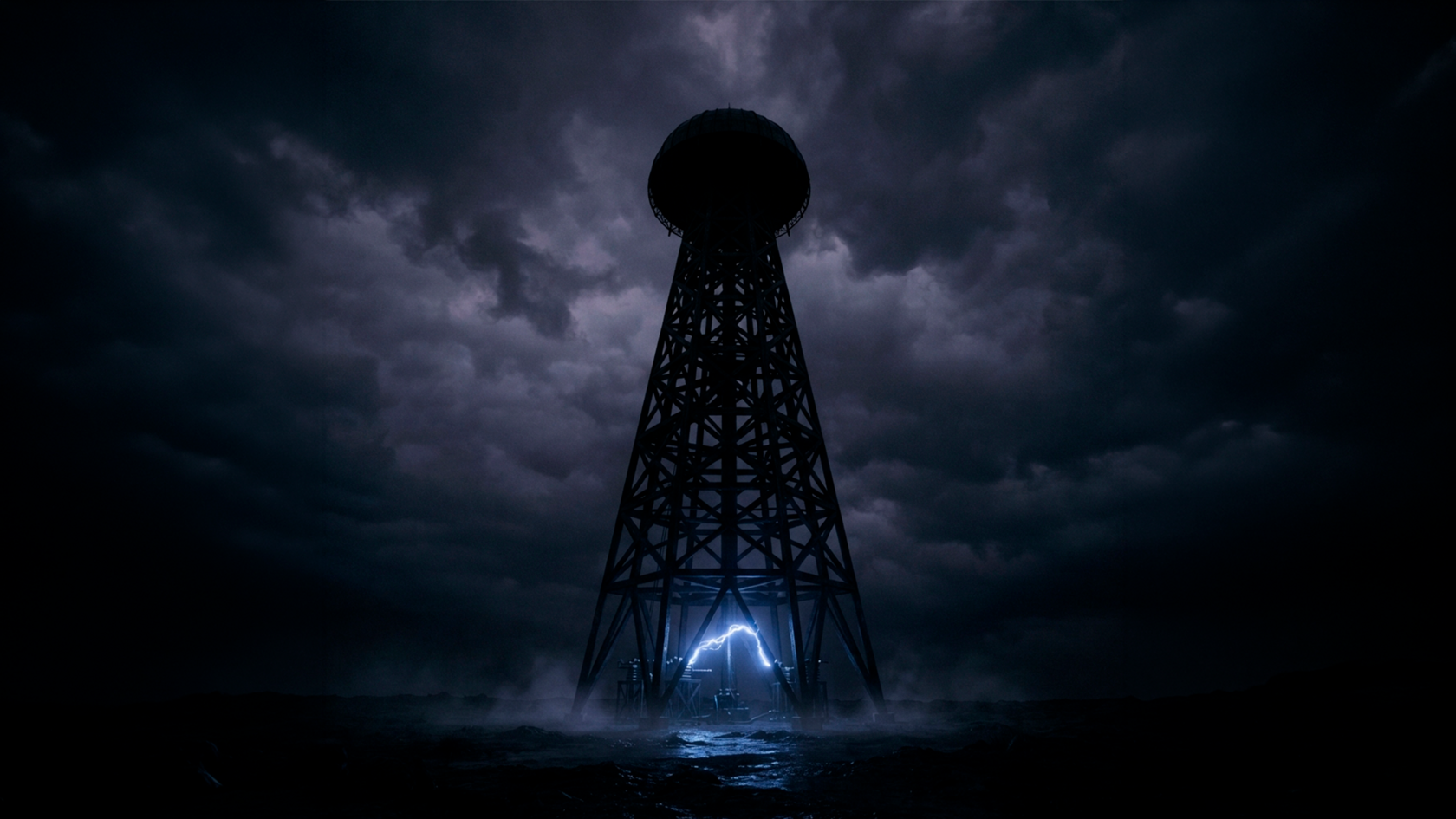
The site was chosen for its emptiness. Here, a tower began to rise — taller and more imposing than the one in Colorado, with a wide wooden dome at its top.
Morgan put up the money — not because he'd fully believed in wireless energy for the whole world, but because he'd heard the word communication and seen in it what he understood better: a wireless telegraph. Tesla signed the contract, aware of the mismatch, telling himself it could be sorted out later.
He wrote letters, drew diagrams, explained again and again that what stood before them wasn't a telegraph station but a first step toward a world without wires at all.
Few listened to the end.
The tower rose slowly. Tesla himself was increasingly left alone at the site, looking at the dome against the darkening sky with the same certainty that, twenty years before, had made him draw a circle in the snow of a Budapest park.
He believed that the moment the tower worked, everything that now sounded like excessive ambition would become obvious even to the men who kept asking how much it would cost.
He wasn't building a station.
He was building proof large enough that it could no longer be ignored.
He didn't know yet that there is a kind of truth for which size makes no difference.
THE SILENCE AFTER THE SIGNAL
The first thing to disappear wasn't the sound.
It was the people.
Only months before, the site at Shoreham had been alive with the ordinary noise of construction. The tower rose slowly, but it rose.
Now, silence settled around it.
The hired workers left first. Then the suppliers left. By the end of summer only the watchman remained, and the tower itself — a wooden dome on a lattice frame, frozen at the height it had managed to reach.
Morgan's letter came at the end of September.
Tesla read it twice. He was looking for one line that said: you were wrong. That line would have been easier to accept.
But Morgan had written something else.
"I invested in a wireless telegraph. In what you now describe to me — power for the whole world, light without a meter — I don't recognize the venture I agreed to enter. I believe we were speaking of two different things from the very start."
He hadn't said: you were wrong.
He'd said: I thought you were building one thing. You're building another.
Tesla sat with the letter in his hand. Morgan had heard exactly what he'd wanted to hear: telegraph, speed, an edge over rivals. As Edison had once heard a rival in him. As the press had heard a sensation. As the investors had heard numbers.
No one had heard the one thing Tesla had actually been saying.
That evening he climbed to the tower alone.
The watchman, seeing him approach, nodded and stayed at the gate.
Tesla went to one of the wooden supports at the base and laid his palm against it — slower, quieter, the way one lays a hand on another man's shoulder after a long silence.
The wood was cold. Idle. But it still stood — waiting for a night that might never come.
Something destroyed would have been easier to accept. Destruction says plainly: you were wrong, here's the proof, start over or stop.
But the unfinished said nothing of the kind. It left the question open: what if he had been right? What if the whole construction had been correct from the first line to the last — simply arrived a few decades before the world learned it needed it?
He stood like that so long that the watchman finally left on his own, leaving him alone with a tower that no longer promised anyone anything but him.
A MAN AHEAD OF TIME
Years passed.
The laboratory on Fifth Avenue grew quieter. He still came to it in the mornings.
One day he found himself in Shoreham again.
The tower was still standing. The wood had darkened with rain. Along one of the steel guy-wires, the first line of rust had already appeared. Birds landed on the lower beams without any caution at all — for them, it had long since become simply part of the landscape.
The sky darkened faster than usual toward evening — a storm was moving in.
He walked to the same support and laid his palm against it.
The wood was cold, as before.
The first flash of lightning struck far off. The second struck closer, tracing the unfinished dome's outline.
He simply watched, with the same attention a boy once gave the creak of an axle over a shrunken creek.
The storm drew closer. The air over the tower grew denser, more charged, and for a few seconds it seemed as though this motionless structure had become, once again, part of the calculation for which it had been raised.
One bolt struck close beside the dome — close enough that for a fraction of a second the tower's entire silhouette flared at once, every beam, every guy-wire traced sharp in white.
Then — dark.
The storm moved on toward the sea, carrying its thunder away before it could reach him.
He stood there, not lifting his hand from the darkened wood, looking at the place where, a second before, the whole structure had stood visible.
For a moment it seemed to him he was seeing that first light again — not this one, but another, distant one, that had come once, long before all the rest.
The storm moved off. The birds, startled by the strike, returned to the beams one by one.
He stood there, not lifting his hand from the wood.
The city park lay in that brief blue hour between sunset and dark, when snow still holds the last light of the sky and the trees have already gone black.
Tesla walked beside Szigety, and both were silent exactly as long as silence takes before turning back to Goethe. Tesla knew Faust by heart — not as memorized text, but as something he could draw out of himself in whole pieces, without ever wondering where it came from.
He began the line about the setting sun.
And stopped.
Szigety thought at first his friend had simply lost the thread, and made to prompt him. But he never finished the gesture. Something in Tesla's face no longer belonged to the conversation.
Tesla was looking straight ahead, but not at the path, not at the snow-covered benches. His gaze held the same direction as before — it was only that whatever he was looking at now had no place on the path or the benches.
There was motion.
Not a wheel. Not a machine. Not a drawing he might remember and sketch out later. It had no beginning and no end — it simply was, whole and at once, the way a sentence is whole when a man doesn't compose it but recalls it.
And in that same instant, as if the motion had been searching for a shape to enter before it could become form, a light flared. Blue, brief, without a source. It appeared and vanished faster than he could blink, and in the empty second that followed, the motion seemed to gain an outline — as though the light had traced it for one instant only to pull away the scaffolding and leave it standing on its own.
Szigety touched his sleeve.
"Nikola?"
Tesla didn't answer. He bent, picked up a broken branch from the ground, and began drawing lines in the snow. Fast, sure, without a single correction.
Szigety leaned in, trying to understand.
The lines formed something like a circle, with more lines inside it, crossing, fanning out like petals. Szigety was seeing exactly what any passerby would see — a pattern traced by a cane in dirty February snow, one that would be meltwater by morning.
But what Tesla was seeing lay on the other side of the drawing.
He was seeing the work itself.
Not a drawing of the work — the work: how it turned, how current ran without a single brush, without a single point of contact, circling and catching itself, a construction so complete there was nothing left to figure out, only to write down, to fix in place before it slipped back to wherever it had come from.
"What is it?" Szigety asked.
Tesla straightened. The branch fell from his hand.
"A motor," he said. And, after a pause, added more quietly: "It already works."
Szigety looked at the snow, at the uneven circle with its branching lines, then back at his friend.
"Where?"
Tesla didn't answer right away. He was looking at the place where the light had flared a moment before — where there was nothing now but ordinary evening air, an ordinary darkness settling faster than either of them had expected.
"There," he said finally, and it wasn't clear whether he meant the snow at his feet or something much further off.
They walked on in silence. A few steps later Szigety looked back — the snow had already begun to cover the drawing, a fine, even powder erasing the lines one by one, unhurried, indifferent.
Tesla didn't look back.
He walked on, eyes forward, and Szigety, glancing at his face, understood something he couldn't have put into words: his friend had just received something enormous — and in that same second was left alone with it, because what he'd received couldn't be handed on with the words the motor already works, any more than taste or pain could be handed on.
He knew only one thing: what he had just seen was real — so real that, for him, it no longer required proof.
THE DRAFTING ROOM
The morning was ordinary in exactly the way a morning can be ordinary after a man has been shown, the night before, how the universe works.
A desk. Papers. A lamp still burning though the sun had long since risen.
Tesla sat at his place longer than usual before picking up a pen. He looked like a man who needed to remember the order in which something already finished belonged on paper — not to invent, but not to make a mistake in the writing down.
He began to draw.
A circle. Inside it, windings arranged so the field would rotate on its own, without a single point of metal touching metal.
By midday a colleague came over — not a superior, not a rival, just a man Tesla had shared a desk with for two years now.
"What's this?"
"A motor," Tesla said. "Alternating current. No brushes, no commutator. The field rotates on its own."
He spoke calmly, in the language he'd been taught. He thought that if he explained precisely enough, the other man would see what he himself had seen in the park.
The colleague leaned over the page. Looked for a long time.
"Beautifully drawn," he said at last. "But how does it move? There's nothing here pushing the armature."
"The field creates the rotation itself. It's already happening — there," Tesla ran a finger around the circle, "and there."
"You mean, in theory."
"I mean, already."
The colleague was genuinely trying to understand, tilting his head, tracing the lines with his eyes.
"Nikola," he said gently, "I see a diagram. I don't see a motor."
Tesla looked at the page as though noticing for the first time that anything was drawn on it at all.
"Here," he repeated, and touched the drawing with his finger.
"No," the colleague said, not unkindly. "Here there's only a drawing."
Tesla said nothing. He looked at his own finger resting on the paper, and in that gesture lay the whole difference between two men standing over the same page: for one of them, the page was a window; for the other, a wall.
The colleague clapped him on the shoulder.
"Maybe," he said, already turning away, "someday it'll work."
Tesla was quiet for a long moment.
"No," he said to the man's back, quietly. "It already works."
The room didn't change. The lamp went on burning uselessly in the daylight.
Tesla stayed where he was, looking at his own drawing the way one looks at a letter written in a language only he can read — understanding every word of it, and knowing already that no translation would help, because what it needed wasn't different words, but a different language in the person reading it.
He picked up the pen again and began redrawing the same sketch — cleaner this time, more detailed, with dimensions, with calculations — like a man who has understood that he will not persuade anyone. He will have to build.
FOOTSTEPS
Smiljan, long before Budapest.
The boy walked beside his father down the main street, and his father talked — about the harvest, about a neighbor. Nikola nodded in the right places. But a part of him — the part that never asked permission — was counting.
Steps to the corner of the priest's house. One hundred forty-two.
Windows on the square. Eighteen, not counting the attic ones, twenty-three if you counted them.
Tiles on the tavern's porch — he knew their pattern by heart, knew where a corner had chipped.
He didn't choose to count. It was only that a world in which steps, windows, and tiles went uncounted felt incomplete to him — not frightening, just unfinished, the way a room feels crooked when someone has forgotten to hang the one picture it was waiting for.
His father stopped at a shop. Nikola waited, studying the cobblestones, and the cobblestones began arranging themselves, without his effort, into rows, angles, repetitions. Somewhere at the edge of his vision, a light flickered — still faint, still without shape — just, for an instant, everything around him grew brighter than it should have, and then it was gone.
He blinked. The cobblestones were ordinary cobblestones again.
"Nikola."
His father was already calling, already walking on. The boy caught up, started counting steps again — lost count at the pause by the shop, started over.
Sometimes, years later, he would try to remember exactly when this strange feeling had begun — the sense that the world already contained an answer, but hadn't yet let him see it. He would never find that date.
He knew only that he had to finish counting the tiles to the end of the porch, because otherwise something in the world would be left unfinished, and he could not let himself walk on without finishing it.
WATER
The creek behind the house ran shallow, nearly dry by summer, but in spring it carried enough to turn a wheel — if the wheel was built correctly.
Nikola spent three days building it. He cut the blades from bark, the axle from a straight branch, soaked so it wouldn't warp. Other children came to watch it spin.
To them, the wheel was a diversion.
To Nikola, it was the first moment the invisible became visible: he had pictured how the water would push the blades, and the water pushed them exactly so, not a degree off.
He didn't admire the spinning. He listened to it — the quiet, even creak of the axle, the splash of each blade entering and leaving the water.
On the third day, the wheel stopped.
The other children had lost interest earlier. Nikola stayed at the creek alone, staring at the motionless axle.
He didn't get upset. He felt not failure, but a question.
He crouched beside it, examining the wheel from every side. He touched a blade — it gave too easily. He dipped a finger into the water below the wheel — the current here was weaker, barely noticeable to the eye, but enough for his hand to feel the difference.
He understood before he'd finished thinking it through: overnight the creek had dropped by a finger's width, and that was enough to keep the lower blades from reaching the water.
He wedged two flat stones under the base, raising the whole structure. The wheel rocked, stalled, rocked again — and started, slowly at first, as if testing a new balance, then steady, as it had been the day before.
Nikola sat on the bank and watched it without smiling — not because there was no joy in it, but because the joy was of another kind, deeper than what shows on a face. This was the first time in his life he had asked the world a question — not in words, but through an action — and the world had answered. Something you could check, repeat, explain to someone else — if you found the right words for it.
He didn't have those words yet. But he remembered the shape of the event: the world has causes, and if you ask it a precise enough question, the world answers.
He sat by the creek until dark, adding and removing stones, watching how the water level changed the height the blades needed to start at, so the wheel would never stop again.
RESISTANCE
Nikola began building a second wheel the very next morning — not because the first had broken, but because another one, more precise, already stood complete in his head.
He changed the angle of the blades — calculated it in advance. In his head the calculation came out perfect.
The wheel turned — but slower than before.
He crouched beside it, not irritated, more puzzled. He checked the blades. Adjusted the axle. Tried again — the same speed, the same gap between what should have happened and what did.
He took different wood — drier, lighter — cut the blades again, more carefully, making sure no two differed by a hair. In his head the construction grew even cleaner: flawless symmetry, angles precisely set.
The wheel spun faster — but on the third day the axle creaked, and one blade, slightly thinner than the rest, split at the base.
He didn't curse. He picked it up and studied the break for a long time — wood that had looked even, splitting along a grain that had given no outward sign of weakness.
This was the new, unfamiliar anger — not at the water, not at the wood. Anger at the distance. Between what he saw with absolute clarity and what real wood, real water produced every single time.
He built a third wheel. Then a fourth. Each time something failed to line up.
By the end of the week, five broken, half-spun wheels lay on the bank in a neat row, as if he still hoped to find the common cause among them.
He sat among them longer than usual, looking not at the creek but at his own hands.
They were an ordinary boy's hands. They didn't know what his head knew — couldn't take a finished, flawless form and carry it into the world without loss.
He didn't build a sixth wheel that day.
He sat and thought about something simpler and far more troubling: what if the idea of a flawless form was the one thing that truly belonged to him alone — and the physical world would never agree to be as flawless as what lived inside him.
ELECTRICITY
Professor Poeschl wheeled a Gramme machine into the middle of the hall — heavy, polished, its brass windings gleaming.
The machine started. A particular hum ran down the rows, the sound people make in the presence of a working wonder.
Nikola wasn't looking at what everyone else was looking at.
The others saw the machine working.
He saw what it was forced to do to work.
His eye caught on the brushes of the commutator — narrow carbon plates sliding along rotating contacts, and where they touched, small sparks kept jumping, dry and sharp.
To the people around him, this was simply part of the machine. To Nikola — a mistake.
He remembered, in his whole body, how the creek behind the house had once refused to flow along the clean line standing in his head, until he understood: the trouble wasn't the water — it was that he'd tried to force a shape onto it that wasn't its own. Now, in front of him, stood a machine in which a man had done exactly the same thing to electricity — forced it to move through friction, through sparks, through constant small losses.
He didn't raise his hand. It was irritation, strangely like what he'd felt years before on the creek bank, among five broken wheels.
After the lecture he stayed in the emptied hall longer than the others, looking at the quieted machine, at the brushes, still warm.
He thought: if current could be forced to flow through friction and loss, then it hadn't yet found its own channel. And somewhere there had to be another way — without sparks, without the argument of metal against metal.
The thought never resolved into an answer. It simply settled beside the creek, beside the counted steps, beside everything he had learned to hear, without yet knowing how to name it, years before.
Years passed.
There were no longer wooden blades or wire coils from student experiments in his hands — only paper, a compass, and a growing certainty that somewhere in the arrangement of the field itself lay an answer he would one day hear all at once, without a draft. The question remained the same: why should a force that flows freely by its own nature have to force its way through obstacles a man had invented?
He didn't yet know where he'd find the answer.
He knew only that one day he would hear it as clearly as he had once heard the creak of an axle on the bank of a creek — whole, without explanation, without room for doubt.
THE MACHINE THAT WORKS
The workshop on Fifth Avenue hummed from morning until night. People who had worked here for years had long since stopped hearing it. To them it was the sound of a civilization finally getting things right.
Tesla heard something else in it.
He stood beside one of the direct-current generators — enormous, heavy, wound so tightly in copper that the machine seemed shackled by its own power rather than fed by it. Around the brush assemblies, short, dry sparks kept jumping — the same ones he'd first seen as a student in Graz, only bigger here.
An engineer beside him clapped the machine's housing proudly.
"Carries the whole district," he said. "Five hundred lamps burning right now, while we stand here."
Tesla nodded. He wasn't arguing — the lamps really were burning, the system really did work. It was only that he wasn't seeing what the engineer was seeing: brushes wearing down every week, and copper that had to be laid thicker with each new block, because direct current wouldn't travel far without loss.
"Runs beautifully," the engineer said, waiting for agreement.
"It runs," Tesla said, "the way it was forced to run. Not the way it would run more easily."
The engineer blinked, and finding nothing to say, clapped the housing again — with less confidence this time.
Tesla moved to the window. Down on the street, the lamps really were burning — warm, faintly trembling light. It was a wonder, and he had no intention of denying it. But in the very steadiness of that light he sensed something coerced — as if the force had been made to shine exactly so, by the same methods a man uses to make a river flow uphill: not finding its own path, but building lock after lock, pump after pump, just to hold in check what had wanted, from the start, to move differently.
He thought of the creek behind the house. Five broken wheels on the bank. The gap between what he'd seen in his head and what agreed to exist in wood and water.
Only now it wasn't a child's game. It was a city, money, people trusting with total faith that this system marked the limit of what could be achieved. They saw a working result and never asked the question he asked: what if the force knew a simpler way, and they simply hadn't learned to hear it yet?
That evening he wrote in his notebook one line, which he crossed out, rewrote, and finally left as it was:
"The system works. The question isn't whether it works. The question is why it has to spend so much force just to do what could happen on its own."
He closed the notebook and sat a long while, looking out at the same lamps he'd seen an hour earlier. The light was the same. But now, knowing the price it had cost, Tesla looked at it differently — not as a wonder, but as a question the city wasn't yet ready to ask itself.
THE DOOR
The water had known this place long before people did. It had been falling here for thousands of years — without blueprints, without patents, without any need to prove to anyone its right to move.
People arrived later. They set up generators, wires — and began coaxing the ancient force to speak the language of engineering.
Tesla arrived at the station two days before the launch. He walked the turbine hall alone, late in the evening, laying his palm against a generator's cold housing the way, as a boy, he'd laid his hand in the water below a wooden wheel — not testing the mechanism, but listening to it.
On launch day the station was crowded. The breaker dropped. A tremor ran through the line. Somewhere out there, the first lamps of Buffalo were meant to come alight.
Tesla wasn't looking toward the city.
He was looking at the line — at the thin, almost invisible thread of wire running into the snowy dark — and thinking of the distance itself. Of the fact that a force which, a minute earlier, had simply been falling water, was now flowing — unseen, unheard — across twenty-some miles of night, to where it was awaited by people who had no idea by what path it had come.
Once, this had been impossible in the plain sense. Now it was a wire. Just a wire, strung through the snow.
Someone shouted that Buffalo had light. An engineer turned to Tesla with the face of a man looking for someone to share the moment with.
He nodded. Smiled, briefly.
But his gaze stayed on the line running off into the snow — on the distance the force now crossed by itself, without coercion, without sparks, without the friction that had first struck him, twenty years earlier, as a flaw rather than a feature.
That evening, thousands of people in Buffalo looked at the light and thought about the future.
Tesla looked at the water and thought about something else.
He had opened a door.
But the door had never been the point.
The hardest part began on the other side.
LIGHT WITHOUT A WIRE
At one of the dinners after Buffalo, someone raised a glass:
"You've changed the world."
Tesla smiled, thanked him. But inside that phrase he heard a boundary, not a compliment. They saw a machine.
He saw a law.
Niagara had never been an end point for him — it was the first proof: if force could travel twenty-some miles without a single mechanical point of contact, why not a thousand? If a wire was only necessary because man hadn't yet learned to do without one — what if a wire wasn't necessary at all?
The old arguments about Edison, about the war of currents, now felt like a childish dispute over the shape of a wheel's blades, long since settled.
One evening he was walking down Fifth Avenue. There were more lamps now — thousands, lining the streets.
Everyone around him saw a city that had become bright.
Tesla saw something else.
He wasn't looking at the lamps themselves but at what ran to each of them — thin dark lines threading along the buildings — a network without which not one of those thousand lamps could burn for a second. Every spark of freedom was on a leash, every lamp had its own wire, the way a captured bird has its own tether.
He stopped in the middle of the sidewalk, tipped his head back, looking at the tangle of wires above the intersection.
And then the thought arrived — slowly, heavily:
If a man needs a wire to have light — then he hasn't understood electricity yet.
He didn't know, in that second, where exactly the thought would lead. He didn't know about the tower yet, or Colorado Springs.
He knew only that the door he'd opened in Buffalo hadn't led into a room. It had led into the next corridor — and this one was darker and longer than anything he had walked through before.
THE TOWER
The altitude was the first thing he noticed.
The air here was thinner, and the sky felt close enough that between a man and a bolt of lightning lay less of the usual illusion of safety. In the evenings, when storms gathered, he would go outside and stand still, watching lightning strike the ground miles away.
The tower he was building looked like nothing he had built before. An enormous wooden coil, wound with miles of wire, rose over the plain. Workers looked at it with reverence and bewilderment.
Tesla knew what it was for.
If Niagara had proved that force could travel twenty-some miles, then here he meant to prove something larger: that the earth itself wasn't a barrier but a conductor, that the whole planet could become one enormous, natural transmission line.
The night the tower was first switched on, the air around it changed — physically: the hair on the necks of those standing nearby stood up, short blue threads danced in the dark between the coil and the ground, and somewhere off in the distance, spooked horses bolted.
The people gathered at the station watched with wide eyes.
They saw light. An enormous, wild, inexplicable light, tearing from the top of the tower into the night sky.
Tesla watched the same thing — and saw something else.
He saw a question he had never before asked himself with such clarity: what if he was building not a machine that would one day change the world, but a machine the world wasn't yet capable of accepting?
The discharge died. The blue threads vanished, leaving behind only the smell of ozone.
The people at the station applauded.
Tesla didn't applaud.
He stood, looking at the darkened top of the tower, and for the first time in his life he had built something that wasn't meant simply to work.
He had built something meant to prove that his picture of the world was even possible.
And the night, closing back in around the tower, gave him no answer at all.
THE TOWER NO ONE WAS WAITING FOR
"And how much will it cost?" an investor asked, looking not at the diagram but at Tesla himself.
Tesla tried to explain: not a station for one city, but a system spanning the entire globe — wireless transmission of energy and signal to anyone, anywhere.
The investor listened politely and asked again:
"But still — how much?"
Tesla didn't answer. He was thinking of something else: Colorado Springs had only been an experiment, proof on the scale of a desert. What was needed was a tower not in the desert, but somewhere the whole world would see it.
He thought of it as a promise — as proof large enough to make the idea impossible to ignore.
WARDENCLYFFE
The site was chosen for its emptiness. Here, a tower began to rise — taller and more imposing than the one in Colorado, with a wide wooden dome at its top.
Morgan put up the money — not because he'd fully believed in wireless energy for the whole world, but because he'd heard the word communication and seen in it what he understood better: a wireless telegraph. Tesla signed the contract, aware of the mismatch, telling himself it could be sorted out later.
He wrote letters, drew diagrams, explained again and again that what stood before them wasn't a telegraph station but a first step toward a world without wires at all.
Few listened to the end.
The tower rose slowly. Tesla himself was increasingly left alone at the site, looking at the dome against the darkening sky with the same certainty that, twenty years before, had made him draw a circle in the snow of a Budapest park.
He believed that the moment the tower worked, everything that now sounded like excessive ambition would become obvious even to the men who kept asking how much it would cost.
He wasn't building a station.
He was building proof large enough that it could no longer be ignored.
He didn't know yet that there is a kind of truth for which size makes no difference.
THE SILENCE AFTER THE SIGNAL
The first thing to disappear wasn't the sound.
It was the people.
Only months before, the site at Shoreham had been alive with the ordinary noise of construction. The tower rose slowly, but it rose.
Now, silence settled around it.
The hired workers left first. Then the suppliers left. By the end of summer only the watchman remained, and the tower itself — a wooden dome on a lattice frame, frozen at the height it had managed to reach.
Morgan's letter came at the end of September.
Tesla read it twice. He was looking for one line that said: you were wrong. That line would have been easier to accept.
But Morgan had written something else.
"I invested in a wireless telegraph. In what you now describe to me — power for the whole world, light without a meter — I don't recognize the venture I agreed to enter. I believe we were speaking of two different things from the very start."
He hadn't said: you were wrong.
He'd said: I thought you were building one thing. You're building another.
Tesla sat with the letter in his hand. Morgan had heard exactly what he'd wanted to hear: telegraph, speed, an edge over rivals. As Edison had once heard a rival in him. As the press had heard a sensation. As the investors had heard numbers.
No one had heard the one thing Tesla had actually been saying.
That evening he climbed to the tower alone.
The watchman, seeing him approach, nodded and stayed at the gate.
Tesla went to one of the wooden supports at the base and laid his palm against it — slower, quieter, the way one lays a hand on another man's shoulder after a long silence.
The wood was cold. Idle. But it still stood — waiting for a night that might never come.
Something destroyed would have been easier to accept. Destruction says plainly: you were wrong, here's the proof, start over or stop.
But the unfinished said nothing of the kind. It left the question open: what if he had been right? What if the whole construction had been correct from the first line to the last — simply arrived a few decades before the world learned it needed it?
He stood like that so long that the watchman finally left on his own, leaving him alone with a tower that no longer promised anyone anything but him.
A MAN AHEAD OF TIME
Years passed.
The laboratory on Fifth Avenue grew quieter. He still came to it in the mornings.
One day he found himself in Shoreham again.
The tower was still standing. The wood had darkened with rain. Along one of the steel guy-wires, the first line of rust had already appeared. Birds landed on the lower beams without any caution at all — for them, it had long since become simply part of the landscape.
The sky darkened faster than usual toward evening — a storm was moving in.
He walked to the same support and laid his palm against it.
The wood was cold, as before.
The first flash of lightning struck far off. The second struck closer, tracing the unfinished dome's outline.
He simply watched, with the same attention a boy once gave the creak of an axle over a shrunken creek.
The storm drew closer. The air over the tower grew denser, more charged, and for a few seconds it seemed as though this motionless structure had become, once again, part of the calculation for which it had been raised.
One bolt struck close beside the dome — close enough that for a fraction of a second the tower's entire silhouette flared at once, every beam, every guy-wire traced sharp in white.
Then — dark.
The storm moved on toward the sea, carrying its thunder away before it could reach him.
He stood there, not lifting his hand from the darkened wood, looking at the place where, a second before, the whole structure had stood visible.
For a moment it seemed to him he was seeing that first light again — not this one, but another, distant one, that had come once, long before all the rest.
The storm moved off. The birds, startled by the strike, returned to the beams one by one.
He stood there, not lifting his hand from the wood.
2026 © Iskandar Kadyrov • All rights reserved • RU / EN (18+)
See also