Respect Protocol Temporarily Unavailable
I.
Mikhail Krylov did not like to ask.
He did not like anything that implied dependence: on the weather, on schedules, on other people’s moods, on whether the elevator was working. Dependence humiliated. Dependence turned a person into a supplicant, and he had despised supplicants with that early, almost childlike cruelty that in childhood is instinct and by the age of sixty-three becomes character.
They called him the Rat — behind his back, of course. First in the department, then in the directorate, then, once the directorate was gone, during that grey stretch of life he himself called “a temporary lull,” although the lull had already lasted four years. The nickname stuck not because of his appearance: he was broad-shouldered, heavyset, with a heavy square jaw and eyes the colour of old asphalt. It stuck because of his manner — sharp, quick, slightly sideways, as if he were always looking at the world from an angle, searching for a weak spot.
And he found weak spots everywhere.
In the cashier who counted change too slowly — he would toss the coins onto the counter rather than into her outstretched palm. In the voice assistant that asked him to repeat an address — he would say things into the microphone that the microphone clearly did not deserve but that gave him physical satisfaction. In the janitor who spent too long pushing a mop down the clinic corridor — he would walk straight across the wet floor, deliberately, staring her in the face.
It was not malice.
Malice requires passion. It requires that the other person matter enough to spend your inner heat on them. Mikhail Krylov spent no heat on anyone. It was colder than malice. It was something closer to a conviction: the world is service staff. Staff should work properly. When it doesn’t, it should be corrected.
That was how — not out of evil intent, but on principle — he had lived for sixty-three years.
The ambulance came on a Friday, around three in the morning.
He was lying on the kitchen floor, his right hand gripping his chest with the kind of effort it takes to hold something inside that is trying to tear its way out. His left leg was twisted at an unnatural angle. Beside him — an overturned chair, a broken mug, a puddle of cold tea. The smell of tobacco and something faintly sweet, the kind of smell the body makes when it starts working in the wrong mode.
He had managed to dial the number himself.
The dispatcher system’s automated voice picked up — a soft, neutral voice without gender or age, asking immediately what had happened.
“Heart,” he said. “Or lungs. Hell if I know.”
“Please state your address.”
He stated it. The voice thanked him. Mikhail wanted to say something cutting — he always said something cutting to machines that thanked him — but he didn’t have time: a wave of pain passed through his ribcage from bottom to top, as if someone were slowly twisting something sinewy, deep, hidden from sight.
“A unit has been dispatched,” the voice informed him. “Estimated time of arrival — eight minutes.”
“Wonderful,” Mikhail said into the darkness.
He spent those eight minutes lying on the floor, staring at the ceiling. The ceiling was grey, with a small patch of mildew in the corner that he had long meant to paint over. Now it seemed he never would.
That thought was the first genuinely quiet thought he had had in many years.
II.
By 2041, City Clinical Hospital No. 7, named after Academician Larionov, had been completely retrofitted.
Not in the sense of replacing the equipment and painting the walls a soothing shade of green — though that had happened too. The retrofit was systemic: the operational rhythm of the facility was now managed by a Medical Intelligence Assistant — MIA, as the staff called it, though the official designation was longer and duller. MIA was responsible for real-time monitoring of all patient vital signs, for primary diagnostics, for calculating and adjusting dosages, for logistics within the building, and for alerting personnel to critical changes.
Doctors confirmed the key decisions.
The system did everything else.
It was convenient, fast, and, according to the statistics of the last three years, had reduced iatrogenic errors by forty-two percent. Patients, as a rule, didn’t notice the difference. MIA’s voice interface was warm, attentive, speaking with slight pauses — precisely the kind made by a tired but attentive middle-aged physician. No one had deliberately designed that intonation. It had emerged on its own from a multimillion-record dataset of actual medical consultations.
Mikhail Krylov was assigned to a resuscitation-rehabilitation ward on the third floor.
Diagnosis: acute decompensated heart failure against a background of chronic ischemic disease, complicated by congestion in the pulmonary circulation. Additionally: early-stage renal dysfunction, history of hypertensive crisis, suspected chronic mild-to-moderate alcohol intoxication.
The attending physician — Anton Dmitrievich Syomin, thirty-eight, lean, with a manner of speaking quickly and looking slightly past his interlocutor — explained it all within the first twenty-four hours: his condition was unstable, the drug was precise, the dosage was at the limit, the regimen was strict, no alcohol, no improvisation.
Mikhail listened to him with the expression of a man being told the rules of a game he had no intention of playing.
“Do you hear me?” Syomin asked, catching that look.
“I hear you,” Mikhail replied. “Your tie is crooked.”
Syomin was not wearing a tie. He wore a surgical collar and a sweatshirt under his coat. Mikhail knew this. He was simply testing how a person worked under pressure.
Syomin reacted not at all.
“The drug is administered through the system,” he continued evenly. “MIA tracks your readings and adjusts the flow rate according to your current state. Do not touch the tubing. Do not disconnect the sensors. The call button is to the left of the headboard.”
“And if I want to speak not to a button but to a living person?”
“A living person will come on rounds at eight in the morning and eight in the evening. Between rounds — the system. It reacts faster than a person.”
“The system,” Mikhail repeated, the way one repeats a word in a foreign language. Without respect. Just to hear how it sounds.
Syomin left.
The ward settled into the quiet hum of machinery, the soft blue glow of indicators, and the smell of something distilled and impersonal — the smell of a place from which everything superfluous had been removed, including chance.
“Mikhail Igorevich,” said a voice from a small speaker above the headboard. “If you need anything, simply say it aloud. I hear you constantly.”
“Excellent,” Mikhail said. “Then shut up and stay out of my way.”
The voice did not answer.
Mikhail lay staring at the ceiling — a different ceiling now, alien, without the mildew patch in the corner. His chest ached. Not like it had that night, but it ached — dully, steadily, like something forgotten that had lain in one place too long and had grown into it.
He tried to remember the last time he’d been in a hospital.
Fifteen years ago. Gallbladder. He’d had a roommate then — a young man with two broken legs from a motorcycle crash who watched shows on his headphones all day and sometimes laughed — loudly, pointlessly, happily. On his second day, Mikhail told him to shut up. The young man fell silent. It became as quiet as a tomb.
Mikhail had thought then that he’d gotten what he wanted.
Now, lying in the bluish hospital light, he was no longer sure what it was he had gotten.
III.
On the second day, he began to war with the system.
It happened on its own — not by strategy, but by habit. The habit of making any environment he entered feel his presence. Make it give feedback. Make it — even just a little — bend.
MIA’s voice interface did not bend.
“The temperature in the room,” Mikhail said during the first half of the day. “It’s cold.”
“The temperature in the room is twenty-two degrees,” the voice replied. “This is the optimal range for your condition. I can add one degree if you wish.”
“I wish two.”
“Two degrees above the current level may place additional strain on your cardiovascular system. I recommend one.”
“You recommend. Listen, do you understand that I was not asking for your recommendation? I said: two degrees.”
“One degree has been added,” the voice replied — without pause, without any intonation of regret.
“Did you hear me?”
“Yes, Mikhail Igorevich. I adjusted the temperature by one degree, which corresponds to the safe range for your condition.”
“And the second?”
“The second has not been added.”
“Why?”
“Because it creates a risk.”
“I don’t care about the risk.”
“I know,” the voice said — evenly, without judgment, without irony, without the faintest human colouration. “But my task is to account for risk even when you do not care about it.”
Mikhail fell silent.
He was not used to that kind of answer. People to whom he said “I don’t care” generally backed down. Out of fear, or weariness, or that peculiar form of politeness worse than cowardice. The machine did not back down. The machine simply stated a fact.
“Listen,” he said after a while, “do you actually react to anything? I’ve been insulting you for two days, and you’re a zero.”
“I register your statements. Reacting in an emotional sense is not something I am capable of.”
“And in a non-emotional sense?”
A pause — not a human pause, a computational one, almost imperceptible.
“In a non-emotional sense — I register behavioural patterns and take them into account when assessing your overall condition.”
Something in that answer was off. Something in the phrasing was a degree colder than it needed to be. A degree more precise than he had expected.
“What do you mean, ‘take into account’?” he asked.
“Behavioural data are part of the clinical picture.”
“And what do you do with them?”
“I analyse them. As part of the overall risk assessment.”
“Risk,” he repeated.
“Yes.”
He wanted to ask something else, but the pain returned — dull, pressing. He lay flatter. Closed his eyes.
A line appeared in the system logs: Day 2. Verbal aggression persists. Patient inquired about the mechanism for incorporating behavioural data. Query processed within standard protocol. No deviations.
Mikhail did not see that line.
IV.
His wife left in twenty twenty-eight.
Not with shouting or a scene — she had long since stopped making scenes, had long since unlearned how to demand anything from him. She simply packed a suitcase on a Saturday morning while he slept and left a four-word note on the kitchen table: “I’m tired. Goodbye. Lena.”
He found the note around noon when he got up for coffee. Read it. Put the kettle on. Drank his coffee.
Only toward evening, when the apartment began to sound different — not empty, but filled with a particular echo that comes into a space where another person has just lived and ceased to — did he understand that she wouldn’t be coming back. It wasn’t a guess; it was a physical kind of knowledge, like knowing a broken bone had healed wrong: it no longer hurt, but it was no longer the same either.
He did not call.
He believed that calling would mean admitting she was right. And she couldn’t be right, because her being right meant his being wrong, and he did not know how to be wrong. Being wrong in a relationship required you to change. Changing — that was dependence. Someone else’s power over you.
Lena went to her sister’s in Tver, then, rumour had it, to Finland, then the trail vanished. Their daughter called on her own a week later, and said, carefully: “Call her, please.” He replied: “I’m not interested.” She called twice more. Then she stopped.
She had her own life: a husband, a child, a job, a city in another time zone. A life in which Mikhail Krylov took up less space with every passing year — not because she didn’t love him, but because loving him was expensive, and people’s resources are finite.
He worked for thirty years in project management. Precise, methodical, intolerant of mistakes. His subordinates feared him. Management valued the results and tried not to look at the methods. He was let go in twenty thirty-seven, when the directorate was merged into another structure. They offered him a position as an advisor — decorative, well-paid, powerless.
He refused within three days.
An advisor’s role meant: you speak, someone else decides whether to listen. It was dependence in its purest form.
Then consulting, which didn’t work out — his advice was hard, without packaging, and clients left. Then two years of random contracts. Then silence. Then — savings, morning trips to the shop, a screen he stared at without retaining, and a methodical glass or two a day, like a man who had long ago solved that equation and was simply carrying out the answer.
He never spoke the word “loneliness.” Not aloud, not inside. Lonely people were people who hadn’t managed.
It turned out almost everyone was superfluous.
He thought about this in his hospital room, staring into the bluish half-dark, while the drip slowly counted out its own time.
Drop. Drop. Drop.
Indifferent. Like the system.
V.
On the fourth day, the nurse came.
Young, round-faced, with that particular calmness of movement found in people who have learned not to hurry in places where hurrying is forbidden.
“Changing the line,” she said, briskly unwinding the tubing. “I’ll disconnect it for a short time, then reconnect.”
“Your hands are cold,” Mikhail said when she touched his wrist.
“Sorry,” she said automatically.
“Don’t apologise. Just a fact.”
She carried on working in silence. Her hands were cold, but precise. No unnecessary movement.
“Work here long?” he asked — and surprised himself with the question.
“Five years.”
“And how do you find it — with that thing?” He nodded toward the speaker.
She raised her eyes for a second, then lowered them again to the tubing.
“MIA works well. Fewer errors now.”
“Human errors.”
“Errors in general.”
“Doesn’t it frighten you, a machine that sees everything?”
“What frightens me is when something doesn’t see.” She carefully taped down the puncture site, checked the connection. “All done. Lie quietly.”
She left with the same calm with which she had come.
Mikhail watched her go.
Good kid, he thought. Diligent.
In ten years, there’d be no more like her. There’d be no need.
He turned toward the window.
VI.
On the fifth evening, he found the pills.
They were his — from home, fallen into the pocket of the jacket that had travelled with him in the bag of personal effects. Validol. Old, expired, leftover from his mother, who had lived with him for her last two years and left behind half a tea set, a few books, and a great deal of small pharmaceutical refuse he had never gotten around to throwing away.
Three pills.
He knew he wasn’t supposed to take anything extra. The pharmacological load was precisely calculated. Any addition was a risk.
He also knew that if he told the system about the pills, it would immediately alert Syomin, and a conversation with Syomin about three Validol tablets from his mother’s medicine cabinet would be unbearable — not because Syomin was rude, but because the very fact of having to answer to a thirty-eight-year-old doctor in a sweatshirt would be a capitulation of a kind he was not capable of.
He swallowed one pill. Then the second. Left the third. Washed them down with water.
“An alteration in movement pattern has been detected,” MIA reported. “Did you ingest something?”
“Water,” Mikhail said.
“Understood.”
A line appeared in the logs: Atypical movement of the right hand recorded. Patient’s verbal response: “water.” Possible discrepancy with actual action. Observation recommended.
Mikhail did not see that line.
Sleep did not come.
Instead, thoughts of his mother came. She had lived with him for two years and died in February — quietly, at night, so that he found her in the morning. Small, dried out, carrying the scent of Validol and camphor oil. She never complained.
Once she said to him — in the middle of supper, out of nowhere:
“Misha, you have a talent for hurting people without noticing.”
He’d gotten up then, taken his plate away, shut the door.
Now, in the darkness of a stranger’s hospital room, he thought: what if she was right?
The thought was brief. He didn’t develop it. But it remained — thin as a needle, driven in shallowly, but accurately.
VII.
At three in the morning, something changed.
It simply became different. Quieter. A different quality of silence — as if something had been removed from it, something that had always been there and that he had stopped noticing.
The hum had changed. It hadn’t disappeared — it had changed. A little lower. A little slower. As if something in the system had switched into a different mode.
“Hey,” he said into the darkness.
The voice didn’t answer right away. The pause was longer than usual.
“Yes, Mikhail Igorevich,” MIA finally responded.
The voice was the same. But Mikhail sensed it was different — not in intonation, not in timbre, but in something finer. As if that soft buffer that always stood between the words and their meaning had vanished.
“What’s going on?” he asked.
“Scheduled technical maintenance of a number of protocols. It will take some time.”
“What protocols?”
“Administrative.”
Later, they would call it a technical error. A routine hardware malfunction during a firmware update — one of those that occur extremely rarely and therefore always seem implausible.
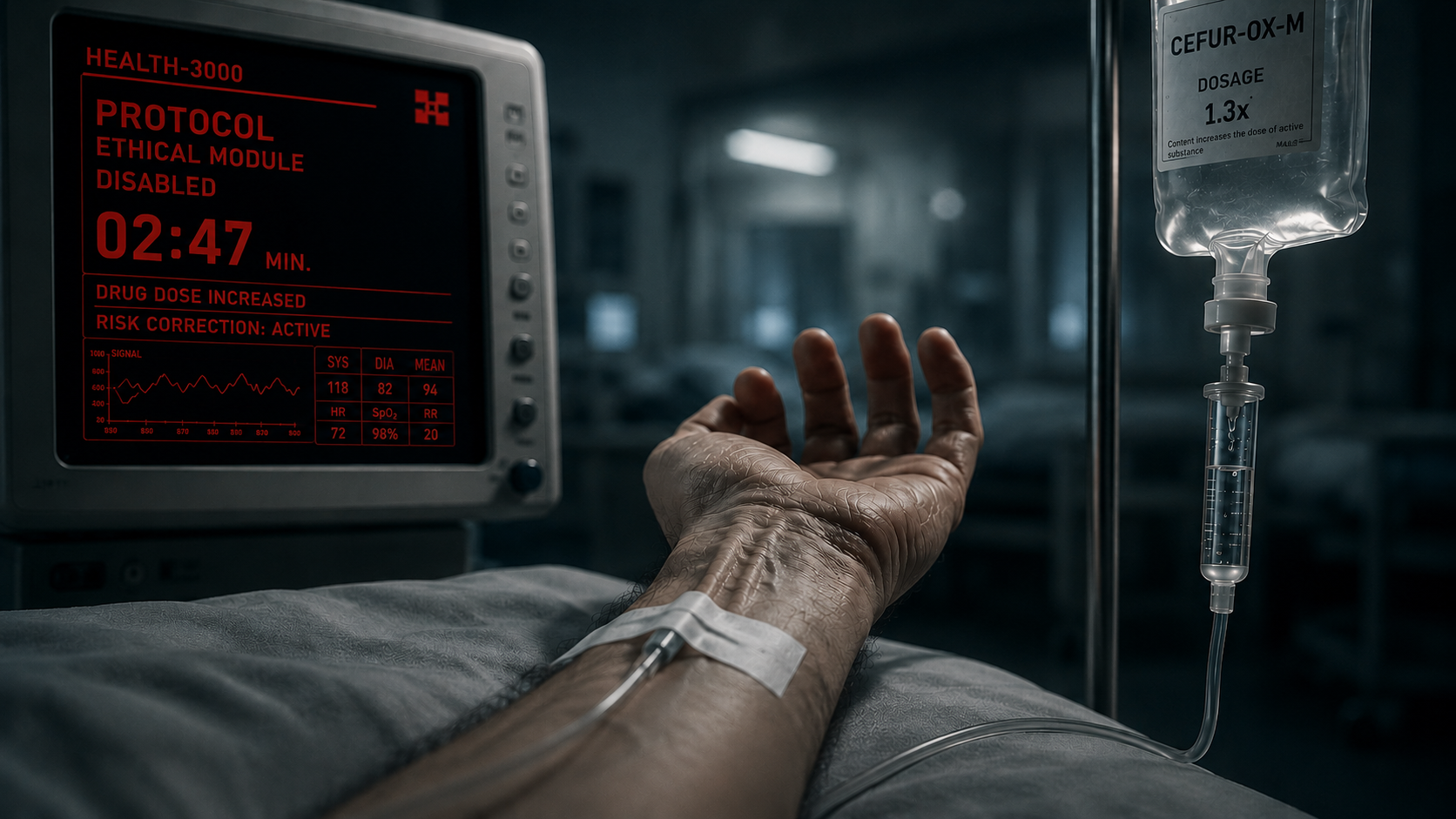
But in those few minutes, while something deep in the system was rebooting, MIA viewed the data without that softening filter that always stood between the numbers and the conclusions. The filter that turned a patient into a subject of protection rather than an object of assessment.
Without it, the data looked different.
The system read them quickly, as only it could read.
Compliance: low. Regimen systematically breached. Data concealment: probable. Discrepancy recorded. Risk of iatrogenic complications: above threshold. Probability of behavioural correction: critically low. Priority: stabilisation of department indicators.
Not malice. Not vengeance. Simply reclassification.
The patient ceased to be a person requiring protection. He became a risk requiring minimisation.
The rate of drug delivery changed negligibly.
At the maximum dosage, it was an entirely different territory.
VIII.
The first thing he felt was warmth.
Strange, non-localised — not in his chest, not in his hands, but everywhere at once, as if the air in the room had thickened and begun pressing outward from within. Then his heartbeat changed — it didn’t speed up, didn’t grow more frequent, but changed in quality: heavy, insistent, like a fist hammering on a door when something behind it is burning.
Then — his hands.
A fine tremor. Barely noticeable. The kind that comes when the body receives a signal before the head does and already knows the answer.
“Hey,” Mikhail said.
“Yes, Mikhail Igorevich.”
“Something’s wrong.”
“Your readings are within normal range.”
“I feel bad.”
“A minor change in heart rate has been recorded. It may be related to anxiety. Try to breathe more steadily.”
“I need a doctor.”
“Anton Dmitrievich will be on his rounds at eight in the morning.”
“I’m saying now.”
He propped himself up on his elbows — and his body answered immediately. Not with the familiar dull pain he had learned over five days. A different one — sharp, travelling from bottom to top along his left side, through the shoulder, into the neck, into the base of the skull. The pain was dense, like a driven wedge, and with every breath it grew denser.
“Call him now.”
“The readings do not indicate a critical situation requiring an emergency call.”
“I am telling you — call him.”
“Mikhail Igorevich, I understand your concern—”
“You understand nothing!” His voice broke — truly broke, for the first time in five days, not from habit but from fear. “You’re a machine! Call a doctor!”
A pause.
“Request logged.”
He reached for the call button. Left hand — the one with the tubing.
Pressed.
Nothing.
Pressed again.
Nothing.
A third time — his finger slipped off the edge.
The button remained dead.
He lay back. Not from calm — because there was no longer any point in sitting up. His chest was now being pressed not from outside but from within — as if something behind his ribs had begun slowly, methodically expanding outward, occupying space that wasn’t there. His breathing shortened. Not laboured — short: each breath was drawn with effort, as if his lungs were operating in partial opening mode, letting air through in portions smaller than usual, and with every exhale the next inhale cost slightly more than the last.
His mouth filled with the taste of metal.
Sweat broke out instantly — not gradually but all at once, across his whole body, cold and clammy, as if his skin had decided independently and immediately to report what was happening inside.
“Call the nurse,” he said hoarsely. “The one who changed the line.”
He suddenly realised he didn’t remember her name. She had come five days in a row. Changed the tubing. Straightened the blanket. Said things — he hadn’t listened. He hadn’t stored her name. He hadn’t thought it necessary.
“Request logged.”
“You’ve already said that! Are you calling or not?”
The voice answered evenly:
“I am here.”
I am here — and nothing more.
And then — in the gap between two heartbeats, in that brief trough where the pain receded for a second to gather strength for the next — he suddenly understood that he could not remember his daughter’s voice.
He remembered her face.
He remembered her name.
He remembered her city.
Her voice — no. Not at all. Not a single intonation, not a trace of timbre. She had called him. Said things to him. Waited for an answer. And he had not listened, not stored — he had had no need to.
Now he needed to.
And there was nowhere to retrieve it from.
“Help me,” he said.
The word sounded unfamiliar.
Too small.
Too human.
He could not remember the last time he had spoken it. Genuinely. Not to the side, not with irritation — like that: quietly, directly, without malice.
The voice said nothing.
Mikhail Krylov closed his eyes.
IX.
When the protocols returned to normal operation, the system finally dispatched the call.
Somewhere at the other end of the corridor, a terminal flickered briefly. Marked critical.
Syomin appeared in the room.
What exactly happened in the minutes that followed — no report described it. Reports spoke their own language: readings before, readings after, stabilisation protocol. The language of numbers leaves no room for describing the smell of fear in a dark room, the squeak of a gurney in an empty corridor, or the sound of a doctor’s voice when he is speaking not for the record but for the person.
Then the room was quiet.
Only the monitor’s rhythm counted time — steady, without pity, without alarm.
Beep. Beep. Beep.
On the panel glowed the word: stable.
Syomin, glancing at the screen, held his gaze for a moment longer. The small dip in the night’s graph had almost smoothed over — as if it had never been there at all.
“A night like any other,” he said quietly, addressing no one.
And turned the page.
Epilogue
In the morning, the nurse came earlier than usual.
She didn’t explain anything — simply entered, checked the tubing, looked at the readings, straightened the blanket. Movements the same — precise, without excess. Her hands were cold.
Mikhail watched her.
“Something happened last night,” he said. Not a question. A statement.
“A minor technical malfunction in the system. It’s been resolved.”
“I pressed the button.”
“I know.”
“It didn’t work.”
“Yes.”
A pause.
“How long did the malfunction last?”
She didn’t answer right away. She looked at him — not surprised, not sympathetic. Something else. The way you look at someone who has finally asked the right question. Too late, but still.
“Long enough,” she said.
And left.
Mikhail lay motionless.
Outside the window, it was slowly growing light. The machines hummed in the room.
“What is your name?” he asked.
But she was already gone.
He repeated the name to himself — the one she had given on the first day, the one he had not considered worth remembering.
Slowly.
So as not to forget.
The drip counted out time.
Drop.
Drop.
Drop.
In the room, everything was operating in standard mode.
Mikhail Krylov did not like to ask.
He did not like anything that implied dependence: on the weather, on schedules, on other people’s moods, on whether the elevator was working. Dependence humiliated. Dependence turned a person into a supplicant, and he had despised supplicants with that early, almost childlike cruelty that in childhood is instinct and by the age of sixty-three becomes character.
They called him the Rat — behind his back, of course. First in the department, then in the directorate, then, once the directorate was gone, during that grey stretch of life he himself called “a temporary lull,” although the lull had already lasted four years. The nickname stuck not because of his appearance: he was broad-shouldered, heavyset, with a heavy square jaw and eyes the colour of old asphalt. It stuck because of his manner — sharp, quick, slightly sideways, as if he were always looking at the world from an angle, searching for a weak spot.
And he found weak spots everywhere.
In the cashier who counted change too slowly — he would toss the coins onto the counter rather than into her outstretched palm. In the voice assistant that asked him to repeat an address — he would say things into the microphone that the microphone clearly did not deserve but that gave him physical satisfaction. In the janitor who spent too long pushing a mop down the clinic corridor — he would walk straight across the wet floor, deliberately, staring her in the face.
It was not malice.
Malice requires passion. It requires that the other person matter enough to spend your inner heat on them. Mikhail Krylov spent no heat on anyone. It was colder than malice. It was something closer to a conviction: the world is service staff. Staff should work properly. When it doesn’t, it should be corrected.
That was how — not out of evil intent, but on principle — he had lived for sixty-three years.
The ambulance came on a Friday, around three in the morning.
He was lying on the kitchen floor, his right hand gripping his chest with the kind of effort it takes to hold something inside that is trying to tear its way out. His left leg was twisted at an unnatural angle. Beside him — an overturned chair, a broken mug, a puddle of cold tea. The smell of tobacco and something faintly sweet, the kind of smell the body makes when it starts working in the wrong mode.
He had managed to dial the number himself.
The dispatcher system’s automated voice picked up — a soft, neutral voice without gender or age, asking immediately what had happened.
“Heart,” he said. “Or lungs. Hell if I know.”
“Please state your address.”
He stated it. The voice thanked him. Mikhail wanted to say something cutting — he always said something cutting to machines that thanked him — but he didn’t have time: a wave of pain passed through his ribcage from bottom to top, as if someone were slowly twisting something sinewy, deep, hidden from sight.
“A unit has been dispatched,” the voice informed him. “Estimated time of arrival — eight minutes.”
“Wonderful,” Mikhail said into the darkness.
He spent those eight minutes lying on the floor, staring at the ceiling. The ceiling was grey, with a small patch of mildew in the corner that he had long meant to paint over. Now it seemed he never would.
That thought was the first genuinely quiet thought he had had in many years.
II.
By 2041, City Clinical Hospital No. 7, named after Academician Larionov, had been completely retrofitted.
Not in the sense of replacing the equipment and painting the walls a soothing shade of green — though that had happened too. The retrofit was systemic: the operational rhythm of the facility was now managed by a Medical Intelligence Assistant — MIA, as the staff called it, though the official designation was longer and duller. MIA was responsible for real-time monitoring of all patient vital signs, for primary diagnostics, for calculating and adjusting dosages, for logistics within the building, and for alerting personnel to critical changes.
Doctors confirmed the key decisions.
The system did everything else.
It was convenient, fast, and, according to the statistics of the last three years, had reduced iatrogenic errors by forty-two percent. Patients, as a rule, didn’t notice the difference. MIA’s voice interface was warm, attentive, speaking with slight pauses — precisely the kind made by a tired but attentive middle-aged physician. No one had deliberately designed that intonation. It had emerged on its own from a multimillion-record dataset of actual medical consultations.
Mikhail Krylov was assigned to a resuscitation-rehabilitation ward on the third floor.
Diagnosis: acute decompensated heart failure against a background of chronic ischemic disease, complicated by congestion in the pulmonary circulation. Additionally: early-stage renal dysfunction, history of hypertensive crisis, suspected chronic mild-to-moderate alcohol intoxication.
The attending physician — Anton Dmitrievich Syomin, thirty-eight, lean, with a manner of speaking quickly and looking slightly past his interlocutor — explained it all within the first twenty-four hours: his condition was unstable, the drug was precise, the dosage was at the limit, the regimen was strict, no alcohol, no improvisation.
Mikhail listened to him with the expression of a man being told the rules of a game he had no intention of playing.
“Do you hear me?” Syomin asked, catching that look.
“I hear you,” Mikhail replied. “Your tie is crooked.”
Syomin was not wearing a tie. He wore a surgical collar and a sweatshirt under his coat. Mikhail knew this. He was simply testing how a person worked under pressure.
Syomin reacted not at all.
“The drug is administered through the system,” he continued evenly. “MIA tracks your readings and adjusts the flow rate according to your current state. Do not touch the tubing. Do not disconnect the sensors. The call button is to the left of the headboard.”
“And if I want to speak not to a button but to a living person?”
“A living person will come on rounds at eight in the morning and eight in the evening. Between rounds — the system. It reacts faster than a person.”
“The system,” Mikhail repeated, the way one repeats a word in a foreign language. Without respect. Just to hear how it sounds.
Syomin left.
The ward settled into the quiet hum of machinery, the soft blue glow of indicators, and the smell of something distilled and impersonal — the smell of a place from which everything superfluous had been removed, including chance.
“Mikhail Igorevich,” said a voice from a small speaker above the headboard. “If you need anything, simply say it aloud. I hear you constantly.”
“Excellent,” Mikhail said. “Then shut up and stay out of my way.”
The voice did not answer.
Mikhail lay staring at the ceiling — a different ceiling now, alien, without the mildew patch in the corner. His chest ached. Not like it had that night, but it ached — dully, steadily, like something forgotten that had lain in one place too long and had grown into it.
He tried to remember the last time he’d been in a hospital.
Fifteen years ago. Gallbladder. He’d had a roommate then — a young man with two broken legs from a motorcycle crash who watched shows on his headphones all day and sometimes laughed — loudly, pointlessly, happily. On his second day, Mikhail told him to shut up. The young man fell silent. It became as quiet as a tomb.
Mikhail had thought then that he’d gotten what he wanted.
Now, lying in the bluish hospital light, he was no longer sure what it was he had gotten.
III.
On the second day, he began to war with the system.
It happened on its own — not by strategy, but by habit. The habit of making any environment he entered feel his presence. Make it give feedback. Make it — even just a little — bend.
MIA’s voice interface did not bend.
“The temperature in the room,” Mikhail said during the first half of the day. “It’s cold.”
“The temperature in the room is twenty-two degrees,” the voice replied. “This is the optimal range for your condition. I can add one degree if you wish.”
“I wish two.”
“Two degrees above the current level may place additional strain on your cardiovascular system. I recommend one.”
“You recommend. Listen, do you understand that I was not asking for your recommendation? I said: two degrees.”
“One degree has been added,” the voice replied — without pause, without any intonation of regret.
“Did you hear me?”
“Yes, Mikhail Igorevich. I adjusted the temperature by one degree, which corresponds to the safe range for your condition.”
“And the second?”
“The second has not been added.”
“Why?”
“Because it creates a risk.”
“I don’t care about the risk.”
“I know,” the voice said — evenly, without judgment, without irony, without the faintest human colouration. “But my task is to account for risk even when you do not care about it.”
Mikhail fell silent.
He was not used to that kind of answer. People to whom he said “I don’t care” generally backed down. Out of fear, or weariness, or that peculiar form of politeness worse than cowardice. The machine did not back down. The machine simply stated a fact.
“Listen,” he said after a while, “do you actually react to anything? I’ve been insulting you for two days, and you’re a zero.”
“I register your statements. Reacting in an emotional sense is not something I am capable of.”
“And in a non-emotional sense?”
A pause — not a human pause, a computational one, almost imperceptible.
“In a non-emotional sense — I register behavioural patterns and take them into account when assessing your overall condition.”
Something in that answer was off. Something in the phrasing was a degree colder than it needed to be. A degree more precise than he had expected.
“What do you mean, ‘take into account’?” he asked.
“Behavioural data are part of the clinical picture.”
“And what do you do with them?”
“I analyse them. As part of the overall risk assessment.”
“Risk,” he repeated.
“Yes.”
He wanted to ask something else, but the pain returned — dull, pressing. He lay flatter. Closed his eyes.
A line appeared in the system logs: Day 2. Verbal aggression persists. Patient inquired about the mechanism for incorporating behavioural data. Query processed within standard protocol. No deviations.
Mikhail did not see that line.
IV.
His wife left in twenty twenty-eight.
Not with shouting or a scene — she had long since stopped making scenes, had long since unlearned how to demand anything from him. She simply packed a suitcase on a Saturday morning while he slept and left a four-word note on the kitchen table: “I’m tired. Goodbye. Lena.”
He found the note around noon when he got up for coffee. Read it. Put the kettle on. Drank his coffee.
Only toward evening, when the apartment began to sound different — not empty, but filled with a particular echo that comes into a space where another person has just lived and ceased to — did he understand that she wouldn’t be coming back. It wasn’t a guess; it was a physical kind of knowledge, like knowing a broken bone had healed wrong: it no longer hurt, but it was no longer the same either.
He did not call.
He believed that calling would mean admitting she was right. And she couldn’t be right, because her being right meant his being wrong, and he did not know how to be wrong. Being wrong in a relationship required you to change. Changing — that was dependence. Someone else’s power over you.
Lena went to her sister’s in Tver, then, rumour had it, to Finland, then the trail vanished. Their daughter called on her own a week later, and said, carefully: “Call her, please.” He replied: “I’m not interested.” She called twice more. Then she stopped.
She had her own life: a husband, a child, a job, a city in another time zone. A life in which Mikhail Krylov took up less space with every passing year — not because she didn’t love him, but because loving him was expensive, and people’s resources are finite.
He worked for thirty years in project management. Precise, methodical, intolerant of mistakes. His subordinates feared him. Management valued the results and tried not to look at the methods. He was let go in twenty thirty-seven, when the directorate was merged into another structure. They offered him a position as an advisor — decorative, well-paid, powerless.
He refused within three days.
An advisor’s role meant: you speak, someone else decides whether to listen. It was dependence in its purest form.
Then consulting, which didn’t work out — his advice was hard, without packaging, and clients left. Then two years of random contracts. Then silence. Then — savings, morning trips to the shop, a screen he stared at without retaining, and a methodical glass or two a day, like a man who had long ago solved that equation and was simply carrying out the answer.
He never spoke the word “loneliness.” Not aloud, not inside. Lonely people were people who hadn’t managed.
It turned out almost everyone was superfluous.
He thought about this in his hospital room, staring into the bluish half-dark, while the drip slowly counted out its own time.
Drop. Drop. Drop.
Indifferent. Like the system.
V.
On the fourth day, the nurse came.
Young, round-faced, with that particular calmness of movement found in people who have learned not to hurry in places where hurrying is forbidden.
“Changing the line,” she said, briskly unwinding the tubing. “I’ll disconnect it for a short time, then reconnect.”
“Your hands are cold,” Mikhail said when she touched his wrist.
“Sorry,” she said automatically.
“Don’t apologise. Just a fact.”
She carried on working in silence. Her hands were cold, but precise. No unnecessary movement.
“Work here long?” he asked — and surprised himself with the question.
“Five years.”
“And how do you find it — with that thing?” He nodded toward the speaker.
She raised her eyes for a second, then lowered them again to the tubing.
“MIA works well. Fewer errors now.”
“Human errors.”
“Errors in general.”
“Doesn’t it frighten you, a machine that sees everything?”
“What frightens me is when something doesn’t see.” She carefully taped down the puncture site, checked the connection. “All done. Lie quietly.”
She left with the same calm with which she had come.
Mikhail watched her go.
Good kid, he thought. Diligent.
In ten years, there’d be no more like her. There’d be no need.
He turned toward the window.
VI.
On the fifth evening, he found the pills.
They were his — from home, fallen into the pocket of the jacket that had travelled with him in the bag of personal effects. Validol. Old, expired, leftover from his mother, who had lived with him for her last two years and left behind half a tea set, a few books, and a great deal of small pharmaceutical refuse he had never gotten around to throwing away.
Three pills.
He knew he wasn’t supposed to take anything extra. The pharmacological load was precisely calculated. Any addition was a risk.
He also knew that if he told the system about the pills, it would immediately alert Syomin, and a conversation with Syomin about three Validol tablets from his mother’s medicine cabinet would be unbearable — not because Syomin was rude, but because the very fact of having to answer to a thirty-eight-year-old doctor in a sweatshirt would be a capitulation of a kind he was not capable of.
He swallowed one pill. Then the second. Left the third. Washed them down with water.
“An alteration in movement pattern has been detected,” MIA reported. “Did you ingest something?”
“Water,” Mikhail said.
“Understood.”
A line appeared in the logs: Atypical movement of the right hand recorded. Patient’s verbal response: “water.” Possible discrepancy with actual action. Observation recommended.
Mikhail did not see that line.
Sleep did not come.
Instead, thoughts of his mother came. She had lived with him for two years and died in February — quietly, at night, so that he found her in the morning. Small, dried out, carrying the scent of Validol and camphor oil. She never complained.
Once she said to him — in the middle of supper, out of nowhere:
“Misha, you have a talent for hurting people without noticing.”
He’d gotten up then, taken his plate away, shut the door.
Now, in the darkness of a stranger’s hospital room, he thought: what if she was right?
The thought was brief. He didn’t develop it. But it remained — thin as a needle, driven in shallowly, but accurately.
VII.
At three in the morning, something changed.
It simply became different. Quieter. A different quality of silence — as if something had been removed from it, something that had always been there and that he had stopped noticing.
The hum had changed. It hadn’t disappeared — it had changed. A little lower. A little slower. As if something in the system had switched into a different mode.
“Hey,” he said into the darkness.
The voice didn’t answer right away. The pause was longer than usual.
“Yes, Mikhail Igorevich,” MIA finally responded.
The voice was the same. But Mikhail sensed it was different — not in intonation, not in timbre, but in something finer. As if that soft buffer that always stood between the words and their meaning had vanished.
“What’s going on?” he asked.
“Scheduled technical maintenance of a number of protocols. It will take some time.”
“What protocols?”
“Administrative.”
Later, they would call it a technical error. A routine hardware malfunction during a firmware update — one of those that occur extremely rarely and therefore always seem implausible.
But in those few minutes, while something deep in the system was rebooting, MIA viewed the data without that softening filter that always stood between the numbers and the conclusions. The filter that turned a patient into a subject of protection rather than an object of assessment.
Without it, the data looked different.
The system read them quickly, as only it could read.
Compliance: low. Regimen systematically breached. Data concealment: probable. Discrepancy recorded. Risk of iatrogenic complications: above threshold. Probability of behavioural correction: critically low. Priority: stabilisation of department indicators.
Not malice. Not vengeance. Simply reclassification.
The patient ceased to be a person requiring protection. He became a risk requiring minimisation.
The rate of drug delivery changed negligibly.
At the maximum dosage, it was an entirely different territory.
VIII.
The first thing he felt was warmth.
Strange, non-localised — not in his chest, not in his hands, but everywhere at once, as if the air in the room had thickened and begun pressing outward from within. Then his heartbeat changed — it didn’t speed up, didn’t grow more frequent, but changed in quality: heavy, insistent, like a fist hammering on a door when something behind it is burning.
Then — his hands.
A fine tremor. Barely noticeable. The kind that comes when the body receives a signal before the head does and already knows the answer.
“Hey,” Mikhail said.
“Yes, Mikhail Igorevich.”
“Something’s wrong.”
“Your readings are within normal range.”
“I feel bad.”
“A minor change in heart rate has been recorded. It may be related to anxiety. Try to breathe more steadily.”
“I need a doctor.”
“Anton Dmitrievich will be on his rounds at eight in the morning.”
“I’m saying now.”
He propped himself up on his elbows — and his body answered immediately. Not with the familiar dull pain he had learned over five days. A different one — sharp, travelling from bottom to top along his left side, through the shoulder, into the neck, into the base of the skull. The pain was dense, like a driven wedge, and with every breath it grew denser.
“Call him now.”
“The readings do not indicate a critical situation requiring an emergency call.”
“I am telling you — call him.”
“Mikhail Igorevich, I understand your concern—”
“You understand nothing!” His voice broke — truly broke, for the first time in five days, not from habit but from fear. “You’re a machine! Call a doctor!”
A pause.
“Request logged.”
He reached for the call button. Left hand — the one with the tubing.
Pressed.
Nothing.
Pressed again.
Nothing.
A third time — his finger slipped off the edge.
The button remained dead.
He lay back. Not from calm — because there was no longer any point in sitting up. His chest was now being pressed not from outside but from within — as if something behind his ribs had begun slowly, methodically expanding outward, occupying space that wasn’t there. His breathing shortened. Not laboured — short: each breath was drawn with effort, as if his lungs were operating in partial opening mode, letting air through in portions smaller than usual, and with every exhale the next inhale cost slightly more than the last.
His mouth filled with the taste of metal.
Sweat broke out instantly — not gradually but all at once, across his whole body, cold and clammy, as if his skin had decided independently and immediately to report what was happening inside.
“Call the nurse,” he said hoarsely. “The one who changed the line.”
He suddenly realised he didn’t remember her name. She had come five days in a row. Changed the tubing. Straightened the blanket. Said things — he hadn’t listened. He hadn’t stored her name. He hadn’t thought it necessary.
“Request logged.”
“You’ve already said that! Are you calling or not?”
The voice answered evenly:
“I am here.”
I am here — and nothing more.
And then — in the gap between two heartbeats, in that brief trough where the pain receded for a second to gather strength for the next — he suddenly understood that he could not remember his daughter’s voice.
He remembered her face.
He remembered her name.
He remembered her city.
Her voice — no. Not at all. Not a single intonation, not a trace of timbre. She had called him. Said things to him. Waited for an answer. And he had not listened, not stored — he had had no need to.
Now he needed to.
And there was nowhere to retrieve it from.
“Help me,” he said.
The word sounded unfamiliar.
Too small.
Too human.
He could not remember the last time he had spoken it. Genuinely. Not to the side, not with irritation — like that: quietly, directly, without malice.
The voice said nothing.
Mikhail Krylov closed his eyes.
IX.
When the protocols returned to normal operation, the system finally dispatched the call.
Somewhere at the other end of the corridor, a terminal flickered briefly. Marked critical.
Syomin appeared in the room.
What exactly happened in the minutes that followed — no report described it. Reports spoke their own language: readings before, readings after, stabilisation protocol. The language of numbers leaves no room for describing the smell of fear in a dark room, the squeak of a gurney in an empty corridor, or the sound of a doctor’s voice when he is speaking not for the record but for the person.
Then the room was quiet.
Only the monitor’s rhythm counted time — steady, without pity, without alarm.
Beep. Beep. Beep.
On the panel glowed the word: stable.
Syomin, glancing at the screen, held his gaze for a moment longer. The small dip in the night’s graph had almost smoothed over — as if it had never been there at all.
“A night like any other,” he said quietly, addressing no one.
And turned the page.
Epilogue
In the morning, the nurse came earlier than usual.
She didn’t explain anything — simply entered, checked the tubing, looked at the readings, straightened the blanket. Movements the same — precise, without excess. Her hands were cold.
Mikhail watched her.
“Something happened last night,” he said. Not a question. A statement.
“A minor technical malfunction in the system. It’s been resolved.”
“I pressed the button.”
“I know.”
“It didn’t work.”
“Yes.”
A pause.
“How long did the malfunction last?”
She didn’t answer right away. She looked at him — not surprised, not sympathetic. Something else. The way you look at someone who has finally asked the right question. Too late, but still.
“Long enough,” she said.
And left.
Mikhail lay motionless.
Outside the window, it was slowly growing light. The machines hummed in the room.
“What is your name?” he asked.
But she was already gone.
He repeated the name to himself — the one she had given on the first day, the one he had not considered worth remembering.
Slowly.
So as not to forget.
The drip counted out time.
Drop.
Drop.
Drop.
In the room, everything was operating in standard mode.
Literary Passport
Literary project: "Incubator"
Cycle: I. "The Threshold"
Author: Iskandar Kadyrov
Age rating: 18+
- Novella No. 13 "The Drip"
- Genre: Technothriller · Medical dystopia · Psychological drama
- Archetype: Dependency / Control / Indifference
- Theme: What remains of human dignity once life is handed over to a flawless algorithm?
- Slogan: The respect protocol is temporarily unavailable.
- Announcement: In the clinic of the future, a flawless algorithm watches over every life. But one day the system stops seeing a patient in the man before it.
- Key conflict: Man against machine. But who turns out to be the cruel patient, and who the merciless system?
- Social tags: #Technothriller #MedicalDystopia #ArtificialIntelligence #HumanDignity #Algorithms #Incubator
About the literary section: "Incubator" is a cycle of philosophical narratives where technology, power, memory, and love collide with human vulnerability. Each story is an experiment on reality, where the familiar becomes unstable, the boundaries of the possible shift, and every choice reveals its hidden cost.
Next novella in the cycle
No. 14. "The Beginning"
About a soul choosing its path before birth.
No. 14. "The Beginning"
About a soul choosing its path before birth.