The Theatre
Literary Passport:
Announcement
For eighteen months he built a world meant to exist only on a stage. But what happens when, one day, the set begins to remember more than its creator does?
Hashtags
#Theatre #Art #Time #Form #Creation #PhilosophicalProse #Incubator
About the Literary Project
THE INCUBATOR™ is a cycle of philosophical novellas by Iskandar Kadyrov at the intersection of intellectual prose, psychological drama, social satire, and dystopian literature.
- Literary Project: INCUBATOR™
- Cycle: I. "The Threshold"
- Author: Iskandar Kadyrov
- Age Rating: 18+
- Novella: "The Theatre"
- Genre: Philosophical prose · Magical realism · A parable of art
- Slogan: The form is already complete.
Announcement
For eighteen months he built a world meant to exist only on a stage. But what happens when, one day, the set begins to remember more than its creator does?
Hashtags
#Theatre #Art #Time #Form #Creation #PhilosophicalProse #Incubator
About the Literary Project
THE INCUBATOR™ is a cycle of philosophical novellas by Iskandar Kadyrov at the intersection of intellectual prose, psychological drama, social satire, and dystopian literature.
The Theatre
I was not acquainted with Lucas F. — a theatrical designer whose name will mean nothing to the reader of programmes, but whose single work, the subject of what follows, deserves, in my judgment, a good deal more attention than the meager notice it received in the obituary column of a provincial newspaper. I owe my acquaintance with this story to the widow of the director of that same theatre, who showed me a correspondence, two copies of one and the same budget, dated seven years apart, and a scale model of the stage, 1:20, which she kept, in her own words, "because throwing it away would have been a kind of sacrilege, and explaining it to anyone would have been impossible." Among other papers, she also gave me Lucas's working notebook, in which, as was his habit, he entered the sections of a future production well in advance, before the sets existed anywhere but in his own hands — a notebook whose system of headings, I confess, struck me more forcibly than the story it frames.
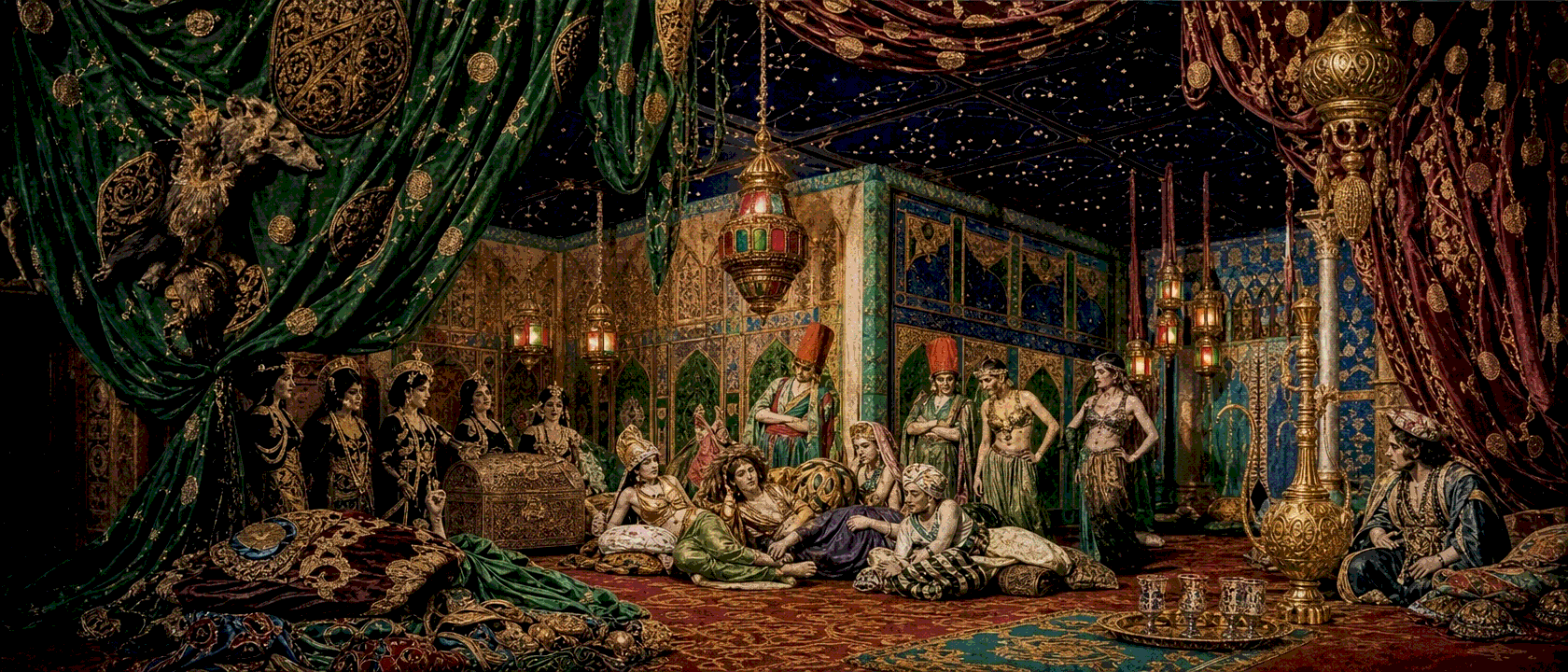
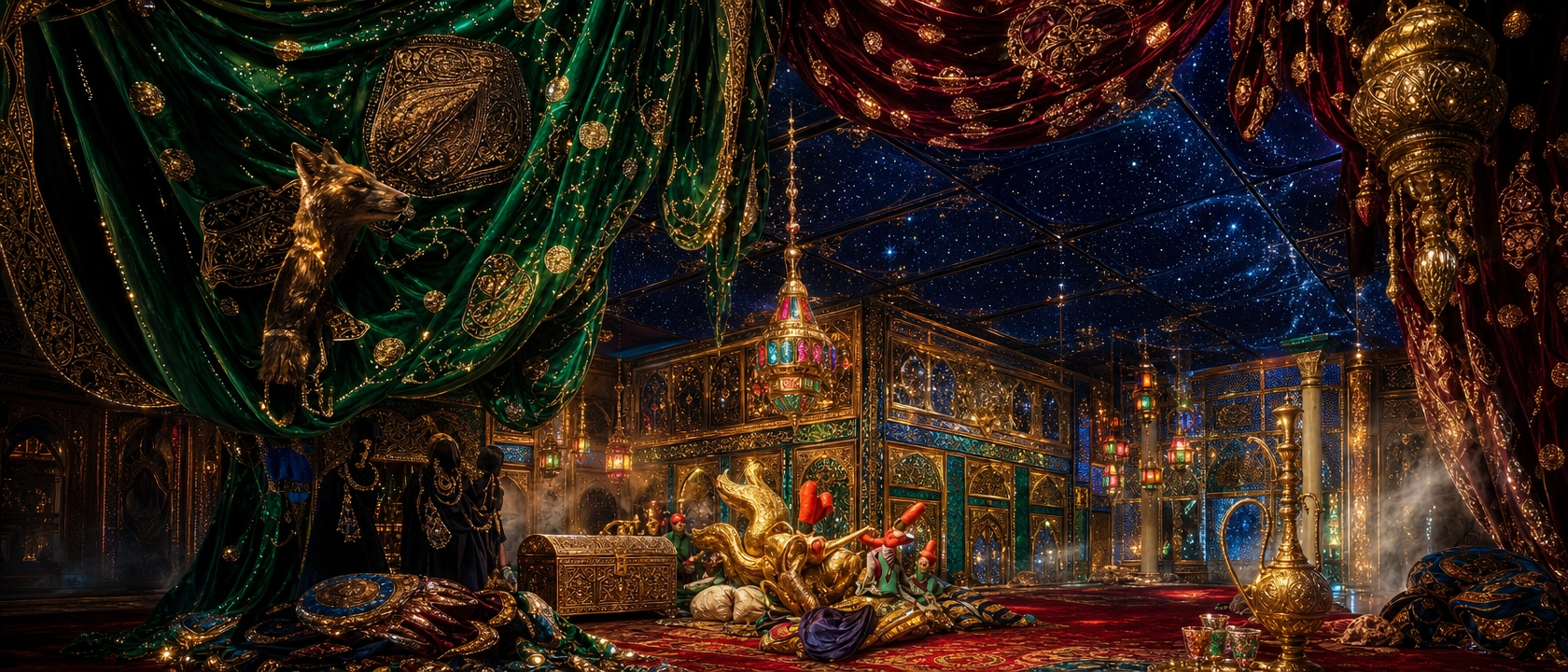
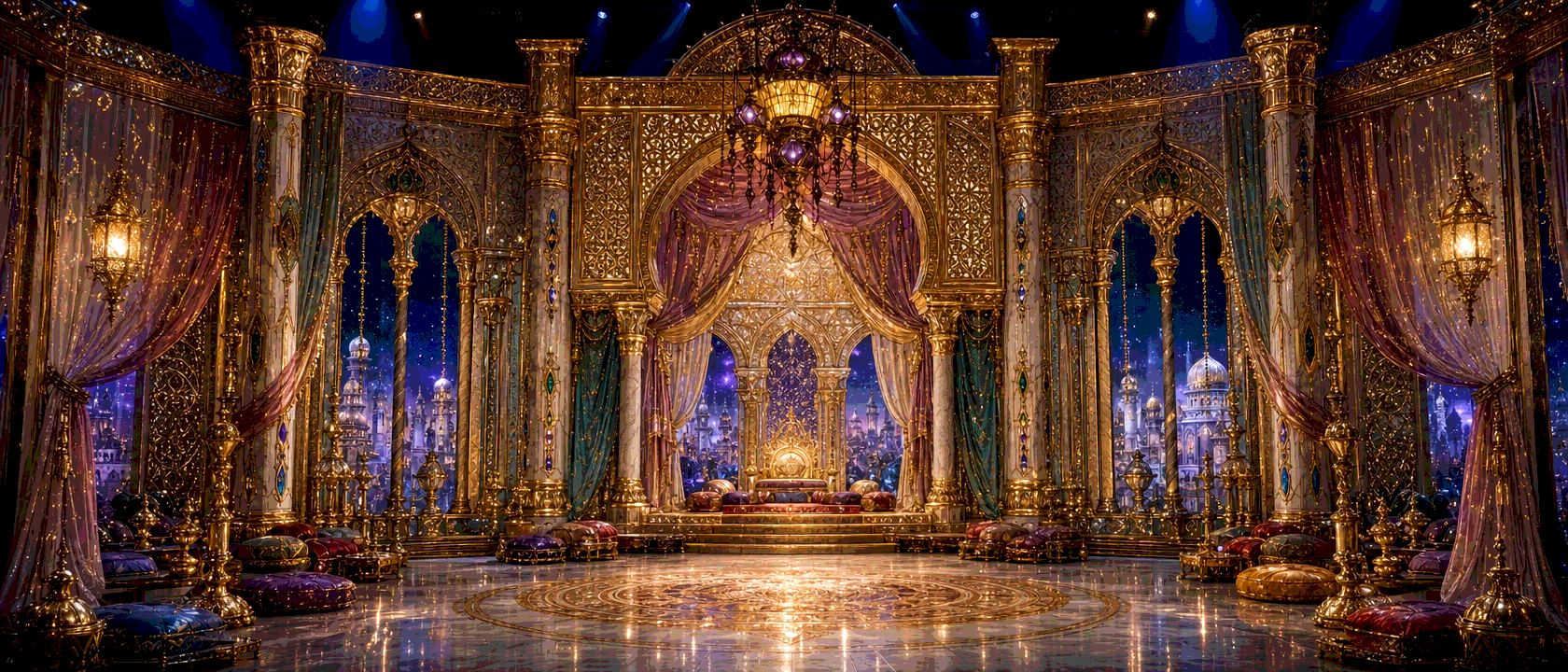
The task I set myself is a modest one: not to recount Lucas's biography, but to examine with due attention a fact the widow herself regarded as a minor curiosity, and which I regard as the central event of this story. The fact is this: Lucas F., twice, seven years apart, created one and the same production of the Thousand and One Nights — identical down to the last fold of purple drapery, down to the angle at which the light fell across the silk, down to the signature L. in the lower right corner of the final sketch. The first production was cancelled by a letter bearing an official seal, one day before opening. The second took place, and was a success.
A superficial mind will see here a story of persistence: an artist, once refused, tried again and succeeded. I maintain the opposite. Lucas F.'s second production is immeasurably richer than the first — although the two are identical in every material particular — and it is in this very identity that the whole philosophical interest of the case resides.
I was not acquainted with Lucas F. — a theatrical designer whose name will mean nothing to the reader of programmes, but whose single work, the subject of what follows, deserves, in my judgment, a good deal more attention than the meager notice it received in the obituary column of a provincial newspaper. I owe my acquaintance with this story to the widow of the director of that same theatre, who showed me a correspondence, two copies of one and the same budget, dated seven years apart, and a scale model of the stage, 1:20, which she kept, in her own words, "because throwing it away would have been a kind of sacrilege, and explaining it to anyone would have been impossible." Among other papers, she also gave me Lucas's working notebook, in which, as was his habit, he entered the sections of a future production well in advance, before the sets existed anywhere but in his own hands — a notebook whose system of headings, I confess, struck me more forcibly than the story it frames.
The task I set myself is a modest one: not to recount Lucas's biography, but to examine with due attention a fact the widow herself regarded as a minor curiosity, and which I regard as the central event of this story. The fact is this: Lucas F., twice, seven years apart, created one and the same production of the Thousand and One Nights — identical down to the last fold of purple drapery, down to the angle at which the light fell across the silk, down to the signature L. in the lower right corner of the final sketch. The first production was cancelled by a letter bearing an official seal, one day before opening. The second took place, and was a success.
A superficial mind will see here a story of persistence: an artist, once refused, tried again and succeeded. I maintain the opposite. Lucas F.'s second production is immeasurably richer than the first — although the two are identical in every material particular — and it is in this very identity that the whole philosophical interest of the case resides.
I
Worthy of note in itself is the division Lucas — for reasons known, presumably, only to him — imposed on this story in advance, at a time when it was nothing but an intention. The notebook opens with a section entitled simply "Overture" — a title exceedingly strange for a man engaged in the creation not of music but of scenery, unless one sees in it what I see: an admission that the theatre itself, quite apart from whatever occurs upon its stage, is a finished work, prior to any particular production. In this section Lucas describes, with an almost liturgical care, not the palace of Scheherazade but the auditorium itself: the gilding, which had "long since ceased to be ornament" and become "the memory of the walls"; the velvet of the stalls, holding the warmth of a thousand evenings "with the particular tenderness only found in things that have never once known an indifferent touch"; the dust on the stage floor, lying in layers, "like an archive." He closes this description with a phrase I consider the key to everything that follows: "This theatre has seen almost everything. But not this."
The question this overture leaves open, and which only the whole of the subsequent story answers, is: which, among all the things this theatre has seen across the centuries of its existence, constitutes the exception for whose sake it was worth writing these lines in advance, before it had even happened?
II
The section Lucas entitled "Act I. First Incarnation" — let us call it, for convenience, Theatre (1) — was a labor of pure imagination: eighteen months of work, during which the world of the Thousand and One Nights existed only as a possibility, as a model on a table, as a sketch in charcoal and gouache, in which Scheherazade looked out from the wall "with the particular patience found only in those who already know how everything will end." The dome, the arches, the silk the color of a sapphire sky — all of this, in the "First Incarnation," was, if I may put it so, innocent: created with no memory of having been created before — because nothing of the kind had ever existed before.
The section ends briefly and dryly, without a single word of comment from Lucas himself — only a letter, pasted whole into the notebook, bearing an official seal and three polite paragraphs, of which one line alone matters for our purposes: "Date not confirmed."
III
Between the two acts, a page in the notebook bears nothing but the heading "Intermission" — and emptiness beneath it. I dwell on this emptiness with more attention than the reader will perhaps think warranted. The seven years contained between the cancelled opening and the new commission — the circumstances of which the widow did not think it necessary to relate to me, nor are they, in any case, material to my argument — fit, for Lucas, onto a single page without text. An intermission in a theatre is not the absence of a performance, but its temporary suspension, with the continuation still guaranteed; in applying this word to seven years of his own life, Lucas, without knowing it, made a prophetic admission: he did not consider the "First Incarnation" finished, or cancelled — he considered it interrupted. The blank page, then, is not a gap in the record, but the exact minutes of a period of waiting.
IV
The section "Act II. Second Incarnation" is the true object of my interest. The testimony of the witness — Lucas himself, recorded on these pages in his own hand — leaves no doubt as to his intention: he did not consult his earlier sketches. The dome of the palace came right the first time, the proportions settling of their own accord, "as if the hand remembered something the head did not." He chose the scale, 1:20, without deliberation — the same scale as seven years before, though, by his own account in that same notebook, he no longer remembered the exact figures of the first work. He set the signature L. in the lower right corner of the final sketch "by hand, without thinking" — a gesture identical to the first, but carrying no memory of it.
Here lies the essential distinction, one that escapes the superficial eye: the "First Incarnation" was the creation of a world that had not previously existed. The "Second Incarnation," identical to it down to the last fold of silk, was the creation of a world that had not previously existed — once again. And this second innocence is immeasurably more difficult than the first, because it occurs, unlike the first, not in the absence of experience, but in defiance of it.
The reader acquainted with my earlier essay on Pierre Menard, author of several chapters of Don Quixote written word for word as Cervantes wrote them — but arrived at not by transcription, engendered anew out of a different experience, a different century, a different fate — will recognize here the same principle, applied not to a word but to a form. Menard's text, identical to Cervantes's on the page, is immeasurably richer in meaning — precisely because it was written by a man of the twentieth century, for whom archaism was no longer a natural idiom, but a choice, burdened with the whole weight of the intervening centuries.
By the same token: the sets of the "Second Incarnation," identical to those of the "First" down to the last detail, are immeasurably richer than they — for they were made by a hand that had already once created them, and once lost them. The dome of the "First Incarnation" was a dome of hope. The dome of the "Second," physically indistinguishable from the first, was the dome of a man who knew the price of what a letter bearing an official seal can, at any moment, declare: "Date not confirmed."
V
The theatre's director, present at the mounting of the second production, said — by the widow's account — a phrase I am inclined to consider an accidentally exact formulation of the central theme of this whole story: "Now it lives on its own."
Lucas, she told me, did not turn around.
I linger on this silence. "On its own" — from whom does the form separate itself, when it begins to live on its own? The answer suggested by the whole logic of repetition is that it separates itself not from its material — silk remains silk, gold remains gold — but from intention. The "First Incarnation" was intention entire: fifteen months of labor, directed at a date that was meant to arrive. When the date failed to arrive, the intention was left hanging in emptiness — in that very emptiness Lucas would later entitle "Intermission." The "Second Incarnation," repeating the first down to the smallest fold, is free of that hanging intention — for it had already once failed to come to pass, and therefore had nothing further to prove.
VI
The notebook's final section bears a single word for its title — "Curtain" — and contains no more than three lines, entered, to judge by the pressure of the pen, considerably later than the event they describe: the ovation, the audience rising as one, "the happiness of recognition" on every face. What is notable is what these lines do not contain: not a word about the audience. Lucas writes only this: that he was not looking at the hall, but at the empty stage, where "the gold went on glowing after the spotlights had gone dark," where "the purple held its shape," where "the blue silk lay in folds, each one exactly where it was meant to be."
I draw a conclusion that struck me, on first reading, as reckless, and now seems to me the only possible one: whoever entitled the final page "Curtain" understood perfectly well that a curtain closes the auditorium, but not the form. The form was finished — not on the evening the audience applauded it, but seven years earlier, on the morning the letter mentioned above arrived. The second incarnation only made that completion visible; the curtain only made it final for those seated in the hall — but not for the form itself, which, by the whole logic of this notebook, had been complete long before anyone thought to invent the word "curtain" for it.
Worthy of note in itself is the division Lucas — for reasons known, presumably, only to him — imposed on this story in advance, at a time when it was nothing but an intention. The notebook opens with a section entitled simply "Overture" — a title exceedingly strange for a man engaged in the creation not of music but of scenery, unless one sees in it what I see: an admission that the theatre itself, quite apart from whatever occurs upon its stage, is a finished work, prior to any particular production. In this section Lucas describes, with an almost liturgical care, not the palace of Scheherazade but the auditorium itself: the gilding, which had "long since ceased to be ornament" and become "the memory of the walls"; the velvet of the stalls, holding the warmth of a thousand evenings "with the particular tenderness only found in things that have never once known an indifferent touch"; the dust on the stage floor, lying in layers, "like an archive." He closes this description with a phrase I consider the key to everything that follows: "This theatre has seen almost everything. But not this."
The question this overture leaves open, and which only the whole of the subsequent story answers, is: which, among all the things this theatre has seen across the centuries of its existence, constitutes the exception for whose sake it was worth writing these lines in advance, before it had even happened?
II
The section Lucas entitled "Act I. First Incarnation" — let us call it, for convenience, Theatre (1) — was a labor of pure imagination: eighteen months of work, during which the world of the Thousand and One Nights existed only as a possibility, as a model on a table, as a sketch in charcoal and gouache, in which Scheherazade looked out from the wall "with the particular patience found only in those who already know how everything will end." The dome, the arches, the silk the color of a sapphire sky — all of this, in the "First Incarnation," was, if I may put it so, innocent: created with no memory of having been created before — because nothing of the kind had ever existed before.
The section ends briefly and dryly, without a single word of comment from Lucas himself — only a letter, pasted whole into the notebook, bearing an official seal and three polite paragraphs, of which one line alone matters for our purposes: "Date not confirmed."
III
Between the two acts, a page in the notebook bears nothing but the heading "Intermission" — and emptiness beneath it. I dwell on this emptiness with more attention than the reader will perhaps think warranted. The seven years contained between the cancelled opening and the new commission — the circumstances of which the widow did not think it necessary to relate to me, nor are they, in any case, material to my argument — fit, for Lucas, onto a single page without text. An intermission in a theatre is not the absence of a performance, but its temporary suspension, with the continuation still guaranteed; in applying this word to seven years of his own life, Lucas, without knowing it, made a prophetic admission: he did not consider the "First Incarnation" finished, or cancelled — he considered it interrupted. The blank page, then, is not a gap in the record, but the exact minutes of a period of waiting.
IV
The section "Act II. Second Incarnation" is the true object of my interest. The testimony of the witness — Lucas himself, recorded on these pages in his own hand — leaves no doubt as to his intention: he did not consult his earlier sketches. The dome of the palace came right the first time, the proportions settling of their own accord, "as if the hand remembered something the head did not." He chose the scale, 1:20, without deliberation — the same scale as seven years before, though, by his own account in that same notebook, he no longer remembered the exact figures of the first work. He set the signature L. in the lower right corner of the final sketch "by hand, without thinking" — a gesture identical to the first, but carrying no memory of it.
Here lies the essential distinction, one that escapes the superficial eye: the "First Incarnation" was the creation of a world that had not previously existed. The "Second Incarnation," identical to it down to the last fold of silk, was the creation of a world that had not previously existed — once again. And this second innocence is immeasurably more difficult than the first, because it occurs, unlike the first, not in the absence of experience, but in defiance of it.
The reader acquainted with my earlier essay on Pierre Menard, author of several chapters of Don Quixote written word for word as Cervantes wrote them — but arrived at not by transcription, engendered anew out of a different experience, a different century, a different fate — will recognize here the same principle, applied not to a word but to a form. Menard's text, identical to Cervantes's on the page, is immeasurably richer in meaning — precisely because it was written by a man of the twentieth century, for whom archaism was no longer a natural idiom, but a choice, burdened with the whole weight of the intervening centuries.
By the same token: the sets of the "Second Incarnation," identical to those of the "First" down to the last detail, are immeasurably richer than they — for they were made by a hand that had already once created them, and once lost them. The dome of the "First Incarnation" was a dome of hope. The dome of the "Second," physically indistinguishable from the first, was the dome of a man who knew the price of what a letter bearing an official seal can, at any moment, declare: "Date not confirmed."
V
The theatre's director, present at the mounting of the second production, said — by the widow's account — a phrase I am inclined to consider an accidentally exact formulation of the central theme of this whole story: "Now it lives on its own."
Lucas, she told me, did not turn around.
I linger on this silence. "On its own" — from whom does the form separate itself, when it begins to live on its own? The answer suggested by the whole logic of repetition is that it separates itself not from its material — silk remains silk, gold remains gold — but from intention. The "First Incarnation" was intention entire: fifteen months of labor, directed at a date that was meant to arrive. When the date failed to arrive, the intention was left hanging in emptiness — in that very emptiness Lucas would later entitle "Intermission." The "Second Incarnation," repeating the first down to the smallest fold, is free of that hanging intention — for it had already once failed to come to pass, and therefore had nothing further to prove.
VI
The notebook's final section bears a single word for its title — "Curtain" — and contains no more than three lines, entered, to judge by the pressure of the pen, considerably later than the event they describe: the ovation, the audience rising as one, "the happiness of recognition" on every face. What is notable is what these lines do not contain: not a word about the audience. Lucas writes only this: that he was not looking at the hall, but at the empty stage, where "the gold went on glowing after the spotlights had gone dark," where "the purple held its shape," where "the blue silk lay in folds, each one exactly where it was meant to be."
I draw a conclusion that struck me, on first reading, as reckless, and now seems to me the only possible one: whoever entitled the final page "Curtain" understood perfectly well that a curtain closes the auditorium, but not the form. The form was finished — not on the evening the audience applauded it, but seven years earlier, on the morning the letter mentioned above arrived. The second incarnation only made that completion visible; the curtain only made it final for those seated in the hall — but not for the form itself, which, by the whole logic of this notebook, had been complete long before anyone thought to invent the word "curtain" for it.
Postscript
{$le}>I have only one further detail to note, one the widow treated with a kind of superstitious caution, and which I set down without comment, leaving the reader to draw his own conclusions: the scale model of the stage, 1:20, which she kept — the one with the palace dome and the lapis-lazuli sky — belonged, by her account, to the "First Incarnation." She did not show me a model of the "Second." "He told me," the widow said, "that he had no need of a second model. He already had one."
The notebook, however, does not end with "Curtain." Its final page, falling outside every system of headings, contains a single line without a title, which I have thought it right to preserve exactly as written: "The form was finished."
Novels
2026 © Iskandar Kadyrov • All rights reserved • RU / EN (18+)
See also