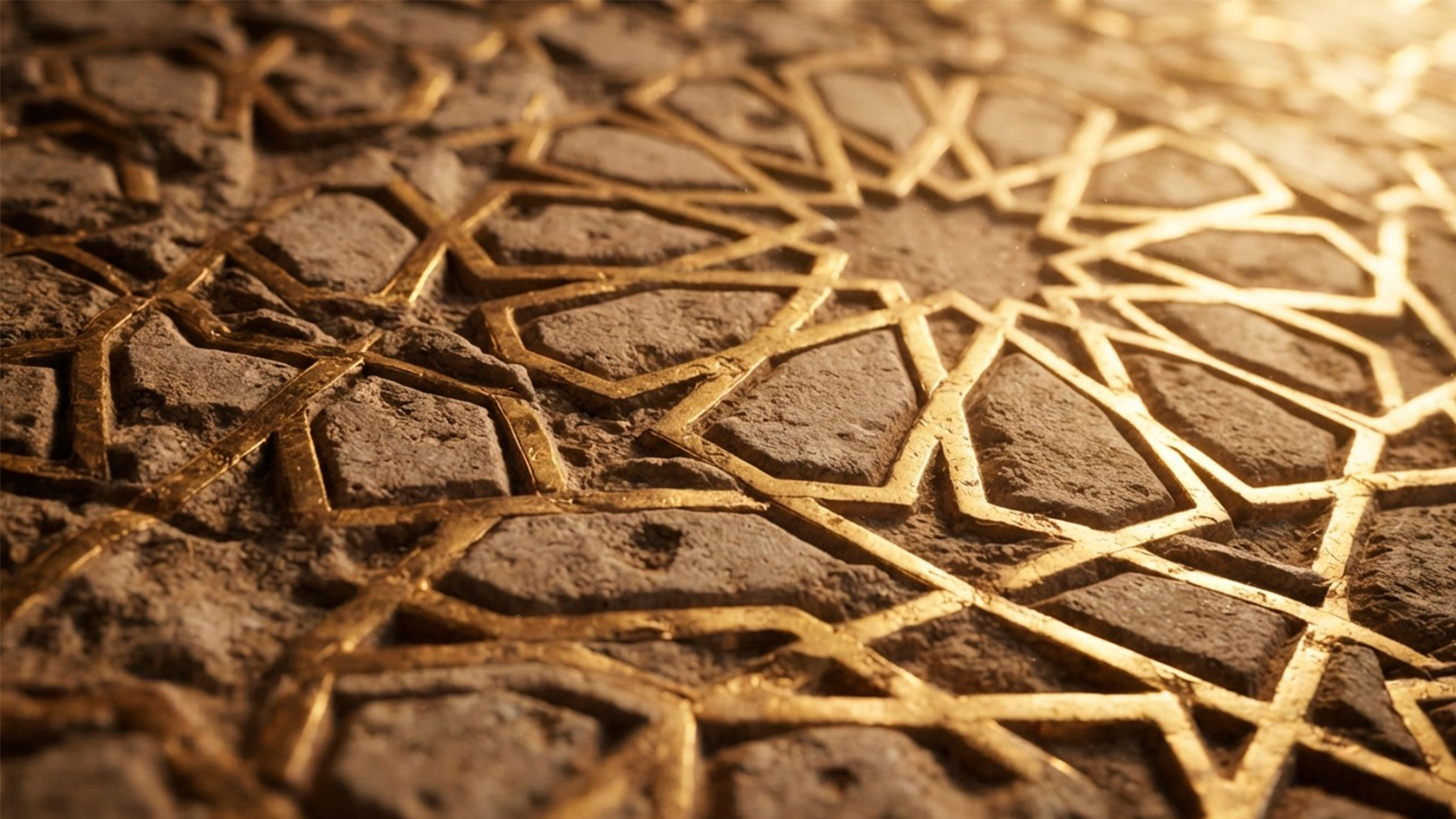
The desert does not tolerate form. The wind erases tracks within an hour; the sun burns outlines out in a day. Every civilization born among the sands faces the same question: how do you leave a mark where nothing holds shape?
Arab civilization answered not with a monument, not with a statue. It answered with geometry.
A Pattern Without an Edge
Take the arabesque. Take the girih. In both systems, there is no compositional center—no focal point toward which the gaze flows and where it rests, as in a European painting. The line enters the frame from nowhere and exits into nowhere. It does not depict infinity—it is structured as infinity: the repeat unit can be extended to the next wall, the next dome, the next century, and the pattern will show no seam.
This is not ornament in the European sense—not surface decoration. It is a model of a world where the only constant is the very principle of repetition. The Indian mandala is also geometric, but it has a center and a deity at that center. The Arab pattern deliberately rejects a center: if infinity had a middle, it would not be infinity.
The Word Instead of a Face
Where other civilizations placed a statue in a niche, Arab civilization placed letters.
The Kufic script covering mosque walls from Córdoba to Samarkand is not a caption beneath the building. It is the building itself—or rather, its semantic façade. The prohibition against depicting living things did not impoverish the visual language; it shifted its focus: if you cannot show the face of God, you can show His word—and make that word so beautiful that it replaces the entire figurative tradition at once.
No other civilization in the GLOBAL VISUAL CODE™ project has dared to make text its primary visual code. Russian civilization speaks through the dome. Chinese—through the dragon. Indian—through the body of the deity in stone. Arab civilization speaks through the letter. This is not an aesthetic difference but an ontological one: what does a civilization deem worthy of eternity—image or word?
Climate as Co-Author
Girih and Kufi are what civilization said about eternity. Mashrabiya and badgir—what it said about climate, and therefore about survival.
The carved wooden lattice on a window does not decorate the façade. It solves an equation: how to let light in without letting heat in; how to let the gaze go out to the street without allowing the street to look in. The windcatcher tower is not an architectural gesture—it is an engineering solution that became so elegant that people began photographing it before studying it. In Arab visual culture, beauty almost never exists separately from function: the pattern on the lattice is literally its resistance to wind and light, calculated and carved.
Here, the desert is not a backdrop but a co-author. The date palm is not just a tree on a postcard; it is simultaneously food, shade, material, and measure of time—a civilization that literally grew from a single plant capable of living where almost nothing else survives.
Color as Theology
Green in Arab civilization is not a "favorite color"—it is the color of paradise promised in the culture’s most important text. Black is not the color of mourning or darkness but of ultimate holiness: the Kaaba’s cover is black precisely because black distracts nothing from the object it conceals. White is not purity in general but a specific, once-in-a-lifetime, collective act—the pilgrimage, in which, for a few days, the difference between rich and poor disappears.
None of these colors was chosen for beauty. Each was chosen for what it means, and only afterward proves to be beautiful. This is a rare case where the civilization’s color code could be reconstructed from religious texts alone, even if not a single building remained.
From Minaret to Orbital Station
It would be strange to end the story of a civilization that built the world’s most compelling visual language of infinity in the past. That is why GLOBAL VISUAL CODE™ extends the Arab code to its logical limit—to the year 2226.
The minaret, which for two thousand years reached toward the sky as a symbol, in this scenario literally becomes the support mast of an orbital station. Girih, a pattern without beginning or end, becomes the structural grid of an underwater hotel—because infinite geometry holds both the light of a mosque and the pressure of the ocean equally well. The astrolabe, an instrument with which the Middle Ages measured the stars, becomes an autonomous seismic station in the desert—an instrument that measures the earth itself instead of the sky.
None of this is invented from scratch. Every step into the future is a literal continuation of what this civilization already knew how to do: turn necessity into geometry, and geometry into something that outlives the one who drew it.
Geometry of Infinity
If you remove the word "Arab" from this civilization—what remains so recognizable that it could not be mistaken for anything else?
There remains a pattern without a center. A letter that became architecture. A lattice calculated for desert light. A color that signifies not a shade but a thought. And a stubborn conviction that if a line cannot be stopped—then it can be extended anywhere, even into the year 2226.
This is the geometry of infinity—not ornament, but a way of thinking that accidentally turned out to be very beautiful.
Arab civilization answered not with a monument, not with a statue. It answered with geometry.
A Pattern Without an Edge
Take the arabesque. Take the girih. In both systems, there is no compositional center—no focal point toward which the gaze flows and where it rests, as in a European painting. The line enters the frame from nowhere and exits into nowhere. It does not depict infinity—it is structured as infinity: the repeat unit can be extended to the next wall, the next dome, the next century, and the pattern will show no seam.
This is not ornament in the European sense—not surface decoration. It is a model of a world where the only constant is the very principle of repetition. The Indian mandala is also geometric, but it has a center and a deity at that center. The Arab pattern deliberately rejects a center: if infinity had a middle, it would not be infinity.
The Word Instead of a Face
Where other civilizations placed a statue in a niche, Arab civilization placed letters.
The Kufic script covering mosque walls from Córdoba to Samarkand is not a caption beneath the building. It is the building itself—or rather, its semantic façade. The prohibition against depicting living things did not impoverish the visual language; it shifted its focus: if you cannot show the face of God, you can show His word—and make that word so beautiful that it replaces the entire figurative tradition at once.
No other civilization in the GLOBAL VISUAL CODE™ project has dared to make text its primary visual code. Russian civilization speaks through the dome. Chinese—through the dragon. Indian—through the body of the deity in stone. Arab civilization speaks through the letter. This is not an aesthetic difference but an ontological one: what does a civilization deem worthy of eternity—image or word?
Climate as Co-Author
Girih and Kufi are what civilization said about eternity. Mashrabiya and badgir—what it said about climate, and therefore about survival.
The carved wooden lattice on a window does not decorate the façade. It solves an equation: how to let light in without letting heat in; how to let the gaze go out to the street without allowing the street to look in. The windcatcher tower is not an architectural gesture—it is an engineering solution that became so elegant that people began photographing it before studying it. In Arab visual culture, beauty almost never exists separately from function: the pattern on the lattice is literally its resistance to wind and light, calculated and carved.
Here, the desert is not a backdrop but a co-author. The date palm is not just a tree on a postcard; it is simultaneously food, shade, material, and measure of time—a civilization that literally grew from a single plant capable of living where almost nothing else survives.
Color as Theology
Green in Arab civilization is not a "favorite color"—it is the color of paradise promised in the culture’s most important text. Black is not the color of mourning or darkness but of ultimate holiness: the Kaaba’s cover is black precisely because black distracts nothing from the object it conceals. White is not purity in general but a specific, once-in-a-lifetime, collective act—the pilgrimage, in which, for a few days, the difference between rich and poor disappears.
None of these colors was chosen for beauty. Each was chosen for what it means, and only afterward proves to be beautiful. This is a rare case where the civilization’s color code could be reconstructed from religious texts alone, even if not a single building remained.
From Minaret to Orbital Station
It would be strange to end the story of a civilization that built the world’s most compelling visual language of infinity in the past. That is why GLOBAL VISUAL CODE™ extends the Arab code to its logical limit—to the year 2226.
The minaret, which for two thousand years reached toward the sky as a symbol, in this scenario literally becomes the support mast of an orbital station. Girih, a pattern without beginning or end, becomes the structural grid of an underwater hotel—because infinite geometry holds both the light of a mosque and the pressure of the ocean equally well. The astrolabe, an instrument with which the Middle Ages measured the stars, becomes an autonomous seismic station in the desert—an instrument that measures the earth itself instead of the sky.
None of this is invented from scratch. Every step into the future is a literal continuation of what this civilization already knew how to do: turn necessity into geometry, and geometry into something that outlives the one who drew it.
Geometry of Infinity
If you remove the word "Arab" from this civilization—what remains so recognizable that it could not be mistaken for anything else?
There remains a pattern without a center. A letter that became architecture. A lattice calculated for desert light. A color that signifies not a shade but a thought. And a stubborn conviction that if a line cannot be stopped—then it can be extended anywhere, even into the year 2226.
This is the geometry of infinity—not ornament, but a way of thinking that accidentally turned out to be very beautiful.