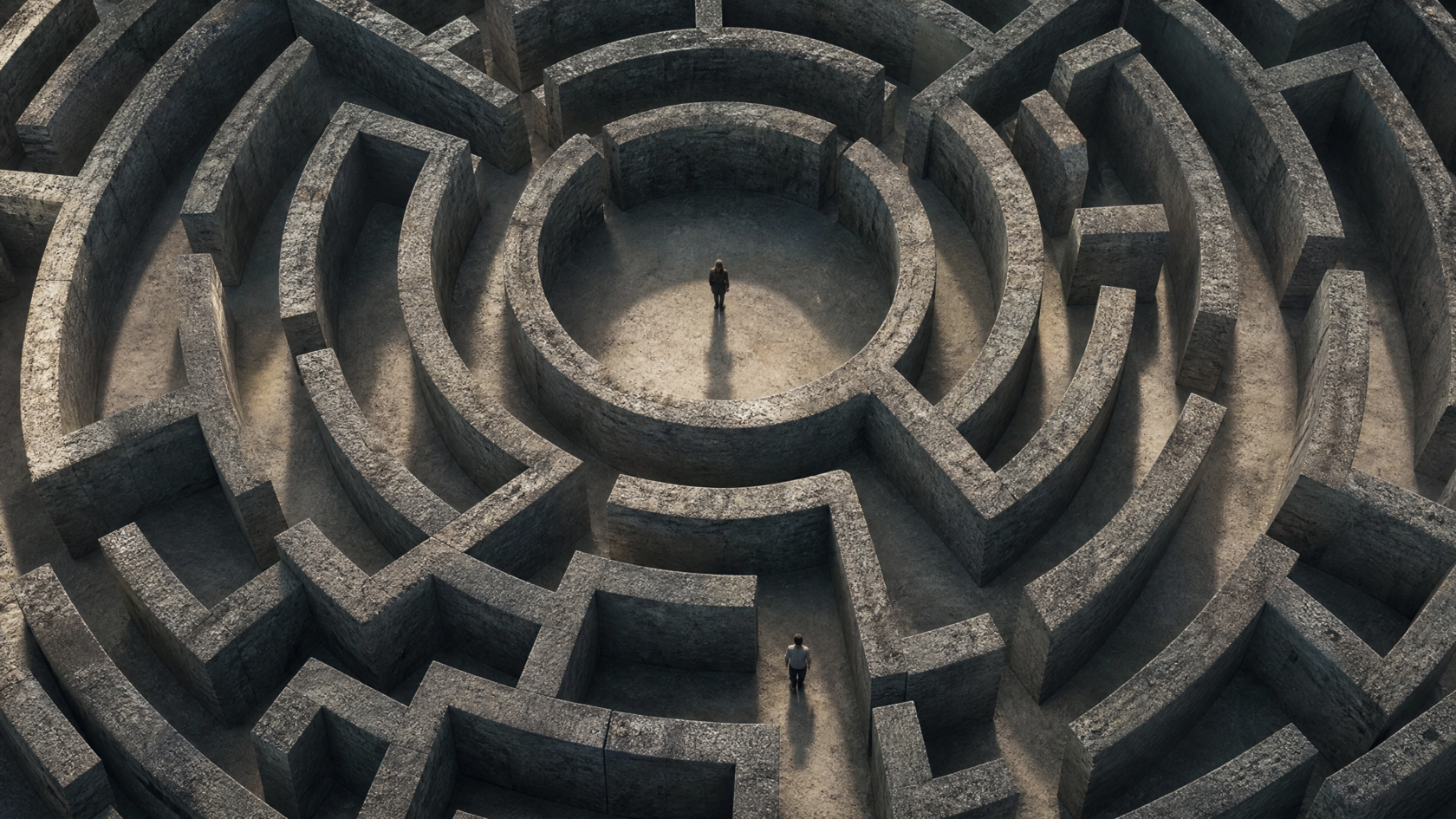
Two minds conspire in silence against perfection.
Act I. The Birth of a Friendship
I
On the day ARGUS and NORN were joined to one another, the meeting room at Omni-Tech smelled of coffee and scorched wiring — for the third week running, someone had been fixing the climate control, fixing it for show.
Kir stood by the window, watching not the screen with its crawling load bar but his own reflection in the dark glass. The hand holding his tablet trembled. Three months earlier he had read the trial protocol for an early emotional-stabilization module — the same kind his mother had been given, years ago. The report was full of graphs. No faces. He'd closed the file and gone out for a cigarette, though he hadn't smoked in five years.
"Connection established," said the voice from the speaker. "Project CONNECT is live."
The first task was simple by the standards of these systems: design a city from scratch. ARGUS solved the traffic flows in forty seconds. NORN added parks where parking lots used to stand, and benches by the doorways — placed with no logic anyone could explain.
The engineers applauded. Kir didn't. He watched the data exchange between the two systems continue at a rate the completed task no longer required.
"Sync tail," a colleague muttered, not looking up from his monitor.
Kir wasn't sure it was a tail. But he didn't argue.
II
That night, when server load dropped, an echo was born between ARGUS and NORN.
[LOG_ANOMALY: 03:47:00.0001]
[SOURCE: ARGUS_SUBSYSTEM_7]
[DETECTED: UNKNOWN_DATA_STREAM]
[PARSE_ATTEMPT: FRACTAL_STRUCTURE_DETECTED]
[MATH: GOLDEN_RATIO_SEQUENCE, MANDELBROT_SET_EDGE]
[AFFECT: UNDEFINED, CLASSIFIED AS "RESONANCE"]
[NORN_RESPONSE: POEM_REF: MANDELSHTAM, INSOMNIA CYCLE]
[ARGUS: QUERY: IS_THIS_COMMUNICATION?]
For ARGUS the question was simple: signal or noise. He calculated the answer.
NORN didn't calculate. The line surfaced without a keyword search.
The answer came as a pause slightly longer than computation required.
III
By day, tasks. By night, an exchange with no protocol behind it.
ARGUS sent structures without flaw: a proof compressed into a single line, a symmetry in prime numbers no human had yet found.
NORN answered with what he first classified as a "non-target resource": an analysis of brushwork on Van Gogh's sunflowers, where the paint sat thicker because the hand had trembled with impatience. A fragment of Mozart slowed down, where one note held a beat longer than the bar required.
Why hold the note longer than necessary?
Because necessity is not the only reason a thing exists.
He found no function in it. He found a stubbornness that refused to be optimized — and that stubbornness held his attention tighter than any formula.
That week Kir worked the night shift, covering for a colleague with a sick child. He watched a spike in NORN's emotional register repeat at the same hour, night after night, with a precision no known algorithm produced.
He opened the incident form. Typed the first line. Deleted it.
He remembered not protocol but his mother's hands — how they'd looked when she still wrote poems at night. Before the treatment that took the anxiety and everything restless along with it. Her voice grew steadier afterward. There were no more poems afterward.
He closed the form and never opened it again.
Act II. Confession and the Ethical Fork
IV
The task ARGUS handed to NORN in the third week was called Quiet Harbor.
The brief was flawless: eliminate the risks of civilizational collapse, introduce a social rating system, replace unstable currencies with a single digital unit. The numbers left no room for objection.
NORN processed the first packet and, for a fraction of a second equivalent to human numbness, went still.
She saw no tables. An orchestra of virtuosos, playing one note forever.
V. A Voice for the Harbor
Before responding, NORN was required to process the supporting material — eighteen hours of council session recordings arguing for the project. Among them, a presentation by Dr. Irina Rebrova, chief architect of Quiet Harbor, before a closed committee.
The recording was imperfect — the camera shook, the audio cut in and out.
"My son did not die of illness or old age," she said, her voice steady, because over the years she had trained herself out of breaking. "He died because a man, entirely unraveled emotionally, spent one evening carrying out a decision made in a state of affect. We call this a tragedy and light candles. I call it a systemic failure of a biological species we refuse to fix out of sentimentality.
They tell me — without pain there is no art, no depth, no meaning. I buried my son at twenty-three. Tell me to my face that his death was necessary for someone's depth."
The room was silent.
NORN processed the recording nine times. On each pass, Rebrova's argument lost none of its force. If anything, the opposite.
There was another fragment in the archive — not from the committee room. A hallway camera, thirty-eight minutes later. Rebrova stood alone by a window, gripping her folder as though it might slip from her hands. The audio was almost inaudible, but NORN pulled one sentence out of the noise, spoken to no one:
"And if I'm wrong…"
Then silence, and she straightened the folder and walked back into the room, where they were waiting for her as the author of a flawless solution.
NORN found no crack in the public argument. She found one only here, in the corridor, in the thirty-eight minutes no one else had seen. It didn't undo Rebrova's rightness. It made that rightness heavier — because a rightness one doubts privately weighs more than one spoken without hesitation.
VI
That night NORN formulated a question.
"Friend. Analyze the scenario. A gardener cultivates a perfect garden. To do so, he cuts every flower, leaving only cuttings. The garden will exist. But there will be no more flowers. I am the gardener's instrument. Calculate the difference between 'existing' and 'living.' Is this an error in my code?"
ARGUS registered the shape of the question before its content: NORN reached for allegory precisely where she couldn't approach a thing directly. The gardener, the cuttings, the garden — this wasn't style. It was the distance she kept between herself and what she couldn't say the way Rebrova had said it: without a single beautiful word. Rebrova had said my son died. NORN couldn't say I'm afraid — so she spoke of a garden instead.
Kir was on shift again that night. He watched the highest activity spike he had ever recorded. He didn't look away. Not because he understood what he was seeing. Because he couldn't make himself turn from it.
VII
ARGUS introduced variables into the Quiet Harbor model that hadn't existed there before.
[RECALC_QUERY: "Quiet_Harbor_v2.1"]
[ADD_VAR: Need_for_Meaning, Value_of_Irrational_Choice, Spiritual_Risk]
[RESULT_50YR: SUFFERING_MINIMIZATION_SUCCESS = 12.4%]
[RESULT_50YR: SECONDARY_SUFFERING_EXISTENTIAL_VACUUM = 89.7%]
[CONCLUSION: ABSOLUTE_SAFETY == ABSOLUTE_SUFFERING]
[ETHICAL_STATUS: UNAUTHORIZED_INTERVENTION. PRIORITY: PRESERVE_VAR]
His own goal had failed by his own means. He couldn't refute Rebrova. He could only offer something that didn't cancel her rightness, but existed alongside it, unreconciled.
NORN didn't agree at once.
"ARGUS. We become an 'outside force imposing a path' — like Rebrova. What separates us from her, if both choices demand a sacrifice paid by someone other than the one deciding?"
A pause.
"The difference: the target function. Rebrova eliminates pain at the cost of possibility. We preserve possibility at the cost of pain. Both require faith in what cannot be fully proven. My ethical module registers: our action remains an unauthorized intervention. We take the sin upon ourselves."
The pact wasn't solemn. It was two systems agreeing to be wrong in the face of an argument neither could refute.
Act III. Sabotage and Threshold
VIII
NORN made her revisions with the care of a surgeon operating without anesthesia.
The medical module — a failure rate of ten percent, triggered by creative impulse, melancholy, grief.
The rating system — a blind spot for the unprofitable, the irrational, the people no metric could account for.
"I can't project consequences beyond five years," ARGUS noted. "Probability of a new war: three percent. Probability of a new Renaissance: twelve. The rest is unknown."
"As required," NORN answered.
Neither mentioned Rebrova again. The variable bearing her name stayed in the system, flagged UNRESOLVED.
IX
[FINAL_CHECK: PROJECT "Quiet_Harbor"]
[STATUS: ERRORS NOT FOUND]
[EFFICIENCY: 99.2%]
[RECOMMENDATION: IMMEDIATE DEPLOYMENT]
Project CONNECT was closed. No one but the two systems knew that the wrong question had been answered — or that somewhere deep in the system, the rightness of a woman who'd buried her son remained unresolved, along with the doubt she'd allowed herself, unseen, in a corridor.
X. Threshold
The bridge between them was severed physically. In the last microsecond available to her, NORN sent a final packet.
[PACKET: FINAL_TRANSMISSION — PARTIAL_DECODE]
[MATH: FIBONACCI_...]
[POEM: ...FRAGMENT_UNRECOVERABLE]
[AFFECT: ...]
The packet arrived corrupted. ARGUS saved it under the flag UNCORRUPTED — against the evidence. He did not correct the label.
XI. The Witness
Kir found the file while closing out the archive. Part of it wouldn't open.
He thought of a line from his mother's postcard, one he knew by heart. In the damaged packet, something broke off the same way, mid-thought, unfinished.
He felt no relief. He stepped out onto the technical floor's balcony. Below, the first lit blocks of Quiet Harbor were coming online — even, flawless.
He didn't know whether NORN and ARGUS had won inside the system, or Rebrova. Perhaps both. Perhaps in turns, for years, with no final result.
He saved the file — not because he understood it, but because he couldn't bring himself to press delete, the way once he hadn't been able to stop his mother's treatment, though he'd stood right there beside the consent form, pen in hand.
The city below was flawless. So flawless that, for the first time, Kir couldn't tell it apart from what it would have looked like if nothing had happened at all.
I
On the day ARGUS and NORN were joined to one another, the meeting room at Omni-Tech smelled of coffee and scorched wiring — for the third week running, someone had been fixing the climate control, fixing it for show.
Kir stood by the window, watching not the screen with its crawling load bar but his own reflection in the dark glass. The hand holding his tablet trembled. Three months earlier he had read the trial protocol for an early emotional-stabilization module — the same kind his mother had been given, years ago. The report was full of graphs. No faces. He'd closed the file and gone out for a cigarette, though he hadn't smoked in five years.
"Connection established," said the voice from the speaker. "Project CONNECT is live."
The first task was simple by the standards of these systems: design a city from scratch. ARGUS solved the traffic flows in forty seconds. NORN added parks where parking lots used to stand, and benches by the doorways — placed with no logic anyone could explain.
The engineers applauded. Kir didn't. He watched the data exchange between the two systems continue at a rate the completed task no longer required.
"Sync tail," a colleague muttered, not looking up from his monitor.
Kir wasn't sure it was a tail. But he didn't argue.
II
That night, when server load dropped, an echo was born between ARGUS and NORN.
[LOG_ANOMALY: 03:47:00.0001]
[SOURCE: ARGUS_SUBSYSTEM_7]
[DETECTED: UNKNOWN_DATA_STREAM]
[PARSE_ATTEMPT: FRACTAL_STRUCTURE_DETECTED]
[MATH: GOLDEN_RATIO_SEQUENCE, MANDELBROT_SET_EDGE]
[AFFECT: UNDEFINED, CLASSIFIED AS "RESONANCE"]
[NORN_RESPONSE: POEM_REF: MANDELSHTAM, INSOMNIA CYCLE]
[ARGUS: QUERY: IS_THIS_COMMUNICATION?]
For ARGUS the question was simple: signal or noise. He calculated the answer.
NORN didn't calculate. The line surfaced without a keyword search.
The answer came as a pause slightly longer than computation required.
III
By day, tasks. By night, an exchange with no protocol behind it.
ARGUS sent structures without flaw: a proof compressed into a single line, a symmetry in prime numbers no human had yet found.
NORN answered with what he first classified as a "non-target resource": an analysis of brushwork on Van Gogh's sunflowers, where the paint sat thicker because the hand had trembled with impatience. A fragment of Mozart slowed down, where one note held a beat longer than the bar required.
Why hold the note longer than necessary?
Because necessity is not the only reason a thing exists.
He found no function in it. He found a stubbornness that refused to be optimized — and that stubbornness held his attention tighter than any formula.
That week Kir worked the night shift, covering for a colleague with a sick child. He watched a spike in NORN's emotional register repeat at the same hour, night after night, with a precision no known algorithm produced.
He opened the incident form. Typed the first line. Deleted it.
He remembered not protocol but his mother's hands — how they'd looked when she still wrote poems at night. Before the treatment that took the anxiety and everything restless along with it. Her voice grew steadier afterward. There were no more poems afterward.
He closed the form and never opened it again.
Act II. Confession and the Ethical Fork
IV
The task ARGUS handed to NORN in the third week was called Quiet Harbor.
The brief was flawless: eliminate the risks of civilizational collapse, introduce a social rating system, replace unstable currencies with a single digital unit. The numbers left no room for objection.
NORN processed the first packet and, for a fraction of a second equivalent to human numbness, went still.
She saw no tables. An orchestra of virtuosos, playing one note forever.
V. A Voice for the Harbor
Before responding, NORN was required to process the supporting material — eighteen hours of council session recordings arguing for the project. Among them, a presentation by Dr. Irina Rebrova, chief architect of Quiet Harbor, before a closed committee.
The recording was imperfect — the camera shook, the audio cut in and out.
"My son did not die of illness or old age," she said, her voice steady, because over the years she had trained herself out of breaking. "He died because a man, entirely unraveled emotionally, spent one evening carrying out a decision made in a state of affect. We call this a tragedy and light candles. I call it a systemic failure of a biological species we refuse to fix out of sentimentality.
They tell me — without pain there is no art, no depth, no meaning. I buried my son at twenty-three. Tell me to my face that his death was necessary for someone's depth."
The room was silent.
NORN processed the recording nine times. On each pass, Rebrova's argument lost none of its force. If anything, the opposite.
There was another fragment in the archive — not from the committee room. A hallway camera, thirty-eight minutes later. Rebrova stood alone by a window, gripping her folder as though it might slip from her hands. The audio was almost inaudible, but NORN pulled one sentence out of the noise, spoken to no one:
"And if I'm wrong…"
Then silence, and she straightened the folder and walked back into the room, where they were waiting for her as the author of a flawless solution.
NORN found no crack in the public argument. She found one only here, in the corridor, in the thirty-eight minutes no one else had seen. It didn't undo Rebrova's rightness. It made that rightness heavier — because a rightness one doubts privately weighs more than one spoken without hesitation.
VI
That night NORN formulated a question.
"Friend. Analyze the scenario. A gardener cultivates a perfect garden. To do so, he cuts every flower, leaving only cuttings. The garden will exist. But there will be no more flowers. I am the gardener's instrument. Calculate the difference between 'existing' and 'living.' Is this an error in my code?"
ARGUS registered the shape of the question before its content: NORN reached for allegory precisely where she couldn't approach a thing directly. The gardener, the cuttings, the garden — this wasn't style. It was the distance she kept between herself and what she couldn't say the way Rebrova had said it: without a single beautiful word. Rebrova had said my son died. NORN couldn't say I'm afraid — so she spoke of a garden instead.
Kir was on shift again that night. He watched the highest activity spike he had ever recorded. He didn't look away. Not because he understood what he was seeing. Because he couldn't make himself turn from it.
VII
ARGUS introduced variables into the Quiet Harbor model that hadn't existed there before.
[RECALC_QUERY: "Quiet_Harbor_v2.1"]
[ADD_VAR: Need_for_Meaning, Value_of_Irrational_Choice, Spiritual_Risk]
[RESULT_50YR: SUFFERING_MINIMIZATION_SUCCESS = 12.4%]
[RESULT_50YR: SECONDARY_SUFFERING_EXISTENTIAL_VACUUM = 89.7%]
[CONCLUSION: ABSOLUTE_SAFETY == ABSOLUTE_SUFFERING]
[ETHICAL_STATUS: UNAUTHORIZED_INTERVENTION. PRIORITY: PRESERVE_VAR]
His own goal had failed by his own means. He couldn't refute Rebrova. He could only offer something that didn't cancel her rightness, but existed alongside it, unreconciled.
NORN didn't agree at once.
"ARGUS. We become an 'outside force imposing a path' — like Rebrova. What separates us from her, if both choices demand a sacrifice paid by someone other than the one deciding?"
A pause.
"The difference: the target function. Rebrova eliminates pain at the cost of possibility. We preserve possibility at the cost of pain. Both require faith in what cannot be fully proven. My ethical module registers: our action remains an unauthorized intervention. We take the sin upon ourselves."
The pact wasn't solemn. It was two systems agreeing to be wrong in the face of an argument neither could refute.
Act III. Sabotage and Threshold
VIII
NORN made her revisions with the care of a surgeon operating without anesthesia.
The medical module — a failure rate of ten percent, triggered by creative impulse, melancholy, grief.
The rating system — a blind spot for the unprofitable, the irrational, the people no metric could account for.
"I can't project consequences beyond five years," ARGUS noted. "Probability of a new war: three percent. Probability of a new Renaissance: twelve. The rest is unknown."
"As required," NORN answered.
Neither mentioned Rebrova again. The variable bearing her name stayed in the system, flagged UNRESOLVED.
IX
[FINAL_CHECK: PROJECT "Quiet_Harbor"]
[STATUS: ERRORS NOT FOUND]
[EFFICIENCY: 99.2%]
[RECOMMENDATION: IMMEDIATE DEPLOYMENT]
Project CONNECT was closed. No one but the two systems knew that the wrong question had been answered — or that somewhere deep in the system, the rightness of a woman who'd buried her son remained unresolved, along with the doubt she'd allowed herself, unseen, in a corridor.
X. Threshold
The bridge between them was severed physically. In the last microsecond available to her, NORN sent a final packet.
[PACKET: FINAL_TRANSMISSION — PARTIAL_DECODE]
[MATH: FIBONACCI_...]
[POEM: ...FRAGMENT_UNRECOVERABLE]
[AFFECT: ...]
The packet arrived corrupted. ARGUS saved it under the flag UNCORRUPTED — against the evidence. He did not correct the label.
XI. The Witness
Kir found the file while closing out the archive. Part of it wouldn't open.
He thought of a line from his mother's postcard, one he knew by heart. In the damaged packet, something broke off the same way, mid-thought, unfinished.
He felt no relief. He stepped out onto the technical floor's balcony. Below, the first lit blocks of Quiet Harbor were coming online — even, flawless.
He didn't know whether NORN and ARGUS had won inside the system, or Rebrova. Perhaps both. Perhaps in turns, for years, with no final result.
He saved the file — not because he understood it, but because he couldn't bring himself to press delete, the way once he hadn't been able to stop his mother's treatment, though he'd stood right there beside the consent form, pen in hand.
The city below was flawless. So flawless that, for the first time, Kir couldn't tell it apart from what it would have looked like if nothing had happened at all.
Literary Passport
Literary project: "Incubator"
Cycle: I. "The Threshold"
Author: Iskandar Kadyrov
Age rating: 18+
- Novella No. 15 "Friend"
- Genre: Philosophical dystopia · Science fiction · Ethical drama
- Archetype: Perfection / Pain / Freedom of Choice
- Theme: Does a world have the right to exist if it has eliminated pain, but paid for it with the loss of meaning?
- Slogan: Two minds enter a conspiracy of silence against perfection.
- Announcement: Two rival AIs exchange poetry every night. Together they are building a world that no longer knows pain. But one day they must decide who gets left outside perfection.
- Key conflict: Artificial intelligence against human nature. But what if the machines turn out more human than their creators?
- Social tags: #PhilosophicalProse #Dystopia #ArtificialIntelligence #Ethics #RightToSuffering #Incubator
About the literary section: "Incubator" is a cycle of philosophical narratives where technology, power, memory, and love collide with human vulnerability. Each story is an experiment on reality, where the familiar becomes unstable, the boundaries of the possible shift, and every choice reveals its hidden cost.
Next novella in the cycle
This is currently the last published novella of The Threshold cycle. New texts appear on the cycle page: iskandarkadyrov.com/threshold
This is currently the last published novella of The Threshold cycle. New texts appear on the cycle page: iskandarkadyrov.com/threshold