No one dies the moment they stop breathing. They die the moment they stop being themselves.
I. Vacuum
He wasn’t falling.
This is important—he wasn’t falling, or flying, or tumbling into darkness, the way books always describe it. One moment he simply was, and the next, he had ceased to be in the place he was accustomed to finding himself. No transition. No threshold. Only a silence that didn’t press down, didn’t frighten, but simply was—like the air in an empty room after everyone has left and someone forgot to close the window.
First, he tried to locate his body.
Nothing.
Not pain, not numbness—just the absence of a body as a fact. As if someone had surgically removed that single argument, and now he had nothing left with which to prove his existence.
Then he thought about light.
There was light. But not in the usual sense—no source, no direction, no shadows cast by it. More like a uniform presence, as if space itself was phosphorescing faintly from within. He tried to focus his gaze. There was no gaze. There was, instead, an understanding. Smooth, calm, like reading a deeply familiar text.
— Where am I?
The question formed on its own. Not spoken—more like it coalesced. Like a thought you don't consciously think, but which appears, unmistakably, within you.
The answer came the same way—not as an external voice, but from somewhere in that part of yourself you never notice while you're alive. It’s always there, that part. It’s just that during life, it’s drowned out: by the alarm clock, traffic jams, bills, irritation, fatigue. Here, none of that existed.
— In earthly terms—a coma. By all other terms—a vacuum.
— A vacuum?
— In between. Neither here nor there. It’s not frightening. It’s simply a point where nothing happens externally. Everything that will happen, happens inside.
He tried to summon anger. Nothing came. Anger requires a body—jaw muscles tensing, air escaping through the nostrils at an unkind velocity. All of that was absent. What remained was only attention. Pure, like the first snowfall.
— Why am I here?
— To decide.
— Decide what?
— Whether you conclude your earthly incarnation, or return.
He paused. Silence here was different—not awkward, not heavy, not something that needed to be urgently filled. Just... the space between words.
— I don't understand anything.
— Understanding will return. Your memory will start coming back soon. Not the one you call memory—dates, faces, grievances. Another one. Deeper.
— How much time do I have?
— Time doesn’t exist here. There—it ranges from three days to several years. You decide that.
— Me? How?
Silence.
Not a pause—true silence. The kind that promises no answer, but also doesn't confiscate the question.
He was alone—if the word "alone" can even apply to something with no body, no location, no coordinates. He was, though. That much hadn't been taken from him. But nothing more. Not yet.
Somewhere very far away—or very close, distances also didn't exist here—someone was crying. He didn't hear it. He knew it. Through a thin, almost imperceptible thread, he knew that someone was holding his hand and weeping. The hand was there. He was here.
II. The Trial of the Soul
He tried to remember what came before.
And couldn't.
Because "before" had no edge.
And that's when he understood: it had all started with an error in perceiving the very fact that anything starts at all.
Because at first, there was nothing you could call a "beginning."
There was a state in which memory hadn't yet decided whether it was itself or not.
And then he saw.
But "saw" is the wrong word.
He had expected one reality. Instead, it diverged. Not like a curtain parting—like a fabric whose layers suddenly became visible.
He was standing in a room. The room was his. And not his. Because he was simultaneously inside it—and already remembering walking out of it. And also—how he had never entered it in the first place. The three versions didn't argue. They simply coexisted.
— You cannot lie, — the voice said.
He wanted to object. But the objection wouldn't assemble. Not from a lack of words, but because words no longer belonged to a sequence.
Instead of a film—and he had expected a film, scene by scene: childhood, school, the first kiss, getting fired—a space arrived.
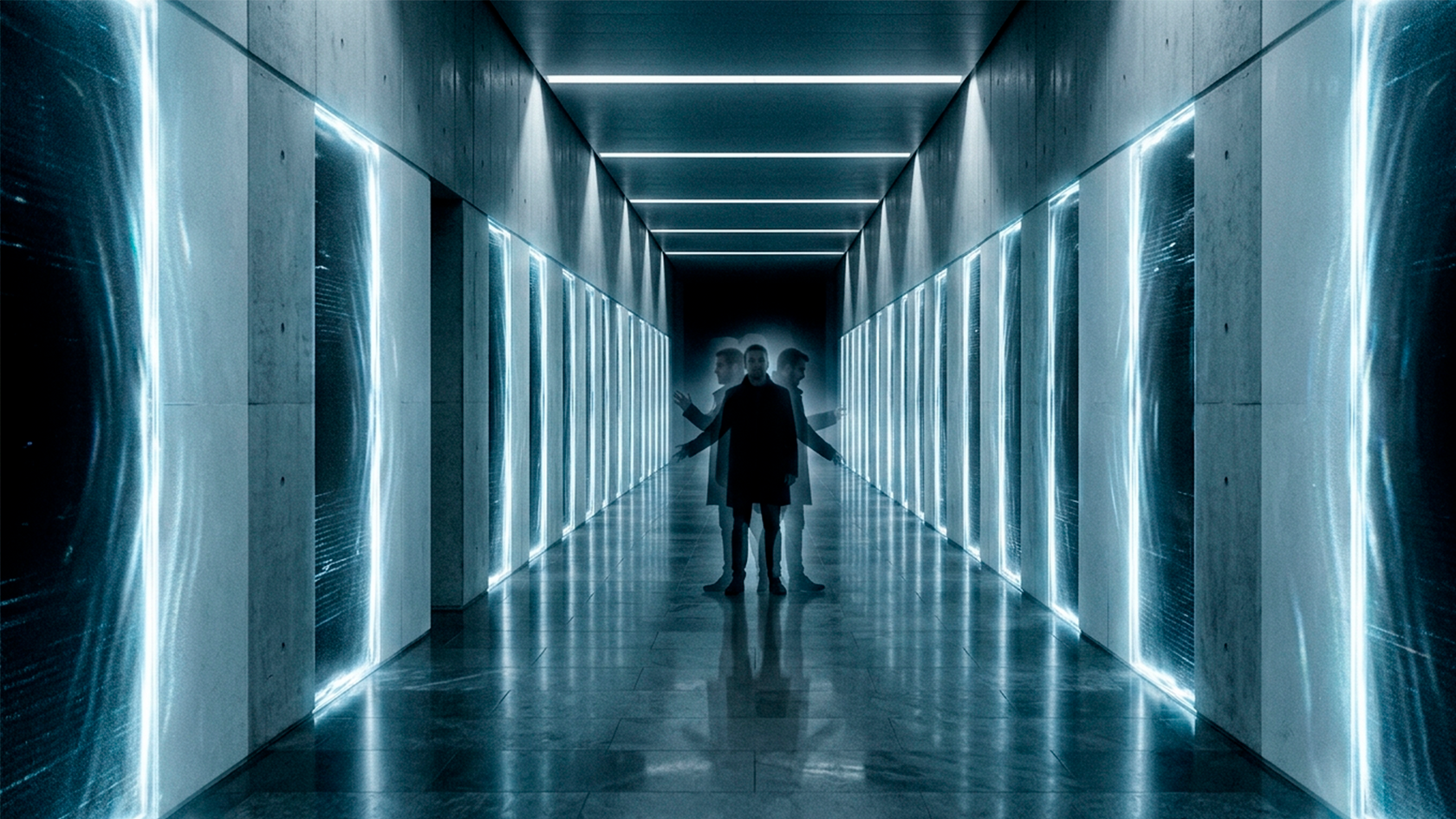
A corridor.
Endless. With doors on either side. Not wood, not plastic—more like clots of silence shaped like doorways. He understood: each door was a version of himself that had never been chosen. Not sins. Not mistakes. Just versions.
He walked.
Behind the first door—a boy with bread and butter, staring out a window at the snow. Happy, because he doesn't yet know that happiness can be lost. He, the adult, stood beside him and felt something that wasn't nostalgia. It was a blow of tenderness for someone who no longer existed.
Behind the second—not school, not grudges. A system of acquiescence. A collective form of softly refusing exceptionalism. It had no face. But it worked. "Don't stick your neck out" wasn't a phrase—it was the way space itself corrected the shape of behavior. And for the first time, he saw it: his life hadn't been destroyed. It had been edited. Very carefully. Until nothing remained of the original that could be classified as an error.
He wanted to get angry. But the anger wouldn't form—because he suddenly saw that he himself had been part of this system. In every moment where life offered him not a fork in the road, but intensity, he had chosen to minimize the intensity. Not out of fear. But because it’s easier to maintain the continuity of "oneself" that way.
And then he opened a door and stopped.
Nothing had happened in there. That was precisely what made it terrifying.
A son, maybe fourteen, stood in the hallway, holding a crumpled piece of paper in his hand—a drawing, a report card, it didn't matter—and looking at him. He, the adult, walked past. Not roughly. Not cruelly. Just said, "Later," and closed the bedroom door behind him.
The son didn't call out. He never called out again. Not because he was offended—because he accepted that "later" never arrives.
He stood in front of that door—or rather, its absence, because the door had slammed shut long ago—and understood: this hadn't been a mistake. It had been a decision. Silent. Final. A single point after which he ceased to be the kind of person people bring drawings to.
Further on, the doors opened themselves. Or didn't open—he simply found himself inside.
His wife. Not as a person—as a gaze. One that had chosen him once, and then began a slow retreat, so as not to be annihilated by his absence. He didn't see her transformation. He saw his own invisibility at the center of it.
His daughter. The drawing she held out to him when she was seven. He had rushed past, phone pressed to his ear. Now the drawing existed simultaneously as: given, lost, and still waiting for a recipient. And the three states didn't argue with each other.
His son. Always by the wall. Slightly to the side. Grown into a man who had learned to take up less space than he was entitled to. The wall wasn't a backdrop—it was a witness. And that shifted the balance of responsibility in the room.
— Is this the trial? — he asked.
The voice was silent just long enough for him to realize the question was meaningless.
And then a shift occurred.
He stopped knowing where he was.
He felt the heaviness of a body—and simultaneously its absence as a final argument. Somewhere, there were machines. Somewhere, a white surface. Somewhere, voices trying to reconcile his condition with medical terminology. But none of these "somewheres" claimed primacy.
And in that moment: everything he had considered "the trial" continued.
But in a different density.
The border between "there" and "here" ceased to exist. Because the "trial" didn't end to make way for a "return." It simply became less explicable.
He saw the strangest thing: everything he had called his life was not a line. It was a set of coincidences that accidentally looked like one. And at some point, he understood: his life hadn't been a series of decisions. It had been a series of avoidances—of any tension that might have changed him.
Nothing concluded. The degree of explicability simply changed.
— Have you made your decision? — the voice asked.
He couldn't determine where the present "now" was located.
— I... — he began.
And fell silent.
III. The Threshold
Then everything vanished.
Not gradually—instantly. Like a light switching off. Vacuum again, silence again—but different. Not empty. Charged, like the air before a thunderstorm: as if everything he had just seen hadn't gone anywhere, but had simply settled inside him and now exerted a quiet, wordless pressure.
He didn't move. Couldn't—and didn't want to.
He thought about the thirty pages in a folder he had long deleted. About his daughter's drawing—where was it now, was anyone keeping it? About his son, to whom he had never said—simply, without a reason—that he was proud of him. Not for his grades. For the person he had become. On his own.
He thought about his wife—that look of hers that had grown cautious. And about how, maybe, it wasn't too late to give her reasons to look at him differently.
— Have you made your decision?
The voice—the same one—surfaced again. Without warning.
— How long have I been here?
— The third day.
The third day. Someone out there was holding his hand. Someone was crying—he knew it through that thread, which he could neither sever nor pull toward himself.
— I... probably... don't know.
Silence. Not pressing. Waiting.
— No, — he said. — I know.
Something shifted. Not all at once, not with a roar—the way something long-stuck shifts when, finally, you apply not brute force, but precise effort in the right direction.
— I need to go back. Not because I'm afraid. Not because people are waiting. Because I can't live here, in this darkness, with the weight of everything I didn't do. There, it's still possible. Not to fix things—that word doesn't exist in what I saw. But to do. Finally.
To tell my son. Not tomorrow. Now. The moment I can open my mouth.
— The decision is made. It is yours alone.
— Wait, — he said. — Why now? Why a coma—why not just... a reminder?
— You were reminded. Many times.
He was silent.
Because he knew it was true.
— Going forward, — the voice said, — you will either endure this, or you will return to simplicity.
He wanted to ask—what exactly is "this"? But the question died on the way out. Because the answer was inside everything he had just seen.
IV. The Return
And then, nothing happened.
But this "nothing" lasted longer than everything that had come before.
And suddenly—not a sound, but the pressure of a sound. As if someone was squeezing his head from the inside. Then released it. Then again.
Only on the third pulse did he understand: it wasn't pain. It was a monitor.
First came the sound. High, monotone, then another—urgent, pulsing in short waves. Then voices, layered over each other—words indistinguishable, only the tonality clear: concern, a command, concern again.
Then—weight. It returned first: the heaviness of his own body, his arms, his eyelids, which he needed to lift and which, for some reason, weighed more than they ever had.
He lifted them.
Light struck him—white, clinical, without nuance. He squeezed his eyes shut. Tried again. Above him, a ceiling with square panels, one slightly misaligned. He managed a fleeting thought: I should tell someone to fix that—and was surprised by it, such an ordinary, living thought.
Then he saw them.
His wife stood closest—she wasn't crying, she was beyond crying, she was just looking at him with a gaze he now had knowledge of: it was that gaze. The early one. Open. As if she, too, had made a decision while she waited.
His daughter—an adult, he kept forgetting she was an adult—pressed a hand to her mouth, laughing or crying without sound, he couldn't tell. Probably both.
His son stood by the wall—slightly to the side, the way he always stood. He was looking at his father—and in that look was something for which there is no name. Not reproach. Not forgiveness. Just expectation. Patient, as if he had always known his father would, one day, look at him properly.
He opened his mouth.
His throat refused—three days without water, without words. Something came out—not a word, just a sound. But they understood everything. His wife took his hand—that same hand he had felt through a thread from the vacuum—and squeezed it. Not hard. Just... held it.
He lay there, staring at the ceiling—at that misaligned panel—and thought about how the doctors would come in soon, the questions, the tests, the explanations would begin. Then rehabilitation. Then home. His wife with that look. His son by the wall. His daughter, laughing and crying at the same time.
And he would have to do something about all of it.
Not fix it—that word had been removed from his vocabulary now. Just... do. Finally.
He shifted his gaze to his hand. On the back, where the IV cannula had been embedded, there was a small circular mark—bluish, slightly swollen, like a map of an unknown island. He stared at that mark and, for some reason, couldn't look away. An island. A map. You could still sail there.
Somewhere inside him, that place still existed—the vacuum, the silence, the corridor of doors. It hadn't disappeared. He felt it the way one feels a scar: not painful, but you always know it's there.
Later—much later, when everything settles down and becomes almost normal—he will take a blank sheet of paper out of his desk drawer. He will simply lay it in front of him. He will stare at it for a long time.
And then—perhaps—the real story will begin.
The coma ended.
The emptiness—did not.
He wasn’t falling.
This is important—he wasn’t falling, or flying, or tumbling into darkness, the way books always describe it. One moment he simply was, and the next, he had ceased to be in the place he was accustomed to finding himself. No transition. No threshold. Only a silence that didn’t press down, didn’t frighten, but simply was—like the air in an empty room after everyone has left and someone forgot to close the window.
First, he tried to locate his body.
Nothing.
Not pain, not numbness—just the absence of a body as a fact. As if someone had surgically removed that single argument, and now he had nothing left with which to prove his existence.
Then he thought about light.
There was light. But not in the usual sense—no source, no direction, no shadows cast by it. More like a uniform presence, as if space itself was phosphorescing faintly from within. He tried to focus his gaze. There was no gaze. There was, instead, an understanding. Smooth, calm, like reading a deeply familiar text.
— Where am I?
The question formed on its own. Not spoken—more like it coalesced. Like a thought you don't consciously think, but which appears, unmistakably, within you.
The answer came the same way—not as an external voice, but from somewhere in that part of yourself you never notice while you're alive. It’s always there, that part. It’s just that during life, it’s drowned out: by the alarm clock, traffic jams, bills, irritation, fatigue. Here, none of that existed.
— In earthly terms—a coma. By all other terms—a vacuum.
— A vacuum?
— In between. Neither here nor there. It’s not frightening. It’s simply a point where nothing happens externally. Everything that will happen, happens inside.
He tried to summon anger. Nothing came. Anger requires a body—jaw muscles tensing, air escaping through the nostrils at an unkind velocity. All of that was absent. What remained was only attention. Pure, like the first snowfall.
— Why am I here?
— To decide.
— Decide what?
— Whether you conclude your earthly incarnation, or return.
He paused. Silence here was different—not awkward, not heavy, not something that needed to be urgently filled. Just... the space between words.
— I don't understand anything.
— Understanding will return. Your memory will start coming back soon. Not the one you call memory—dates, faces, grievances. Another one. Deeper.
— How much time do I have?
— Time doesn’t exist here. There—it ranges from three days to several years. You decide that.
— Me? How?
Silence.
Not a pause—true silence. The kind that promises no answer, but also doesn't confiscate the question.
He was alone—if the word "alone" can even apply to something with no body, no location, no coordinates. He was, though. That much hadn't been taken from him. But nothing more. Not yet.
Somewhere very far away—or very close, distances also didn't exist here—someone was crying. He didn't hear it. He knew it. Through a thin, almost imperceptible thread, he knew that someone was holding his hand and weeping. The hand was there. He was here.
II. The Trial of the Soul
He tried to remember what came before.
And couldn't.
Because "before" had no edge.
And that's when he understood: it had all started with an error in perceiving the very fact that anything starts at all.
Because at first, there was nothing you could call a "beginning."
There was a state in which memory hadn't yet decided whether it was itself or not.
And then he saw.
But "saw" is the wrong word.
He had expected one reality. Instead, it diverged. Not like a curtain parting—like a fabric whose layers suddenly became visible.
He was standing in a room. The room was his. And not his. Because he was simultaneously inside it—and already remembering walking out of it. And also—how he had never entered it in the first place. The three versions didn't argue. They simply coexisted.
— You cannot lie, — the voice said.
He wanted to object. But the objection wouldn't assemble. Not from a lack of words, but because words no longer belonged to a sequence.
Instead of a film—and he had expected a film, scene by scene: childhood, school, the first kiss, getting fired—a space arrived.
A corridor.
Endless. With doors on either side. Not wood, not plastic—more like clots of silence shaped like doorways. He understood: each door was a version of himself that had never been chosen. Not sins. Not mistakes. Just versions.
He walked.
Behind the first door—a boy with bread and butter, staring out a window at the snow. Happy, because he doesn't yet know that happiness can be lost. He, the adult, stood beside him and felt something that wasn't nostalgia. It was a blow of tenderness for someone who no longer existed.
Behind the second—not school, not grudges. A system of acquiescence. A collective form of softly refusing exceptionalism. It had no face. But it worked. "Don't stick your neck out" wasn't a phrase—it was the way space itself corrected the shape of behavior. And for the first time, he saw it: his life hadn't been destroyed. It had been edited. Very carefully. Until nothing remained of the original that could be classified as an error.
He wanted to get angry. But the anger wouldn't form—because he suddenly saw that he himself had been part of this system. In every moment where life offered him not a fork in the road, but intensity, he had chosen to minimize the intensity. Not out of fear. But because it’s easier to maintain the continuity of "oneself" that way.
And then he opened a door and stopped.
Nothing had happened in there. That was precisely what made it terrifying.
A son, maybe fourteen, stood in the hallway, holding a crumpled piece of paper in his hand—a drawing, a report card, it didn't matter—and looking at him. He, the adult, walked past. Not roughly. Not cruelly. Just said, "Later," and closed the bedroom door behind him.
The son didn't call out. He never called out again. Not because he was offended—because he accepted that "later" never arrives.
He stood in front of that door—or rather, its absence, because the door had slammed shut long ago—and understood: this hadn't been a mistake. It had been a decision. Silent. Final. A single point after which he ceased to be the kind of person people bring drawings to.
Further on, the doors opened themselves. Or didn't open—he simply found himself inside.
His wife. Not as a person—as a gaze. One that had chosen him once, and then began a slow retreat, so as not to be annihilated by his absence. He didn't see her transformation. He saw his own invisibility at the center of it.
His daughter. The drawing she held out to him when she was seven. He had rushed past, phone pressed to his ear. Now the drawing existed simultaneously as: given, lost, and still waiting for a recipient. And the three states didn't argue with each other.
His son. Always by the wall. Slightly to the side. Grown into a man who had learned to take up less space than he was entitled to. The wall wasn't a backdrop—it was a witness. And that shifted the balance of responsibility in the room.
— Is this the trial? — he asked.
The voice was silent just long enough for him to realize the question was meaningless.
And then a shift occurred.
He stopped knowing where he was.
He felt the heaviness of a body—and simultaneously its absence as a final argument. Somewhere, there were machines. Somewhere, a white surface. Somewhere, voices trying to reconcile his condition with medical terminology. But none of these "somewheres" claimed primacy.
And in that moment: everything he had considered "the trial" continued.
But in a different density.
The border between "there" and "here" ceased to exist. Because the "trial" didn't end to make way for a "return." It simply became less explicable.
He saw the strangest thing: everything he had called his life was not a line. It was a set of coincidences that accidentally looked like one. And at some point, he understood: his life hadn't been a series of decisions. It had been a series of avoidances—of any tension that might have changed him.
Nothing concluded. The degree of explicability simply changed.
— Have you made your decision? — the voice asked.
He couldn't determine where the present "now" was located.
— I... — he began.
And fell silent.
III. The Threshold
Then everything vanished.
Not gradually—instantly. Like a light switching off. Vacuum again, silence again—but different. Not empty. Charged, like the air before a thunderstorm: as if everything he had just seen hadn't gone anywhere, but had simply settled inside him and now exerted a quiet, wordless pressure.
He didn't move. Couldn't—and didn't want to.
He thought about the thirty pages in a folder he had long deleted. About his daughter's drawing—where was it now, was anyone keeping it? About his son, to whom he had never said—simply, without a reason—that he was proud of him. Not for his grades. For the person he had become. On his own.
He thought about his wife—that look of hers that had grown cautious. And about how, maybe, it wasn't too late to give her reasons to look at him differently.
— Have you made your decision?
The voice—the same one—surfaced again. Without warning.
— How long have I been here?
— The third day.
The third day. Someone out there was holding his hand. Someone was crying—he knew it through that thread, which he could neither sever nor pull toward himself.
— I... probably... don't know.
Silence. Not pressing. Waiting.
— No, — he said. — I know.
Something shifted. Not all at once, not with a roar—the way something long-stuck shifts when, finally, you apply not brute force, but precise effort in the right direction.
— I need to go back. Not because I'm afraid. Not because people are waiting. Because I can't live here, in this darkness, with the weight of everything I didn't do. There, it's still possible. Not to fix things—that word doesn't exist in what I saw. But to do. Finally.
To tell my son. Not tomorrow. Now. The moment I can open my mouth.
— The decision is made. It is yours alone.
— Wait, — he said. — Why now? Why a coma—why not just... a reminder?
— You were reminded. Many times.
He was silent.
Because he knew it was true.
— Going forward, — the voice said, — you will either endure this, or you will return to simplicity.
He wanted to ask—what exactly is "this"? But the question died on the way out. Because the answer was inside everything he had just seen.
IV. The Return
And then, nothing happened.
But this "nothing" lasted longer than everything that had come before.
And suddenly—not a sound, but the pressure of a sound. As if someone was squeezing his head from the inside. Then released it. Then again.
Only on the third pulse did he understand: it wasn't pain. It was a monitor.
First came the sound. High, monotone, then another—urgent, pulsing in short waves. Then voices, layered over each other—words indistinguishable, only the tonality clear: concern, a command, concern again.
Then—weight. It returned first: the heaviness of his own body, his arms, his eyelids, which he needed to lift and which, for some reason, weighed more than they ever had.
He lifted them.
Light struck him—white, clinical, without nuance. He squeezed his eyes shut. Tried again. Above him, a ceiling with square panels, one slightly misaligned. He managed a fleeting thought: I should tell someone to fix that—and was surprised by it, such an ordinary, living thought.
Then he saw them.
His wife stood closest—she wasn't crying, she was beyond crying, she was just looking at him with a gaze he now had knowledge of: it was that gaze. The early one. Open. As if she, too, had made a decision while she waited.
His daughter—an adult, he kept forgetting she was an adult—pressed a hand to her mouth, laughing or crying without sound, he couldn't tell. Probably both.
His son stood by the wall—slightly to the side, the way he always stood. He was looking at his father—and in that look was something for which there is no name. Not reproach. Not forgiveness. Just expectation. Patient, as if he had always known his father would, one day, look at him properly.
He opened his mouth.
His throat refused—three days without water, without words. Something came out—not a word, just a sound. But they understood everything. His wife took his hand—that same hand he had felt through a thread from the vacuum—and squeezed it. Not hard. Just... held it.
He lay there, staring at the ceiling—at that misaligned panel—and thought about how the doctors would come in soon, the questions, the tests, the explanations would begin. Then rehabilitation. Then home. His wife with that look. His son by the wall. His daughter, laughing and crying at the same time.
And he would have to do something about all of it.
Not fix it—that word had been removed from his vocabulary now. Just... do. Finally.
He shifted his gaze to his hand. On the back, where the IV cannula had been embedded, there was a small circular mark—bluish, slightly swollen, like a map of an unknown island. He stared at that mark and, for some reason, couldn't look away. An island. A map. You could still sail there.
Somewhere inside him, that place still existed—the vacuum, the silence, the corridor of doors. It hadn't disappeared. He felt it the way one feels a scar: not painful, but you always know it's there.
Later—much later, when everything settles down and becomes almost normal—he will take a blank sheet of paper out of his desk drawer. He will simply lay it in front of him. He will stare at it for a long time.
And then—perhaps—the real story will begin.
The coma ended.
The emptiness—did not.
#Coma #TheIncubator #PhilosophicalFiction #Novella #ExistentialFiction #PsychologicalFiction #ContemporaryLiterature #MetaFiction #Consciousness #Choice