№7 Anna Pavlova — "The Woman Who Dissolved"
Passport
Synopsis
A review of the novella about Anna Pavlova: how the gift of making the body invisible brings The Gift to its final story — and cost Anna Pavlova the right to ever be simply a body again.
Hashtags
#GIFT #LiteraryProject #IskandarKadyrov #AnnaPavlova #TheWomanWhoDissolved #BiographicalParable #PsychologicalNovella #ThePriceOfGenius #Dance #Ballet #LiteratureHauteCouture
About the Literary Project
GIFT is a literary project by Iskandar Kadyrov, created in the genre of literary nonfiction and biographical parable. Seven stories about P. T. Barnum, Nikola Tesla, Coco Chanel, Vincent van Gogh, Wolfgang Amadeus Mozart, Sergei Rachmaninoff, and Anna Pavlova explore the nature of exceptional talent — and the price a person pays for possessing it. Here, genius is not a privilege but a test: it demands obsession, solitude, sacrifice, risk, and sometimes life itself. Seven heroes. Seven forms of genius. Seven prices. GIFT is literature haute couture: an artistic reinterpretation of real figures, events, and circumstances within the framework of the author's vision.
- Literary Project: «The Gift»
- Author: Iskandar Kadyrov
- Age Rating: 18+
- Novella: №7 Anna Pavlova — "The Woman Who Dissolved"
- Genre: Philosophical biographical parable / psychological novella
- Slogan: "She never defeated weight. She made it forget"
- Gift: To make the body invisible inside movement — not to break the laws of weight technically, but to make an audience forget those laws exist. Dissolution grows out of this: even naive, dated choreography, worn on her body, took on meaning and a grace the choreography itself never contained
Synopsis
A review of the novella about Anna Pavlova: how the gift of making the body invisible brings The Gift to its final story — and cost Anna Pavlova the right to ever be simply a body again.
Hashtags
#GIFT #LiteraryProject #IskandarKadyrov #AnnaPavlova #TheWomanWhoDissolved #BiographicalParable #PsychologicalNovella #ThePriceOfGenius #Dance #Ballet #LiteratureHauteCouture
About the Literary Project
GIFT is a literary project by Iskandar Kadyrov, created in the genre of literary nonfiction and biographical parable. Seven stories about P. T. Barnum, Nikola Tesla, Coco Chanel, Vincent van Gogh, Wolfgang Amadeus Mozart, Sergei Rachmaninoff, and Anna Pavlova explore the nature of exceptional talent — and the price a person pays for possessing it. Here, genius is not a privilege but a test: it demands obsession, solitude, sacrifice, risk, and sometimes life itself. Seven heroes. Seven forms of genius. Seven prices. GIFT is literature haute couture: an artistic reinterpretation of real figures, events, and circumstances within the framework of the author's vision.
Anna Pavlova — "The Woman Who Dissolved"
THE SLEEPING BEAUTY / St. Petersburg, 1889
The snow had just fallen, and under the streetlamps it caught a color that wasn't quite white and wasn't quite yellow — the particular color of snow on the first evening of winter, before anyone has walked through it.
She was eight. Her mother had announced that morning that they would go to the theatre that night, and all day Anna had wandered the apartment half-present, not understanding what the word meant — theatre — but sensing that something was coming she would not be able to forget afterward.
They rode in a sledge to the Mariinsky, and Anna pressed against her mother, watching the streetlamps slide past one by one, as if counting down to something.
Inside it was warm and close, smelling of wax and other people's perfume. Their seats were high up, in the gallery, and the stage below looked like a small gold box she wanted to lean into whole.
The curtain rose, and a crowd of boys and girls came spilling onto the stage in a waltz — light, quick — and it seemed to Anna she wasn't watching a dance at all, but some unfamiliar way of existing in the air.
"Would you like to dance like that?" her mother asked, leaning close.
Anna didn't answer right away. She was looking at the stage, at the place where in a moment the Sleeping Beauty herself would appear, and she already knew the answer — she simply hadn't found the words for it yet.
"I want to dance," she said finally, "like that beautiful lady."
Her mother laughed softly, not knowing her daughter had just found what she would spend the rest of her life reaching for.
In the intermission, in the crowded corridor, a small white feather fell onto the hem of Anna's dress — loosed, probably, from someone's boa. She picked it up, blew on it, and it didn't fall away at once. It hung in the air a moment longer than it should have, as if deciding whether it was worth coming down at all.
She didn't know what that was.
She only knew she wanted the same thing for herself. Not to dance — to stop being heavy.
THE SCHOOL / St. Petersburg, 1891–1899
The stone floors stayed cold even in summer.
A great bell woke them at eight. Prayers, breakfast, the dance lesson — the youngest first, then the older girls — then fencing, music, dance again. The mistress corrected her elbow with a cane, never hard, but unerring, as if the exact line of an elbow were a matter of state.
"Straighter in the legs," she would say. "Open the arms — don't lose yourself in them."
Anna stood at the barre for hours at a stretch, and by evening her body ached too much to lift a comb to her own hair. The weight never left her. It worked itself into muscle, into joint, into the very mechanics of breathing.
"Weight," the mistress told her once, catching her eyes in the mirror, "cannot be tricked. It can only be hidden well enough that the audience forgets it exists."
Anna didn't understand this then. She understood it years later, alone past midnight in an empty studio, running a simple exercise past its ending — past the point where the trained technique stopped and something without a name began.
In the mirror she saw not herself.
She saw a line — without weight, without age, without a face.
The candle had burned halfway down by the time she lowered her arms, and the weight came back into her body all at once, its full mass, as though it had been waiting just outside the door.
She understood — not with her mind, but with something plainer and more permanent — that this line would have to be paid for. Not now. Later.
She put out the candle and went to bed.
In 1899 she was accepted into the Imperial ballet company. In the company records, she was listed as Pavlova the Second.
THE SWAN / St. Petersburg, 1906–1907
Her work with Fokine was not the matter of a single evening.
He set her in La Vigne, in Le Pavillon d'Armide, in Egyptian Nights — testing, adjusting, remaking the same combination of arms ten times over. She was not his pupil so much as his instrument of thought — the one body against which an idea for a new ballet could actually be measured.
In 1906, preparing the first version of Chopiniana, he composed a waltz for her.
He showed her only a little — almost nothing: the line of the arms, the tilt of the head, the direction of a glance. He rarely explained. He would show a gesture and watch to see what she made of it afterward.
She made something he hadn't shown her.
Other dancers he had seen could jump higher. Many surpassed her technically. But when Pavlova jumped, something else happened: she didn't rise above the stage so much as, for an instant, stop being heavy at all. It wasn't a trick, wasn't the final pirouette. Something in the figure itself, in the long line of the arms, made the audience forget the body had weight in the first place.
A year later Fokine showed her a different movement — fading rather than soaring: arms lowering not because they were lowered, but because life left them on its own, wave after wave.
The premiere of The Dying Swan played almost without music for the hall — that is, the music sounded, but the audience didn't hear it, having become, all together, a single breath held for five minutes.
Anna stood in the final pose — knees folded, head bowed, arms crossed behind her like a broken wing — and felt the room stop breathing along with her.
Somewhere in the third row someone wept — not out of pity for the swan, but for something that had no name.
She rose from her knees, bowed, smiled as she was meant to. The weight came back into her body all at once, like water rushing in after a long breath held underwater.
Backstage, alone, against a cold wall, she didn't think of death or of tragedy. She thought: here is a way to be light for longer than five minutes. And what she felt wasn't fear. It was gratitude.
Later, people would ask who had made whom immortal in that number — Fokine, who had invented the form, or Pavlova, who had filled that form with a life so complete the form went on living without the choreographer at all. There was no answer. There was only the form, which now lived apart from either of them.
A HOUSE WITHOUT ROOTS / World tours, 1910s–1920s
Train, steamship, train again.
Cities changed faster than she could hold their names on the local playbills. Buenos Aires, Melbourne, Mexico City, Tokyo — stages where audiences had never seen ballet before, where after the curtain people came to the footlights not to applaud but simply to look at her up close, as if to make sure she was made of flesh.
Her secretary once did the arithmetic: in ten years she had never stayed in one place longer than three weeks.
"Doesn't it exhaust you?" he asked.
She was quiet a while, watching the unclaimed land slide past the compartment window.
"What would exhaust me," she said finally, "is stopping."
In 1912 she bought a house outside London — Ivy House — dug a pond, and brought in swans of her own: real ones, live, with stiff feathers and bad tempers, nothing at all like the line that lived in her arms onstage. She loved watching them glide, oarless, as if the water itself had decided not to get in their way.
She spent only a few weeks a year there.
After 1917 she never went back to Petersburg — not because she couldn't; visas could be arranged. She didn't go back because she didn't know what to do with the girl in the blue school uniform, hair pulled tight in a braid, still standing at the barre under the mistress's cane. That girl no longer existed anywhere — not there, not here. She had dissolved somewhere between the Mariinsky and every city in the world at once.
She had many houses now. None of them, quite, was home.
THE HAGUE / January 1931
The train was late, and the carriage was cold.
She felt the chill on the journey itself — an ordinary traveler's chill, one she had long grown used to — but by evening it hadn't passed. It had gone deep, settling not in the body but somewhere beneath it.
The doctor examined her by the light of the single lamp in the hotel room.
"Pleurisy," he said.
"Can it be saved?" she asked.
He didn't answer at once.
"There's an operation we could try."
Rain, not snow, was falling outside — The Hague was southern enough of her childhood that winter here had never learned to be entirely real.
She raised her eyes.
"Will I be able to dance?"
He shook his head.
"No."
She looked down at the leg under the blanket — the same leg thirty years of repetitions at the barre had shaped into something that had stopped, long ago, being merely a leg — and drew her palm along the line of the knee. Not saying goodbye to the illness. Saying goodbye to something else: to that childhood mirror, to the line without face or age, to the feather that had once refused to fall at once.
"Then no," she said quietly. "Let it stay as it is."
THE LAST CHOICE
Toward night the fever rose.
Her secretary sat beside her, changing the cold compresses, not daring to speak. Outside, the rain had turned into that particular northern snow that never quite settles, melting before it touches ground.
She opened her eyes once, briefly.
"Get the costume ready," she said, almost too faint to hear. "The swan one."
Her secretary didn't understand — there was no performance, no theatre; London was three hundred kilometers away. But he didn't ask. He only nodded.
She closed her eyes again.
The room held only breathing — hers first, then only his, then only his own breath, which he realized, all at once, he had been listening to alone for some time.
The lamp flame trembled, though the window was shut.
Something in the room stopped being a body and did not become anything else — it simply dissolved, the way that line in the mirror had dissolved years before: without face, without age, without weight. What remained on the bed was only the form the weight had finally taken back for itself, whole, without remainder, without resistance.
Her secretary went to the window. Outside, snow was falling — slow, weightless, never quite reaching the ground.
He didn't notice the moment he stopped weeping and simply started watching.
THE EMPTY STAGE / London, 1931, the following evening
The Dying Swan was to be performed at Covent Garden.
The house was full — the tickets had sold long before The Hague, long before the rain, long before the word pleurisy. The audience settled into their seats not knowing what a handful of people backstage already knew.
The conductor came to the podium. He announced nothing. He simply raised his baton.
The orchestra began Saint-Saëns.
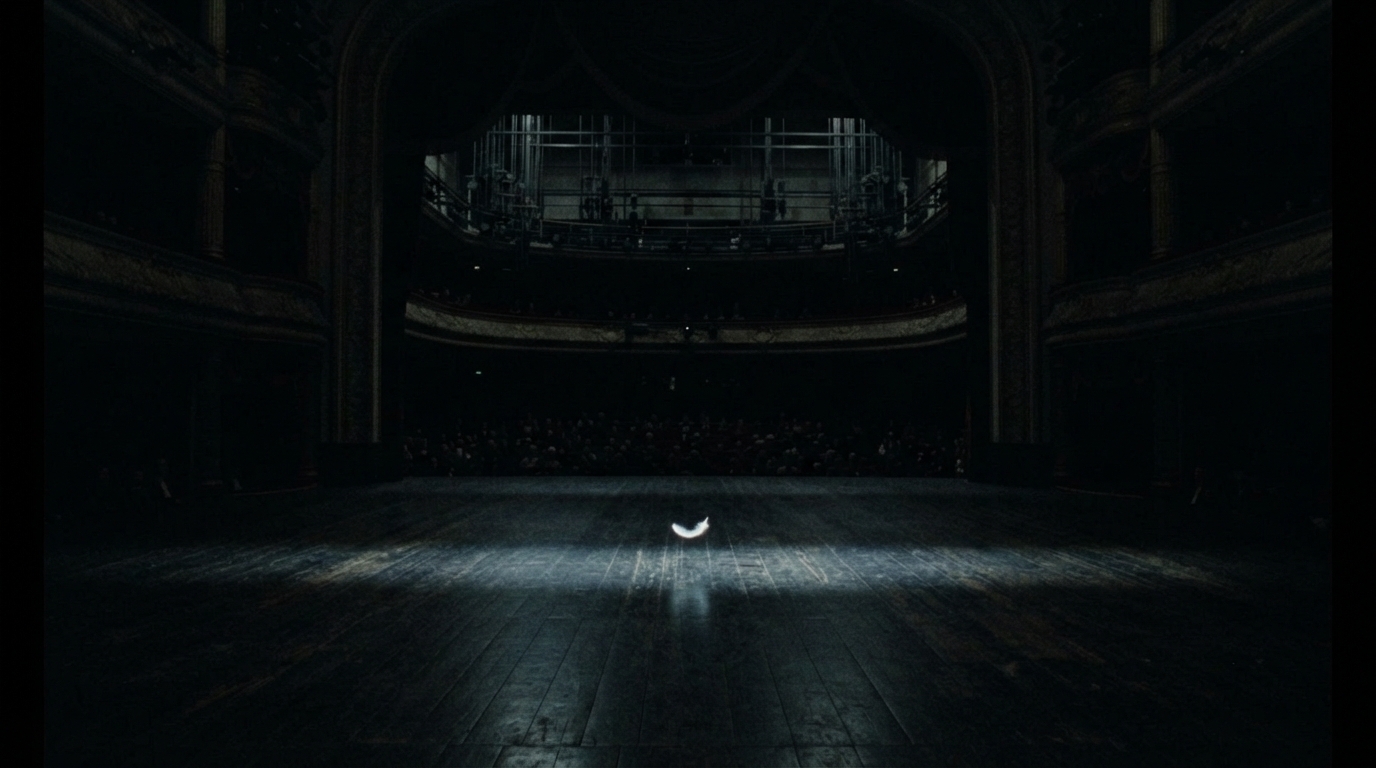
The lights dimmed slowly, all but one — a narrow white beam that settled on the empty stage. It moved — unhurried, deliberate — retracing a path no one could show them anymore, though it still seemed, somehow, to have been drawn in the air by somebody.
The beam bent, rose, held a fraction of a second longer than it should have, by every law of what is called weight.
The hall fell silent. No one had told it to. The silence came on its own — the kind that arrives before applause, in the moment before an audience has decided what it has just seen.
In the third row sat a girl of about eight, brought to the theatre by her mother for the first time in her life. She didn't understand what was happening on a stage where no one stood, but she leaned forward over the armrest and watched the empty circle of light as if it were showing her something.
The dancer who had made this gesture no longer existed. But the gesture remained — and it went on doing, to this room, exactly what it had done thirty years before: making them forget the weight of a body.
When the light died on the final note, a small white feather — lodged for years in a crack of the stage floor, stirred loose now by a draft from the wings — lifted for an instant into the air, and settled onto the boards.
Settled all the way down. No pause. Not a second longer than it should have taken.
Not as a death.
As the final return of weight.
No one in the hall saw it happen.
The snow had just fallen, and under the streetlamps it caught a color that wasn't quite white and wasn't quite yellow — the particular color of snow on the first evening of winter, before anyone has walked through it.
She was eight. Her mother had announced that morning that they would go to the theatre that night, and all day Anna had wandered the apartment half-present, not understanding what the word meant — theatre — but sensing that something was coming she would not be able to forget afterward.
They rode in a sledge to the Mariinsky, and Anna pressed against her mother, watching the streetlamps slide past one by one, as if counting down to something.
Inside it was warm and close, smelling of wax and other people's perfume. Their seats were high up, in the gallery, and the stage below looked like a small gold box she wanted to lean into whole.
The curtain rose, and a crowd of boys and girls came spilling onto the stage in a waltz — light, quick — and it seemed to Anna she wasn't watching a dance at all, but some unfamiliar way of existing in the air.
"Would you like to dance like that?" her mother asked, leaning close.
Anna didn't answer right away. She was looking at the stage, at the place where in a moment the Sleeping Beauty herself would appear, and she already knew the answer — she simply hadn't found the words for it yet.
"I want to dance," she said finally, "like that beautiful lady."
Her mother laughed softly, not knowing her daughter had just found what she would spend the rest of her life reaching for.
In the intermission, in the crowded corridor, a small white feather fell onto the hem of Anna's dress — loosed, probably, from someone's boa. She picked it up, blew on it, and it didn't fall away at once. It hung in the air a moment longer than it should have, as if deciding whether it was worth coming down at all.
She didn't know what that was.
She only knew she wanted the same thing for herself. Not to dance — to stop being heavy.
THE SCHOOL / St. Petersburg, 1891–1899
The stone floors stayed cold even in summer.
A great bell woke them at eight. Prayers, breakfast, the dance lesson — the youngest first, then the older girls — then fencing, music, dance again. The mistress corrected her elbow with a cane, never hard, but unerring, as if the exact line of an elbow were a matter of state.
"Straighter in the legs," she would say. "Open the arms — don't lose yourself in them."
Anna stood at the barre for hours at a stretch, and by evening her body ached too much to lift a comb to her own hair. The weight never left her. It worked itself into muscle, into joint, into the very mechanics of breathing.
"Weight," the mistress told her once, catching her eyes in the mirror, "cannot be tricked. It can only be hidden well enough that the audience forgets it exists."
Anna didn't understand this then. She understood it years later, alone past midnight in an empty studio, running a simple exercise past its ending — past the point where the trained technique stopped and something without a name began.
In the mirror she saw not herself.
She saw a line — without weight, without age, without a face.
The candle had burned halfway down by the time she lowered her arms, and the weight came back into her body all at once, its full mass, as though it had been waiting just outside the door.
She understood — not with her mind, but with something plainer and more permanent — that this line would have to be paid for. Not now. Later.
She put out the candle and went to bed.
In 1899 she was accepted into the Imperial ballet company. In the company records, she was listed as Pavlova the Second.
THE SWAN / St. Petersburg, 1906–1907
Her work with Fokine was not the matter of a single evening.
He set her in La Vigne, in Le Pavillon d'Armide, in Egyptian Nights — testing, adjusting, remaking the same combination of arms ten times over. She was not his pupil so much as his instrument of thought — the one body against which an idea for a new ballet could actually be measured.
In 1906, preparing the first version of Chopiniana, he composed a waltz for her.
He showed her only a little — almost nothing: the line of the arms, the tilt of the head, the direction of a glance. He rarely explained. He would show a gesture and watch to see what she made of it afterward.
She made something he hadn't shown her.
Other dancers he had seen could jump higher. Many surpassed her technically. But when Pavlova jumped, something else happened: she didn't rise above the stage so much as, for an instant, stop being heavy at all. It wasn't a trick, wasn't the final pirouette. Something in the figure itself, in the long line of the arms, made the audience forget the body had weight in the first place.
A year later Fokine showed her a different movement — fading rather than soaring: arms lowering not because they were lowered, but because life left them on its own, wave after wave.
The premiere of The Dying Swan played almost without music for the hall — that is, the music sounded, but the audience didn't hear it, having become, all together, a single breath held for five minutes.
Anna stood in the final pose — knees folded, head bowed, arms crossed behind her like a broken wing — and felt the room stop breathing along with her.
Somewhere in the third row someone wept — not out of pity for the swan, but for something that had no name.
She rose from her knees, bowed, smiled as she was meant to. The weight came back into her body all at once, like water rushing in after a long breath held underwater.
Backstage, alone, against a cold wall, she didn't think of death or of tragedy. She thought: here is a way to be light for longer than five minutes. And what she felt wasn't fear. It was gratitude.
Later, people would ask who had made whom immortal in that number — Fokine, who had invented the form, or Pavlova, who had filled that form with a life so complete the form went on living without the choreographer at all. There was no answer. There was only the form, which now lived apart from either of them.
A HOUSE WITHOUT ROOTS / World tours, 1910s–1920s
Train, steamship, train again.
Cities changed faster than she could hold their names on the local playbills. Buenos Aires, Melbourne, Mexico City, Tokyo — stages where audiences had never seen ballet before, where after the curtain people came to the footlights not to applaud but simply to look at her up close, as if to make sure she was made of flesh.
Her secretary once did the arithmetic: in ten years she had never stayed in one place longer than three weeks.
"Doesn't it exhaust you?" he asked.
She was quiet a while, watching the unclaimed land slide past the compartment window.
"What would exhaust me," she said finally, "is stopping."
In 1912 she bought a house outside London — Ivy House — dug a pond, and brought in swans of her own: real ones, live, with stiff feathers and bad tempers, nothing at all like the line that lived in her arms onstage. She loved watching them glide, oarless, as if the water itself had decided not to get in their way.
She spent only a few weeks a year there.
After 1917 she never went back to Petersburg — not because she couldn't; visas could be arranged. She didn't go back because she didn't know what to do with the girl in the blue school uniform, hair pulled tight in a braid, still standing at the barre under the mistress's cane. That girl no longer existed anywhere — not there, not here. She had dissolved somewhere between the Mariinsky and every city in the world at once.
She had many houses now. None of them, quite, was home.
THE HAGUE / January 1931
The train was late, and the carriage was cold.
She felt the chill on the journey itself — an ordinary traveler's chill, one she had long grown used to — but by evening it hadn't passed. It had gone deep, settling not in the body but somewhere beneath it.
The doctor examined her by the light of the single lamp in the hotel room.
"Pleurisy," he said.
"Can it be saved?" she asked.
He didn't answer at once.
"There's an operation we could try."
Rain, not snow, was falling outside — The Hague was southern enough of her childhood that winter here had never learned to be entirely real.
She raised her eyes.
"Will I be able to dance?"
He shook his head.
"No."
She looked down at the leg under the blanket — the same leg thirty years of repetitions at the barre had shaped into something that had stopped, long ago, being merely a leg — and drew her palm along the line of the knee. Not saying goodbye to the illness. Saying goodbye to something else: to that childhood mirror, to the line without face or age, to the feather that had once refused to fall at once.
"Then no," she said quietly. "Let it stay as it is."
THE LAST CHOICE
Toward night the fever rose.
Her secretary sat beside her, changing the cold compresses, not daring to speak. Outside, the rain had turned into that particular northern snow that never quite settles, melting before it touches ground.
She opened her eyes once, briefly.
"Get the costume ready," she said, almost too faint to hear. "The swan one."
Her secretary didn't understand — there was no performance, no theatre; London was three hundred kilometers away. But he didn't ask. He only nodded.
She closed her eyes again.
The room held only breathing — hers first, then only his, then only his own breath, which he realized, all at once, he had been listening to alone for some time.
The lamp flame trembled, though the window was shut.
Something in the room stopped being a body and did not become anything else — it simply dissolved, the way that line in the mirror had dissolved years before: without face, without age, without weight. What remained on the bed was only the form the weight had finally taken back for itself, whole, without remainder, without resistance.
Her secretary went to the window. Outside, snow was falling — slow, weightless, never quite reaching the ground.
He didn't notice the moment he stopped weeping and simply started watching.
THE EMPTY STAGE / London, 1931, the following evening
The Dying Swan was to be performed at Covent Garden.
The house was full — the tickets had sold long before The Hague, long before the rain, long before the word pleurisy. The audience settled into their seats not knowing what a handful of people backstage already knew.
The conductor came to the podium. He announced nothing. He simply raised his baton.
The orchestra began Saint-Saëns.
The lights dimmed slowly, all but one — a narrow white beam that settled on the empty stage. It moved — unhurried, deliberate — retracing a path no one could show them anymore, though it still seemed, somehow, to have been drawn in the air by somebody.
The beam bent, rose, held a fraction of a second longer than it should have, by every law of what is called weight.
The hall fell silent. No one had told it to. The silence came on its own — the kind that arrives before applause, in the moment before an audience has decided what it has just seen.
In the third row sat a girl of about eight, brought to the theatre by her mother for the first time in her life. She didn't understand what was happening on a stage where no one stood, but she leaned forward over the armrest and watched the empty circle of light as if it were showing her something.
The dancer who had made this gesture no longer existed. But the gesture remained — and it went on doing, to this room, exactly what it had done thirty years before: making them forget the weight of a body.
When the light died on the final note, a small white feather — lodged for years in a crack of the stage floor, stirred loose now by a draft from the wings — lifted for an instant into the air, and settled onto the boards.
Settled all the way down. No pause. Not a second longer than it should have taken.
Not as a death.
As the final return of weight.
No one in the hall saw it happen.
2026 © Iskandar Kadyrov • All rights reserved • RU / EN (18+)
See also