Heat transfers only through contact.
Chapter I. Ozone
He drove to the river without a reason he could name.
Not an impulse, not a plan — just at some point in the morning he found himself in the car with the key in the ignition, and driving to the river seemed no less meaningful than anything else. Thirty-five. He sometimes thought he ought to call it a midlife crisis, but the words were too round for what he felt — or, more precisely, for what he had stopped feeling. Not pain. More like a drop in current. As if somewhere inside the voltage had been reduced, and everything kept running, but with less intensity, quieter, more economically, without excess.
The road ran through a field. Poplars on the right, harvested earth on the left — dark, rich after a recent rain. He parked at a turnoff from the dirt track and walked to the bank along a path between clumps of burdock.
The river here was narrow and slow. Dark water carried dry reeds and a few leaves that still, it seemed, hadn't realized it was already autumn. An old tree by the bank — a willow, probably — hung over the water with its lower branches, roots exposed, trunk tilted as if it had long been planning to fall but kept changing its mind. He sat down, leaned his back against the trunk, and closed his eyes.
He didn't think. He simply listened.
Water. Wind in the tall grass. A distant tractor — then the tractor fell silent, and the silence took on that particular density when you begin to hear your own breathing. He sat in it long enough for it to stop being awkward. Then he opened his eyes.
Clouds had come from the west — he hadn't noticed when. Leaden, low, they moved too fast for such a still day, as if someone were hurrying to make it before a deadline. Their lower edge was ragged — like scorched paper along the margins. Beneath them the water darkened and began to resemble metal.
The smell came before he understood what it was. Sharp, pungent, almost sweet — not unpleasant. Ozone: the scent of air through which a discharge has already passed. Or is about to pass.
Then — a metallic taste in his mouth.
He swallowed. Again.
The hairs on his forearms rose — all at once, uniformly, as if on command. He looked at his arm. He waited a second — just to confirm it was happening. The arm was an ordinary arm. Only the hairs on it stood on end.
The air changed its density.
Not thicker — precisely a change in quality. As if something new had arisen between the molecules: a tension that hadn't been there before. The skin on his face registered it before he found a word.
He stood up.
His car keys turned up in his pocket at once — which in itself was strange. He took a step away from the tree. Then a second — toward the path.
On the third step he managed to notice that the grass at his feet had also risen.
Then there was nothing.
Then there was whiteness — but not the kind eyes are used to: not light from a source, not a flash radiating from a point. Simply whiteness — as if everything that was not it had forfeited the right to exist. No sky, no earth, no river.
Sound vanished. Not as in silence — differently. In silence your own breath remains, the blood in your ears, the distant background hum of the world. There was none of that here. The very possibility of sound disappeared — as one removes the condition under which it exists.
The air became solid.
He sensed it — not with his hands, not with his body. He simply understood: what had previously been the space between things had become a thing itself.
And the last thing he managed to register:
his body ceased to be the main object of perception. It didn't die. It didn't vanish. It simply ceased to be the center — as if all his life he had been looking at the world from one point, and suddenly it turned out that there were infinitely many points, and he himself was only one of them, not even the most conspicuous.
Forced return of conductivity.
He would find that phrase later. When he tried to tell himself what had happened. He would not find a more precise one.
Chapter II. The Construction
The first thing he understood: he was not falling.
Not because he had landed — the category "down" existed, but it did not apply to him now. As if he were standing on a surface that was neither floor nor ground — simply a fixed point requiring no explanation.
His body was there. He felt it — but differently. The way you feel a strange object you are holding in your hands.
He began to perceive the space — gradually, as a photograph develops: first the general outlines, then the details.
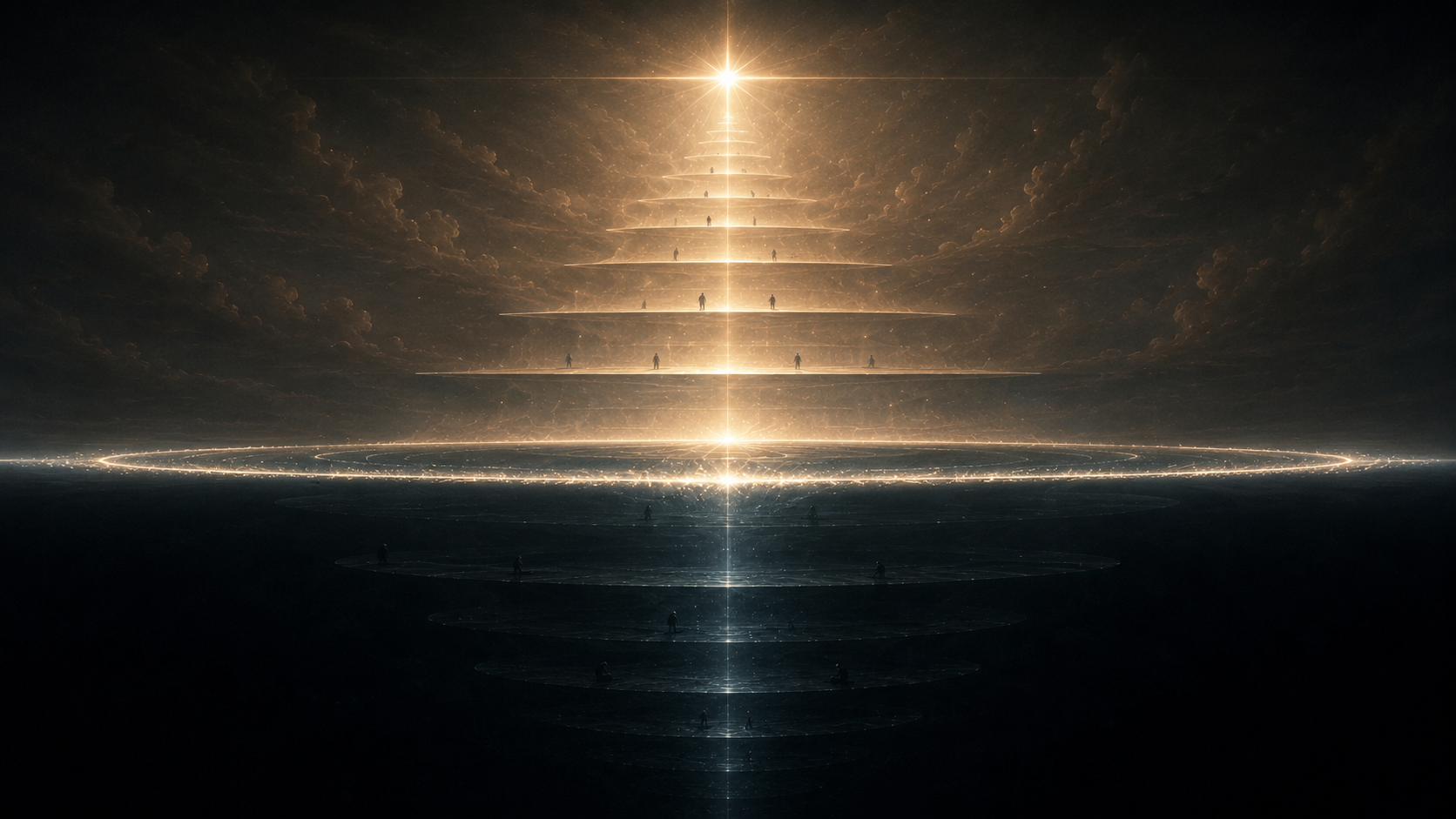
The construction was enormous.
Two massifs directed from a common base in opposite directions — one upward, one downward. Each of the horizontal layers, distinguishable not visually but otherwise: the way you distinguish temperature or pressure when moving from one room to another. You don't see the difference — you feel it with your body before your mind registers it.
The upper layers were warmer. Not in the sense of air temperature — in the sense of something for which he had no word. He mentally ran through options and settled on "conductivity" — not because it was accurate, but because it was less inaccurate than the others. The light there was also different: not brighter, but more alive — the way the air is more alive after rain, when everything around suddenly begins to smell of itself.
The lower layers were colder — with each tier colder and more still. Not like frost: frost acts actively, demands a reaction. Here the cold was passive. Like absence. As if from the substance of each successive layer something had been removed that made it alive — not all at once, but methodically, layer by layer, long ago, so long ago that no one remembered what it had been like before.
Between the two massifs — a membrane.
He did not see it at once. It did not glow and was not otherwise marked — it simply existed. A thin horizontal surface separating upper and lower. Taut, like the surface layer of water when you look from the side and see that it holds its shape not because it wants to, but because that is how tension works.
He did not notice the Architect right away.
At first it seemed part of the construction — a detail that happened to be slightly more complex than the others. Without clear contours. Without movement in the usual sense. Simply — a presence that occupied a certain place and no other. He looked at that detail and gradually understood: it was reacting to the fact that he was looking. Not with a glance, not with a gesture — by being where it was.
Here time ceased to be a measure. Density remained the only measure.
At some point something he had perceived as part of the construction became a source. Not of sound. Not of speech. Understanding appeared inside him — the way the meaning of a sentence you've read appears: without a moment when you haven't yet understood and without a moment when you have. Simply: there was non-understanding — and there was understanding. There was no boundary between them.
There was a single phrase.
No one is holding anyone down below. But many grow accustomed to their own weight.
After that — nothing. The detail of the construction became a detail of the construction again. The construction did not change. It simply worked.
He lowered his attention several tiers below the membrane.
The cold intensified — not sharply, but methodically, as pressure intensifies when you descend: each tier took something from the sensation of forward impulse. Not the body's impulse — that which makes possible the desire to take the next step.
At the third tier from the bottom he stopped. He sensed: further on — different conditions. Not danger. Mechanics.
The seventh tier from the bottom he understood without visiting it — the way one understands a depth known only from descriptions: by the absence of light, by the pressure, by the fact that there is nothing superfluous there. There was no pain there. There was an almost total absence of impulse. That is more terrible than pain — because pain requires presence, requires someone who feels it. There, no one was needed.
He rose back up and looked long at the membrane.
From below it looked different than from above. From above — the surface layer of water: transparent, barely visible, held by tension. From below — a ceiling. Not oppressive. Simply existing where it existed.
People passed through it — with effort, with a change in density, slowly, as through the surface layer of water, climbing out from within. From top to bottom — easier, but with a limitation: too long below, and something began to change in those who had come from above.
He looked at the construction and thought: it had not been built for him. That was the key understanding — and not an unpleasant one. Simply precise. The architecture did not adjust to the observer and did not make perception easier. It worked according to its own laws — the way any system works that has existed long enough to no longer need explanations.
Chapter III. The Sixth Heaven
He did not seek her out.
She was — as a source of heat becomes visible in a cold room: not because you are looking for it, but because your body finds it before your mind can formulate the question. A woman from the sixth level. Her density was different — higher in conductivity. He sensed it as a difference in pressure.
She was moving downward.
He observed.
Movement came to her without effort — up to a certain point. Around the third tier from the bottom something began to change. Not sharply — gradually, as the quality of sound changes as you move away from its source. She continued to move, but her conductivity — the very thing he had felt as "the sixth level" — began to decrease. The space of the lower tiers worked like this: it did not attack. It simply offered its conditions to everything that entered it. And whatever remained for long began to adapt to them.
She knew this. She moved without haste, but with a precise sense of time — like a person who knows how to dive and knows, not by a watch but by the lungs, how much longer they can stay underwater.
Her son was here.
The third tier from the bottom — he existed in it with that particular stability belonging to objects that have long occupied the same place: when the place has already partly become you, molded itself to your form, accepted you as a given. He did not suffer. That was important to register — precisely, he did not suffer. Suffering requires an attitude toward one's own condition as a problem. Here there was none of that. He simply existed in the conditions of that tier, and the tier had become the norm — the way one grows accustomed to the temperature of water one has been in long enough: one stops noticing it.
Inertial mass.
Not as weakness of character — as a physical state. An object at rest that requires an effort to begin moving. The effort would not arise on its own.
She entered his tier.
The Observer felt it as a change in the surrounding space. In the place where she stopped, the air — or whatever served as air here — became slightly different: a little less dense, a little less heavy, the way a room changes when someone opens a window on a warm day. Not all at once — gradually, while she was near, while what he could only call the transfer of state was taking place: she carried high conductivity, and it became temporarily accessible here only because she had brought it.
The son received it.
The Observer saw how something in him shifted slightly — he did not move, but the quality of his presence changed, the way a needle on a gauge shifts when the field changes: barely, without sudden jumps, but perceptibly.
This continued while she was near.
Then she began to ascend.
Her own conductivity had decreased — quietly, without sudden changes, but steadily. She rose without explanation: just as a diver rises not because he got scared, but because he knows — a little longer, and the ascent will require effort he may not have.
After she left, the space slowly returned to its former density — like water in which movement has ceased: not at once, not abruptly, but steadily. The warmth was leaving. The son felt it — the Observer saw it in a slight change, in a glance upward, toward where she had gone.
And then — not irritation and not anger. Something quieter and more persistent: a sense of the unfairness of the way things are arranged. It's better there. She lives there. It's easier for her.
The Observer registered this — and understood: there it was.
He was looking not at the distance between himself and the first tier above. He was looking at the distance between himself and the sixth. That is a great distance — real, undeniable. And it becomes an argument against movement. Why begin, if it's so far. Why take one step, if you need thousands.
And each such glance added density — not someone else's, his own. His own weight grew from comparison just as surely as it grows from stillness. It was an error of coordinates, not a weakness of spirit. But that did not stop it from working.
She kept coming back.
The Observer did not count the visits — there were many of them. Enough to understand: she comes back not because she believes in an immediate result. High conductivity simply cannot do otherwise, when there is something nearby to which it can transmit warmth. Transmission happens where there is a potential difference and the possibility of contact. She created contact. The potential difference was there. And each time — briefly, not enough for ascent, but enough to keep the impulse in the son from dying out entirely.
The Observer thought: she is keeping him from falling further down. She is not lifting him — she is keeping him from falling. That is work, too.
But she cannot lift him. He can only lift himself. That is not the cruelty of the system — it is its design.
And at some point — he could not say when — the Observer realized he had been watching too long.
Chapter IV. Cold Current
He did not remember the moment he stopped observing.
It happened the way many important things happen: not through a decision, but because a decision ceased to be possible. Just now he had been there, higher up, at a point from which everything was visible. And then the third tier from the bottom became the space around him — without warning, casually, the way the weather changes while you're looking the other way.
He felt the cold at once.
Not the kind you expect from the word "cold" — sharp, attacking. A different one: quiet, even, without source and without direction. As if something that made the space warm had been removed long ago — not violently, but methodically, so long ago that no one remembered what it had been like. And now it was simply the norm. The temperature of this place.
The body did not get used to it.
The son was nearby.
The Observer sensed him before he saw him — by the change in density in the nearby space, by that particular quality of presence belonging to someone who has been sitting in one place for a long time: when the place has already partly become him, has accepted his form as a given.
Not worn out. Not broken.
That was the hardest thing to take in: he had a perfectly normal, peaceful existence. He was simply here. For a long time. Habitually. And in that habitualness — the whole horror. Suffering at least requires a relationship to one's own condition as something that needs to change. Here — a quiet, stable "that's just how it is." The peace of a person who has stopped considering his place temporary.
The Observer did not move.
And he understood — not with his mind, but in the same way he understood everything here — what was happening to him.
The cold was entering from within.
Slowly — you wouldn't notice until you found that a thought that had just been alive had become slightly more sluggish. That the impulse with which he had come here was already a little shorter than it had been. The space was offering its conditions — quietly, without coercion, simply by existing — and he was beginning to adapt.
And the most unexpected thing: it was not unpleasant.
That was the point. That was what he hadn't known before — sitting by the river, calling his condition a "midlife crisis," choosing words that didn't fit but were at least some kind of words. This state — when you stop moving, when you grow used to your own weight, when the inertia of rest becomes the norm — it is not painful. It is almost cozy. There is nothing to decide. There is nowhere to go. There is no need to explain to yourself why you are here and not there.
Simply here.
He stood in that cold and recognized it.
The son lifted his gaze.
Not at him — somewhere upward, where his mother had recently gone. He looked for a long time. Then quietly, without malice, almost rhetorically — he said something to the side. There were no words — there was a change in the density around him.
It's better there. She has it better there.
And the Observer saw what happened at the moment of that thought: the space around the son became slightly heavier. Not immediately — over a few seconds, almost imperceptibly. As if each comparison added something small to him — but it did add. His own weight grew not from stillness and not from time. It grew from looking in the wrong direction.
The Observer understood: to stay silent any longer was also a choice. And not the best one.
He tried. Not aloud — in the way everything else was transmitted here: through a change in the state of the space nearby.
The son felt his presence. He looked — without surprise, almost without interest.
"You are looking too far away."
The space between them stood quiet.
"You see the distance to the sixth level. It is large — you're right, it is large. But it has nothing to do with the next step. The next step is one tier. Not six."
The son did not answer.
"You remember what it's like — when she is here. When everything around becomes a little different, a little lighter. You remember that. That means you know which direction. That means the impulse hasn't died — it's just very small right now. A small impulse and a small step — that's enough. Not a feat. Just a step a little easier than yesterday."
A pause.
"Every time you look over there and think 'it's easier for her' — you become a little heavier. I just saw it. Envy won't lift you — it's heavy. And what you're looking for begins here. One tier higher than now. Not six."
The silence was long.
Not hostile — simply long. The kind of silence in which something slowly shifts position, the way a heavy object shifts when given enough time.
The Observer felt the cold had reached deep. His own density had dropped — not dangerously, but perceptibly. He needed to ascend.
He waited.
Not because he hoped for something immediate. He simply waited for what had been said to settle. For the space between them to stop being so dense.
And at some point — quietly, without announcement — the son did something small. Not a step. The intention of a step. The change in density that precedes movement, when the decision has not yet been made, but something inside has already begun to prepare.
That was enough.
The Observer began to ascend.
Chapter V. The Membrane
The mother arrived at the moment he was already ascending.
They had not arranged it. That was impossible — arrangements did not work here in the sense he understood them. It was simply how the transfer of state was designed: when something begins to change in a lower tier — a tiny shift, barely noticeable, an intention where before there had only been inertia — the upper level feels it. Not immediately. But it feels it — the way you feel a change in current in a conductor.
She appeared — and the space around him once again became different. Warmer. More alive. The Observer felt it even now, as he ascended — the way you feel sunlight on your face when you step out of shadow into an open place.
The son was moving.
Not fast — slowly, the way objects that have been at rest for a long time move, not yet having found their rhythm. But he was moving. The Observer watched this and thought: so that's what it looks like. Not heroic. Not beautiful. Simply — a body that has begun to make the next movement. Nothing more.
The mother walked beside him.
She was not pulling him — that would have been wrong. Here you cannot lift another. You can walk alongside, you can transmit warmth, you can be a presence that reminds: the upper levels are real, the warmth there is real, it is not a legend and not someone else's life. That was exactly what she was doing — walking alongside and carrying her state as testimony.
The membrane was close.
The Observer stopped just below it and watched.
From below it did not look like a barrier — more like the surface of water from the inside, when you are swimming upward and see it above you: trembling slightly, letting light through, promising air on the other side. Not a wall. A boundary — one that can be crossed, if you have enough.
The son approached it.
He stopped.
The Observer watched him stand before it — and understood what was happening. This moment — the hardest one — not because it required effort. But because it required a decision. Not a single step. A choice.
The mother stood beside him. She said nothing. She was simply there — and her conductivity warmed the space in which he stood, made it slightly less heavy, slightly more possible.
He passed through.
Not beautifully. Not triumphantly. Simply — passed through, the way you pass through the surface layer of water, climbing out of it: with effort, with resistance, in the moment of transition — almost painful from the difference in pressure. And then — a different density. A different temperature. Air that lets light through differently.
The first level above the membrane.
Not paradise. Not triumph. Simply a space where you can breathe without effort — where the norm is a little different, where the density is a little less, where the warmth is not imported but your own.
The mother was beside him. At last — beside him. Not in stolen minutes, not in countdown mode. Simply — beside him, in the same space, at the same level of conductivity.
The Observer looked at them — and felt something he did not wish to give grand names. Simply: right. The way things are right when they end up in their places — not because someone put them there, but because they got there themselves.
Then he began to ascend further. Quickly — because the cold in him had not yet gone, and he needed to return to his own space. But for a second — one second — he turned.
They were standing beside each other.
That was enough.
Chapter VI. Cold Water
A vile sensation.
Someone was pouring cold water on his face — evenly, briskly, without warning. A voice — strange, professional, toneless: calling out numbers to someone nearby. He tried to open his eyes.
The sky was cloudless.
Blue, smooth, without a single hint of what had just taken place here. As if the clouds — those leaden ones, with the ragged edge, that had come from the west too fast — had been merely a short dream. A face bent over him: a paramedic, focused, without unnecessary words.
"Alive," the paramedic said to someone. "Alive."
It was said matter-of-factly — the way you speak of a thing found where it belongs.
He was lying under the old willow.
The grass nearby was scorched in a circle — neatly, as if someone had set down a red-hot object and then removed it. The tree's roots by the bank. The slow dark water. The reeds, the leaves — everything as it had been. Only the air smelled different: clean, almost piercing, the way it smells after a thunderstorm, when the sky has given up everything it held.
They took him to the hospital. Kept him for a day. Released him.
His mother met him at the door.
She didn't ask questions — or she did, but he didn't remember them. He remembered something else: how her house smells — of wood, of food, of something warm and steady that exists here always, regardless of whether he visits or not. How she bustles in the kitchen — not fussily, but habitually, with that particular confidence of movement belonging to people who have long known their place. How she murmurs, without turning around: that he's finally come, that he's found a job at last, that she's glad.
He sat at the table and watched the steam rising from the pot.
Thin vertical threads — even, as long as there is no movement of air. They rose upward slowly and steadily, the way everything light rises, if left unhindered.
Exactly the same.
Exactly the same way the light rose between the levels — he had seen it, he had definitely seen it. The same mechanics, the same direction, the same simple physics: the light rises. Always. If it has enough warmth and enough space.
The architecture of light had been here all along.
Not there — here. In this house, in this kitchen, in this steam above the pot. It had not vanished while he was driving to the river and calling his condition words that didn't fit. It had simply waited for him to learn how to see.
His mother set a plate in front of him.
"Eat," she said. "You've lost weight."
He looked at her. At how she moves — calmly, without haste, with that density of presence he now knew how to sense differently. The sixth heaven. He thought that — and nearly laughed. But he didn't. He simply picked up his spoon.
At night, the storm returned.
His mother was asleep in the next room, and he sat by the window watching lightning silently rip the sky above the city. Far away — beyond the rooftops, beyond the poplars, beyond that field where his car had been and his river and his old willow with the scorched grass around it.
Now he knew: light does not appear where there is no darkness.
Light appears where something is still capable of conducting a charge.
The End
He drove to the river without a reason he could name.
Not an impulse, not a plan — just at some point in the morning he found himself in the car with the key in the ignition, and driving to the river seemed no less meaningful than anything else. Thirty-five. He sometimes thought he ought to call it a midlife crisis, but the words were too round for what he felt — or, more precisely, for what he had stopped feeling. Not pain. More like a drop in current. As if somewhere inside the voltage had been reduced, and everything kept running, but with less intensity, quieter, more economically, without excess.
The road ran through a field. Poplars on the right, harvested earth on the left — dark, rich after a recent rain. He parked at a turnoff from the dirt track and walked to the bank along a path between clumps of burdock.
The river here was narrow and slow. Dark water carried dry reeds and a few leaves that still, it seemed, hadn't realized it was already autumn. An old tree by the bank — a willow, probably — hung over the water with its lower branches, roots exposed, trunk tilted as if it had long been planning to fall but kept changing its mind. He sat down, leaned his back against the trunk, and closed his eyes.
He didn't think. He simply listened.
Water. Wind in the tall grass. A distant tractor — then the tractor fell silent, and the silence took on that particular density when you begin to hear your own breathing. He sat in it long enough for it to stop being awkward. Then he opened his eyes.
Clouds had come from the west — he hadn't noticed when. Leaden, low, they moved too fast for such a still day, as if someone were hurrying to make it before a deadline. Their lower edge was ragged — like scorched paper along the margins. Beneath them the water darkened and began to resemble metal.
The smell came before he understood what it was. Sharp, pungent, almost sweet — not unpleasant. Ozone: the scent of air through which a discharge has already passed. Or is about to pass.
Then — a metallic taste in his mouth.
He swallowed. Again.
The hairs on his forearms rose — all at once, uniformly, as if on command. He looked at his arm. He waited a second — just to confirm it was happening. The arm was an ordinary arm. Only the hairs on it stood on end.
The air changed its density.
Not thicker — precisely a change in quality. As if something new had arisen between the molecules: a tension that hadn't been there before. The skin on his face registered it before he found a word.
He stood up.
His car keys turned up in his pocket at once — which in itself was strange. He took a step away from the tree. Then a second — toward the path.
On the third step he managed to notice that the grass at his feet had also risen.
Then there was nothing.
Then there was whiteness — but not the kind eyes are used to: not light from a source, not a flash radiating from a point. Simply whiteness — as if everything that was not it had forfeited the right to exist. No sky, no earth, no river.
Sound vanished. Not as in silence — differently. In silence your own breath remains, the blood in your ears, the distant background hum of the world. There was none of that here. The very possibility of sound disappeared — as one removes the condition under which it exists.
The air became solid.
He sensed it — not with his hands, not with his body. He simply understood: what had previously been the space between things had become a thing itself.
And the last thing he managed to register:
his body ceased to be the main object of perception. It didn't die. It didn't vanish. It simply ceased to be the center — as if all his life he had been looking at the world from one point, and suddenly it turned out that there were infinitely many points, and he himself was only one of them, not even the most conspicuous.
Forced return of conductivity.
He would find that phrase later. When he tried to tell himself what had happened. He would not find a more precise one.
Chapter II. The Construction
The first thing he understood: he was not falling.
Not because he had landed — the category "down" existed, but it did not apply to him now. As if he were standing on a surface that was neither floor nor ground — simply a fixed point requiring no explanation.
His body was there. He felt it — but differently. The way you feel a strange object you are holding in your hands.
He began to perceive the space — gradually, as a photograph develops: first the general outlines, then the details.
The construction was enormous.
Two massifs directed from a common base in opposite directions — one upward, one downward. Each of the horizontal layers, distinguishable not visually but otherwise: the way you distinguish temperature or pressure when moving from one room to another. You don't see the difference — you feel it with your body before your mind registers it.
The upper layers were warmer. Not in the sense of air temperature — in the sense of something for which he had no word. He mentally ran through options and settled on "conductivity" — not because it was accurate, but because it was less inaccurate than the others. The light there was also different: not brighter, but more alive — the way the air is more alive after rain, when everything around suddenly begins to smell of itself.
The lower layers were colder — with each tier colder and more still. Not like frost: frost acts actively, demands a reaction. Here the cold was passive. Like absence. As if from the substance of each successive layer something had been removed that made it alive — not all at once, but methodically, layer by layer, long ago, so long ago that no one remembered what it had been like before.
Between the two massifs — a membrane.
He did not see it at once. It did not glow and was not otherwise marked — it simply existed. A thin horizontal surface separating upper and lower. Taut, like the surface layer of water when you look from the side and see that it holds its shape not because it wants to, but because that is how tension works.
He did not notice the Architect right away.
At first it seemed part of the construction — a detail that happened to be slightly more complex than the others. Without clear contours. Without movement in the usual sense. Simply — a presence that occupied a certain place and no other. He looked at that detail and gradually understood: it was reacting to the fact that he was looking. Not with a glance, not with a gesture — by being where it was.
Here time ceased to be a measure. Density remained the only measure.
At some point something he had perceived as part of the construction became a source. Not of sound. Not of speech. Understanding appeared inside him — the way the meaning of a sentence you've read appears: without a moment when you haven't yet understood and without a moment when you have. Simply: there was non-understanding — and there was understanding. There was no boundary between them.
There was a single phrase.
No one is holding anyone down below. But many grow accustomed to their own weight.
After that — nothing. The detail of the construction became a detail of the construction again. The construction did not change. It simply worked.
He lowered his attention several tiers below the membrane.
The cold intensified — not sharply, but methodically, as pressure intensifies when you descend: each tier took something from the sensation of forward impulse. Not the body's impulse — that which makes possible the desire to take the next step.
At the third tier from the bottom he stopped. He sensed: further on — different conditions. Not danger. Mechanics.
The seventh tier from the bottom he understood without visiting it — the way one understands a depth known only from descriptions: by the absence of light, by the pressure, by the fact that there is nothing superfluous there. There was no pain there. There was an almost total absence of impulse. That is more terrible than pain — because pain requires presence, requires someone who feels it. There, no one was needed.
He rose back up and looked long at the membrane.
From below it looked different than from above. From above — the surface layer of water: transparent, barely visible, held by tension. From below — a ceiling. Not oppressive. Simply existing where it existed.
People passed through it — with effort, with a change in density, slowly, as through the surface layer of water, climbing out from within. From top to bottom — easier, but with a limitation: too long below, and something began to change in those who had come from above.
He looked at the construction and thought: it had not been built for him. That was the key understanding — and not an unpleasant one. Simply precise. The architecture did not adjust to the observer and did not make perception easier. It worked according to its own laws — the way any system works that has existed long enough to no longer need explanations.
Chapter III. The Sixth Heaven
He did not seek her out.
She was — as a source of heat becomes visible in a cold room: not because you are looking for it, but because your body finds it before your mind can formulate the question. A woman from the sixth level. Her density was different — higher in conductivity. He sensed it as a difference in pressure.
She was moving downward.
He observed.
Movement came to her without effort — up to a certain point. Around the third tier from the bottom something began to change. Not sharply — gradually, as the quality of sound changes as you move away from its source. She continued to move, but her conductivity — the very thing he had felt as "the sixth level" — began to decrease. The space of the lower tiers worked like this: it did not attack. It simply offered its conditions to everything that entered it. And whatever remained for long began to adapt to them.
She knew this. She moved without haste, but with a precise sense of time — like a person who knows how to dive and knows, not by a watch but by the lungs, how much longer they can stay underwater.
Her son was here.
The third tier from the bottom — he existed in it with that particular stability belonging to objects that have long occupied the same place: when the place has already partly become you, molded itself to your form, accepted you as a given. He did not suffer. That was important to register — precisely, he did not suffer. Suffering requires an attitude toward one's own condition as a problem. Here there was none of that. He simply existed in the conditions of that tier, and the tier had become the norm — the way one grows accustomed to the temperature of water one has been in long enough: one stops noticing it.
Inertial mass.
Not as weakness of character — as a physical state. An object at rest that requires an effort to begin moving. The effort would not arise on its own.
She entered his tier.
The Observer felt it as a change in the surrounding space. In the place where she stopped, the air — or whatever served as air here — became slightly different: a little less dense, a little less heavy, the way a room changes when someone opens a window on a warm day. Not all at once — gradually, while she was near, while what he could only call the transfer of state was taking place: she carried high conductivity, and it became temporarily accessible here only because she had brought it.
The son received it.
The Observer saw how something in him shifted slightly — he did not move, but the quality of his presence changed, the way a needle on a gauge shifts when the field changes: barely, without sudden jumps, but perceptibly.
This continued while she was near.
Then she began to ascend.
Her own conductivity had decreased — quietly, without sudden changes, but steadily. She rose without explanation: just as a diver rises not because he got scared, but because he knows — a little longer, and the ascent will require effort he may not have.
After she left, the space slowly returned to its former density — like water in which movement has ceased: not at once, not abruptly, but steadily. The warmth was leaving. The son felt it — the Observer saw it in a slight change, in a glance upward, toward where she had gone.
And then — not irritation and not anger. Something quieter and more persistent: a sense of the unfairness of the way things are arranged. It's better there. She lives there. It's easier for her.
The Observer registered this — and understood: there it was.
He was looking not at the distance between himself and the first tier above. He was looking at the distance between himself and the sixth. That is a great distance — real, undeniable. And it becomes an argument against movement. Why begin, if it's so far. Why take one step, if you need thousands.
And each such glance added density — not someone else's, his own. His own weight grew from comparison just as surely as it grows from stillness. It was an error of coordinates, not a weakness of spirit. But that did not stop it from working.
She kept coming back.
The Observer did not count the visits — there were many of them. Enough to understand: she comes back not because she believes in an immediate result. High conductivity simply cannot do otherwise, when there is something nearby to which it can transmit warmth. Transmission happens where there is a potential difference and the possibility of contact. She created contact. The potential difference was there. And each time — briefly, not enough for ascent, but enough to keep the impulse in the son from dying out entirely.
The Observer thought: she is keeping him from falling further down. She is not lifting him — she is keeping him from falling. That is work, too.
But she cannot lift him. He can only lift himself. That is not the cruelty of the system — it is its design.
And at some point — he could not say when — the Observer realized he had been watching too long.
Chapter IV. Cold Current
He did not remember the moment he stopped observing.
It happened the way many important things happen: not through a decision, but because a decision ceased to be possible. Just now he had been there, higher up, at a point from which everything was visible. And then the third tier from the bottom became the space around him — without warning, casually, the way the weather changes while you're looking the other way.
He felt the cold at once.
Not the kind you expect from the word "cold" — sharp, attacking. A different one: quiet, even, without source and without direction. As if something that made the space warm had been removed long ago — not violently, but methodically, so long ago that no one remembered what it had been like. And now it was simply the norm. The temperature of this place.
The body did not get used to it.
The son was nearby.
The Observer sensed him before he saw him — by the change in density in the nearby space, by that particular quality of presence belonging to someone who has been sitting in one place for a long time: when the place has already partly become him, has accepted his form as a given.
Not worn out. Not broken.
That was the hardest thing to take in: he had a perfectly normal, peaceful existence. He was simply here. For a long time. Habitually. And in that habitualness — the whole horror. Suffering at least requires a relationship to one's own condition as something that needs to change. Here — a quiet, stable "that's just how it is." The peace of a person who has stopped considering his place temporary.
The Observer did not move.
And he understood — not with his mind, but in the same way he understood everything here — what was happening to him.
The cold was entering from within.
Slowly — you wouldn't notice until you found that a thought that had just been alive had become slightly more sluggish. That the impulse with which he had come here was already a little shorter than it had been. The space was offering its conditions — quietly, without coercion, simply by existing — and he was beginning to adapt.
And the most unexpected thing: it was not unpleasant.
That was the point. That was what he hadn't known before — sitting by the river, calling his condition a "midlife crisis," choosing words that didn't fit but were at least some kind of words. This state — when you stop moving, when you grow used to your own weight, when the inertia of rest becomes the norm — it is not painful. It is almost cozy. There is nothing to decide. There is nowhere to go. There is no need to explain to yourself why you are here and not there.
Simply here.
He stood in that cold and recognized it.
The son lifted his gaze.
Not at him — somewhere upward, where his mother had recently gone. He looked for a long time. Then quietly, without malice, almost rhetorically — he said something to the side. There were no words — there was a change in the density around him.
It's better there. She has it better there.
And the Observer saw what happened at the moment of that thought: the space around the son became slightly heavier. Not immediately — over a few seconds, almost imperceptibly. As if each comparison added something small to him — but it did add. His own weight grew not from stillness and not from time. It grew from looking in the wrong direction.
The Observer understood: to stay silent any longer was also a choice. And not the best one.
He tried. Not aloud — in the way everything else was transmitted here: through a change in the state of the space nearby.
The son felt his presence. He looked — without surprise, almost without interest.
"You are looking too far away."
The space between them stood quiet.
"You see the distance to the sixth level. It is large — you're right, it is large. But it has nothing to do with the next step. The next step is one tier. Not six."
The son did not answer.
"You remember what it's like — when she is here. When everything around becomes a little different, a little lighter. You remember that. That means you know which direction. That means the impulse hasn't died — it's just very small right now. A small impulse and a small step — that's enough. Not a feat. Just a step a little easier than yesterday."
A pause.
"Every time you look over there and think 'it's easier for her' — you become a little heavier. I just saw it. Envy won't lift you — it's heavy. And what you're looking for begins here. One tier higher than now. Not six."
The silence was long.
Not hostile — simply long. The kind of silence in which something slowly shifts position, the way a heavy object shifts when given enough time.
The Observer felt the cold had reached deep. His own density had dropped — not dangerously, but perceptibly. He needed to ascend.
He waited.
Not because he hoped for something immediate. He simply waited for what had been said to settle. For the space between them to stop being so dense.
And at some point — quietly, without announcement — the son did something small. Not a step. The intention of a step. The change in density that precedes movement, when the decision has not yet been made, but something inside has already begun to prepare.
That was enough.
The Observer began to ascend.
Chapter V. The Membrane
The mother arrived at the moment he was already ascending.
They had not arranged it. That was impossible — arrangements did not work here in the sense he understood them. It was simply how the transfer of state was designed: when something begins to change in a lower tier — a tiny shift, barely noticeable, an intention where before there had only been inertia — the upper level feels it. Not immediately. But it feels it — the way you feel a change in current in a conductor.
She appeared — and the space around him once again became different. Warmer. More alive. The Observer felt it even now, as he ascended — the way you feel sunlight on your face when you step out of shadow into an open place.
The son was moving.
Not fast — slowly, the way objects that have been at rest for a long time move, not yet having found their rhythm. But he was moving. The Observer watched this and thought: so that's what it looks like. Not heroic. Not beautiful. Simply — a body that has begun to make the next movement. Nothing more.
The mother walked beside him.
She was not pulling him — that would have been wrong. Here you cannot lift another. You can walk alongside, you can transmit warmth, you can be a presence that reminds: the upper levels are real, the warmth there is real, it is not a legend and not someone else's life. That was exactly what she was doing — walking alongside and carrying her state as testimony.
The membrane was close.
The Observer stopped just below it and watched.
From below it did not look like a barrier — more like the surface of water from the inside, when you are swimming upward and see it above you: trembling slightly, letting light through, promising air on the other side. Not a wall. A boundary — one that can be crossed, if you have enough.
The son approached it.
He stopped.
The Observer watched him stand before it — and understood what was happening. This moment — the hardest one — not because it required effort. But because it required a decision. Not a single step. A choice.
The mother stood beside him. She said nothing. She was simply there — and her conductivity warmed the space in which he stood, made it slightly less heavy, slightly more possible.
He passed through.
Not beautifully. Not triumphantly. Simply — passed through, the way you pass through the surface layer of water, climbing out of it: with effort, with resistance, in the moment of transition — almost painful from the difference in pressure. And then — a different density. A different temperature. Air that lets light through differently.
The first level above the membrane.
Not paradise. Not triumph. Simply a space where you can breathe without effort — where the norm is a little different, where the density is a little less, where the warmth is not imported but your own.
The mother was beside him. At last — beside him. Not in stolen minutes, not in countdown mode. Simply — beside him, in the same space, at the same level of conductivity.
The Observer looked at them — and felt something he did not wish to give grand names. Simply: right. The way things are right when they end up in their places — not because someone put them there, but because they got there themselves.
Then he began to ascend further. Quickly — because the cold in him had not yet gone, and he needed to return to his own space. But for a second — one second — he turned.
They were standing beside each other.
That was enough.
Chapter VI. Cold Water
A vile sensation.
Someone was pouring cold water on his face — evenly, briskly, without warning. A voice — strange, professional, toneless: calling out numbers to someone nearby. He tried to open his eyes.
The sky was cloudless.
Blue, smooth, without a single hint of what had just taken place here. As if the clouds — those leaden ones, with the ragged edge, that had come from the west too fast — had been merely a short dream. A face bent over him: a paramedic, focused, without unnecessary words.
"Alive," the paramedic said to someone. "Alive."
It was said matter-of-factly — the way you speak of a thing found where it belongs.
He was lying under the old willow.
The grass nearby was scorched in a circle — neatly, as if someone had set down a red-hot object and then removed it. The tree's roots by the bank. The slow dark water. The reeds, the leaves — everything as it had been. Only the air smelled different: clean, almost piercing, the way it smells after a thunderstorm, when the sky has given up everything it held.
They took him to the hospital. Kept him for a day. Released him.
His mother met him at the door.
She didn't ask questions — or she did, but he didn't remember them. He remembered something else: how her house smells — of wood, of food, of something warm and steady that exists here always, regardless of whether he visits or not. How she bustles in the kitchen — not fussily, but habitually, with that particular confidence of movement belonging to people who have long known their place. How she murmurs, without turning around: that he's finally come, that he's found a job at last, that she's glad.
He sat at the table and watched the steam rising from the pot.
Thin vertical threads — even, as long as there is no movement of air. They rose upward slowly and steadily, the way everything light rises, if left unhindered.
Exactly the same.
Exactly the same way the light rose between the levels — he had seen it, he had definitely seen it. The same mechanics, the same direction, the same simple physics: the light rises. Always. If it has enough warmth and enough space.
The architecture of light had been here all along.
Not there — here. In this house, in this kitchen, in this steam above the pot. It had not vanished while he was driving to the river and calling his condition words that didn't fit. It had simply waited for him to learn how to see.
His mother set a plate in front of him.
"Eat," she said. "You've lost weight."
He looked at her. At how she moves — calmly, without haste, with that density of presence he now knew how to sense differently. The sixth heaven. He thought that — and nearly laughed. But he didn't. He simply picked up his spoon.
At night, the storm returned.
His mother was asleep in the next room, and he sat by the window watching lightning silently rip the sky above the city. Far away — beyond the rooftops, beyond the poplars, beyond that field where his car had been and his river and his old willow with the scorched grass around it.
Now he knew: light does not appear where there is no darkness.
Light appears where something is still capable of conducting a charge.
The End
#LightningNovella, #InnerCurrent, #WarmthThroughContact, #PhysicsOfSpirit, #InertiaAsTrap, #CoordinateError, #ArchitectureOfLight