№4 Vincent van Gogh — “The Man Who Felt Too Much”
Passport
Synopsis
She learned to free women from a form that dictated how they should look, move, and live. But one day, she discovered that the person who had spent her life removing other people’s constraints had become a prisoner of her own form.
Hashtags
#GIFT #LiteraryProject #IskandarKadyrov #VincentVanGogh #TheManWhoFeltTooMuch #BiographicalParable #PhilosophicalProse #PsychologicalNovella #ThePriceOfGenius #Genius #Color #LiteratureHauteCouture
About the Literary Project
GIFT is a literary project by Iskandar Kadyrov, created in the genre of literary nonfiction and biographical parable. Seven stories about P. T. Barnum, Nikola Tesla, Coco Chanel, Vincent van Gogh, Wolfgang Amadeus Mozart, Sergei Rachmaninoff, and Anna Pavlova explore the nature of exceptional talent — and the price a person pays for possessing it. Here, genius is not a privilege but a test: it demands obsession, solitude, sacrifice, risk, and sometimes life itself. Seven heroes. Seven forms of genius. Seven prices. GIFT is literature haute couture: an artistic reinterpretation of real figures, events, and circumstances within the framework of the author's vision.
- Literary Project: «The Gift»
- Author: Iskandar Kadyrov
- Age Rating: 18+
- Novella: №4 Vincent van Gogh — “The Man Who Felt Too Much”
- Genre: Philosophical biographical parable / psychological novella
- Slogan: "He did not paint what he saw with his eyes. He painted what he could not help but feel"
- Gift: To feel the inner life of the world beneath its outer form — with no filter between himself and the world
Synopsis
She learned to free women from a form that dictated how they should look, move, and live. But one day, she discovered that the person who had spent her life removing other people’s constraints had become a prisoner of her own form.
Hashtags
#GIFT #LiteraryProject #IskandarKadyrov #VincentVanGogh #TheManWhoFeltTooMuch #BiographicalParable #PhilosophicalProse #PsychologicalNovella #ThePriceOfGenius #Genius #Color #LiteratureHauteCouture
About the Literary Project
GIFT is a literary project by Iskandar Kadyrov, created in the genre of literary nonfiction and biographical parable. Seven stories about P. T. Barnum, Nikola Tesla, Coco Chanel, Vincent van Gogh, Wolfgang Amadeus Mozart, Sergei Rachmaninoff, and Anna Pavlova explore the nature of exceptional talent — and the price a person pays for possessing it. Here, genius is not a privilege but a test: it demands obsession, solitude, sacrifice, risk, and sometimes life itself. Seven heroes. Seven forms of genius. Seven prices. GIFT is literature haute couture: an artistic reinterpretation of real figures, events, and circumstances within the framework of the author's vision.
Vincent van Gogh — “The Man Who Felt Too Much”
THE FIELD
The light did not fall the way light usually falls.
It did not illuminate things — it entered them, vibrating along the edge of every stalk, every furrow, until the ground itself seemed to breathe faster than ground is supposed to breathe.
A man stood at the edge of the field with a paint box in his hands and could not begin.
Not because he didn't know what to paint. Because he saw too much at once — the yellow field screaming yellow, the sky pressing down blue, and between them, in the air itself, a trembling line that existed on no palette ever made.
He shut his eyes. It did not get easier. Only darker.
When he opened them again, the field was still there. Calm, ordinary, ready to become someone's dinner in two months' time.
He alone could see it tremble.
COAL
The Borinage was black all the way to the horizon — slag heaps, soot on snow, the faces of miners whose lungs, it seemed, no longer washed clean of coal at all.
He had come here to preach. They gave him a Bible and a room.
Within a month he had given his clothes to the miners and was sleeping on straw, because he could not speak to people about the Kingdom of Heaven while standing over them in a clean shirt, over men whose chests held coal instead of air.
"You mustn't exhaust yourself like this," the mission inspector told him.
"I can't do otherwise."
"People come to hear a sermon, not to look at your poverty."
He was dismissed six months before his contract ended — not for any wrongdoing. For excess. He preached too literally, felt too much, and that frightened people more than the coal itself ever had.
He left the mission on foot, carrying a paint box he had traded a neighbor his coat for.
He did not know yet that it was the only truly right decision of his life.
YELLOW
At the art supply shop, the tubes stood in rows like cartridges.
He picked one up — chrome yellow, the most expensive on the shelf — and held it a long time before he could bring himself to pay.
At home, by candlelight, he squeezed a drop onto the palette and looked at it longer than one looks at a color.
Yellow was not simply a color. Yellow answered back.
He set it beside blue and felt both colors flinch, as if a current had passed between them. No drawing instructor had ever told him that color could behave like a living thing, either welcoming its neighbor or pushing it away.
He painted until morning. Not because the picture needed finishing.
Because as long as the brush kept moving, the tremor of the world became bearable, if only for a second.
THEO
The letters arrived in envelopes addressed in the same even hand.
Inside — money, always a little less than was needed, and words that never once carried reproach.
"Write as much as you can. I'll find a way."
He answered at length, page after page — not because there was much to report, but because Theo was the one person for whom nothing he felt required translation into ordinary language. Theo simply took it on faith that a color could ache, that a field could scream.
He sketched on the backs of his letters — sheaves of wheat, faces, boots. Theo filed them away in a separate folder, and never once mentioned it aloud.
It was the only correspondence of his life in which the other man's silence never once meant he had gone unheard.
THE YELLOW HOUSE IN ARLES
The house was small, cheap, and stood in full sun.
He painted the shutters yellow and bought twelve chairs — not because he expected twelve guests, but because he believed that if he made a place warm enough, painters would gather there on their own, working side by side, sharing what they saw.
He painted sunflowers — not because he loved flowers. Because he wanted the walls of the house Gauguin was coming to live in to already speak the same language he did.
He hung canvases room by room, stepped back, straightened a frame.
"It'll be good here," he said aloud, to the empty house — the only listener he had at that moment.
He did not know yet that the house could hold only one person who felt the way he felt.
GAUGUIN
Gauguin painted in broad, flat planes, calmly, from a distance.
He painted up close, from inside, as though the canvas were skin, not surface.
For the first week it felt like an advantage — two different ways of seeing the same field, two easels side by side, a living argument over exactly where the object ended and the light began.
By the second week, the argument stopped being about painting.
"You don't paint what you see," Gauguin said, looking at his canvas. "You paint what's happening to you."
"Isn't that the same thing?"
"Not for me, it isn't."
Gauguin knew how to close his easel and go drink coffee. He did not. He could not switch off his sight the way one switches off a lamp. The world kept entering him even after the brush was set down, and that difference, invisible from the outside, ran deeper than any argument about color ever could.
THE SILENCE AFTER
Gauguin left the next morning.
What happened that December night he was never able to explain afterward — not to the doctors, not to Theo, not to himself in letters — only that the world, always too loud, had that night been louder than he could bear without breaking.
He woke in the Arles hospital with his head bandaged.
Neighbors on the street had signed a letter to the mayor asking that the "red-headed madman" be shut away.
He read the letter in his hospital bed, calmly, twice, and found in himself no strength to argue or explain.
Theo arrived on the first train. He asked nothing — simply sat beside him until his brother spoke first.
"I want to keep painting," he said.
Theo nodded, as though that were the only reasonable answer to what had happened.
SAINT-RÉMY
The asylum stood among olives and cypresses, and through the barred window of his room there was enough sky visible to work by.
They allowed him an easel. The doctors called it therapy. He called it the only proof that he was still alive.
He painted the cypresses — dark, twisting, like flame frozen into green. He painted stars as no astronomer had ever seen them — swirling, moving, because for him the sky did not simply hang still; it breathed, the way that first field had once breathed.
"Doesn't it tire you, painting such restless pictures?" an orderly asked, watching the canvas.
"It would tire me more not to paint them."
The attacks returned without a schedule, without warning, like weather. Between them came weeks of clarity, when he worked ten hours at a stretch, as if making up for the time the illness kept taking from him.
LETTERS WITHOUT ANSWER
The canvases went to Theo by the crate. One sold.
The critics who wrote about the Paris salons never mentioned his name. The few who did treated him as a curiosity — "the madman from Provence who paints swirling stars."
He never argued the point in his letters. He sent Theo new canvases with short notes attached: "This one came out better than the last one, I think" — no complaints, no request that the market be made to understand what he was doing.
The one thing that genuinely troubled him was not the critics' silence, but a growing silence in his own body — a tiredness that no longer lifted after sleep, hands that began to shake by evening not from feeling anymore, but simply from the length of the work.
He painted faster. As though he sensed that the time left for translating the world into color was shorter than it used to seem.
AUVERS-SUR-OISE
Dr. Gachet lived in a house with a large garden and talked about painting more readily than most doctors talk about medicine.
Here, for the first time in a long while, the quiet was not the kind that presses down but the kind that lets a man work.
In ten weeks he painted more than seventy canvases — rain on rooftops, the church, fields cut through by roads the way a canvas is cut through by a brush.
Theo came with his wife and their infant son, named after him. He held his nephew awkwardly, as though afraid of passing something on through touch — not the illness, but the sight.
"How are things in Paris?" he asked.
Theo did not answer right away. Things in Paris were worse than his letters had let on — the art trade, his health, money.
For the first time, he noticed that the brother who had carried his life on his own shoulders for years was tired of carrying it.
It was a weight his gift could not translate into any color at all.
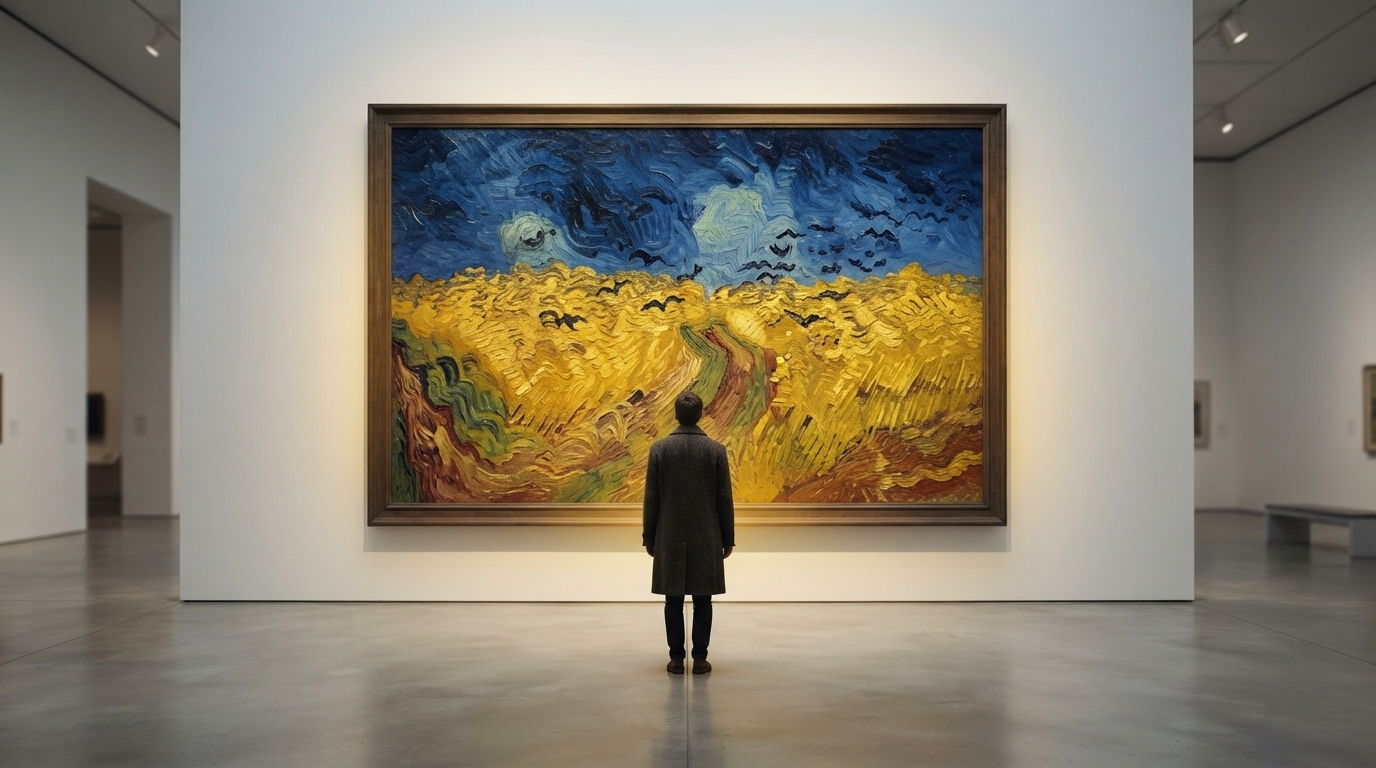
THE WHEAT FIELD
The field beyond Auvers was the same as that very first one, years before — except that now he knew what to do with the tremor in the air.
He set up his easel right in the wheat. Crows rose in scattered flocks and settled farther off, as if marking the canvas with a movement he could not control, only record.
The sky above the field was almost black despite the daylight — that dense, thunderous blue he had always recognized before he ever saw it.
He painted fast, in broad strokes, as if racing to keep up with the clouds.
He wanted to write to Theo. Began the letter in his head more than once. But the words, as had so often happened to him in recent years, turned out poorer than the color.
THE MUSEUM ROOM
The gallery was bright, quiet, high-ceilinged — the same even, diffused light that is designed, specifically, not to compete with color.
Someone stopped in front of the canvas — that same field, the same tremor in the air between the wheat and the sky that only one person on earth had ever seen before.
Just a passerby, who happened to have twenty free minutes that day.
He stood there longer than he'd meant to.
It seemed to him that the yellow on the canvas ran slightly warmer than ordinary paint should — as if light were still coming out of it, rather than merely reflecting off its surface.
He could not have explained this to anyone who might have asked him afterward what he had seen.
But something in the room went on feeling it for him.
The light did not fall the way light usually falls.
It did not illuminate things — it entered them, vibrating along the edge of every stalk, every furrow, until the ground itself seemed to breathe faster than ground is supposed to breathe.
A man stood at the edge of the field with a paint box in his hands and could not begin.
Not because he didn't know what to paint. Because he saw too much at once — the yellow field screaming yellow, the sky pressing down blue, and between them, in the air itself, a trembling line that existed on no palette ever made.
He shut his eyes. It did not get easier. Only darker.
When he opened them again, the field was still there. Calm, ordinary, ready to become someone's dinner in two months' time.
He alone could see it tremble.
COAL
The Borinage was black all the way to the horizon — slag heaps, soot on snow, the faces of miners whose lungs, it seemed, no longer washed clean of coal at all.
He had come here to preach. They gave him a Bible and a room.
Within a month he had given his clothes to the miners and was sleeping on straw, because he could not speak to people about the Kingdom of Heaven while standing over them in a clean shirt, over men whose chests held coal instead of air.
"You mustn't exhaust yourself like this," the mission inspector told him.
"I can't do otherwise."
"People come to hear a sermon, not to look at your poverty."
He was dismissed six months before his contract ended — not for any wrongdoing. For excess. He preached too literally, felt too much, and that frightened people more than the coal itself ever had.
He left the mission on foot, carrying a paint box he had traded a neighbor his coat for.
He did not know yet that it was the only truly right decision of his life.
YELLOW
At the art supply shop, the tubes stood in rows like cartridges.
He picked one up — chrome yellow, the most expensive on the shelf — and held it a long time before he could bring himself to pay.
At home, by candlelight, he squeezed a drop onto the palette and looked at it longer than one looks at a color.
Yellow was not simply a color. Yellow answered back.
He set it beside blue and felt both colors flinch, as if a current had passed between them. No drawing instructor had ever told him that color could behave like a living thing, either welcoming its neighbor or pushing it away.
He painted until morning. Not because the picture needed finishing.
Because as long as the brush kept moving, the tremor of the world became bearable, if only for a second.
THEO
The letters arrived in envelopes addressed in the same even hand.
Inside — money, always a little less than was needed, and words that never once carried reproach.
"Write as much as you can. I'll find a way."
He answered at length, page after page — not because there was much to report, but because Theo was the one person for whom nothing he felt required translation into ordinary language. Theo simply took it on faith that a color could ache, that a field could scream.
He sketched on the backs of his letters — sheaves of wheat, faces, boots. Theo filed them away in a separate folder, and never once mentioned it aloud.
It was the only correspondence of his life in which the other man's silence never once meant he had gone unheard.
THE YELLOW HOUSE IN ARLES
The house was small, cheap, and stood in full sun.
He painted the shutters yellow and bought twelve chairs — not because he expected twelve guests, but because he believed that if he made a place warm enough, painters would gather there on their own, working side by side, sharing what they saw.
He painted sunflowers — not because he loved flowers. Because he wanted the walls of the house Gauguin was coming to live in to already speak the same language he did.
He hung canvases room by room, stepped back, straightened a frame.
"It'll be good here," he said aloud, to the empty house — the only listener he had at that moment.
He did not know yet that the house could hold only one person who felt the way he felt.
GAUGUIN
Gauguin painted in broad, flat planes, calmly, from a distance.
He painted up close, from inside, as though the canvas were skin, not surface.
For the first week it felt like an advantage — two different ways of seeing the same field, two easels side by side, a living argument over exactly where the object ended and the light began.
By the second week, the argument stopped being about painting.
"You don't paint what you see," Gauguin said, looking at his canvas. "You paint what's happening to you."
"Isn't that the same thing?"
"Not for me, it isn't."
Gauguin knew how to close his easel and go drink coffee. He did not. He could not switch off his sight the way one switches off a lamp. The world kept entering him even after the brush was set down, and that difference, invisible from the outside, ran deeper than any argument about color ever could.
THE SILENCE AFTER
Gauguin left the next morning.
What happened that December night he was never able to explain afterward — not to the doctors, not to Theo, not to himself in letters — only that the world, always too loud, had that night been louder than he could bear without breaking.
He woke in the Arles hospital with his head bandaged.
Neighbors on the street had signed a letter to the mayor asking that the "red-headed madman" be shut away.
He read the letter in his hospital bed, calmly, twice, and found in himself no strength to argue or explain.
Theo arrived on the first train. He asked nothing — simply sat beside him until his brother spoke first.
"I want to keep painting," he said.
Theo nodded, as though that were the only reasonable answer to what had happened.
SAINT-RÉMY
The asylum stood among olives and cypresses, and through the barred window of his room there was enough sky visible to work by.
They allowed him an easel. The doctors called it therapy. He called it the only proof that he was still alive.
He painted the cypresses — dark, twisting, like flame frozen into green. He painted stars as no astronomer had ever seen them — swirling, moving, because for him the sky did not simply hang still; it breathed, the way that first field had once breathed.
"Doesn't it tire you, painting such restless pictures?" an orderly asked, watching the canvas.
"It would tire me more not to paint them."
The attacks returned without a schedule, without warning, like weather. Between them came weeks of clarity, when he worked ten hours at a stretch, as if making up for the time the illness kept taking from him.
LETTERS WITHOUT ANSWER
The canvases went to Theo by the crate. One sold.
The critics who wrote about the Paris salons never mentioned his name. The few who did treated him as a curiosity — "the madman from Provence who paints swirling stars."
He never argued the point in his letters. He sent Theo new canvases with short notes attached: "This one came out better than the last one, I think" — no complaints, no request that the market be made to understand what he was doing.
The one thing that genuinely troubled him was not the critics' silence, but a growing silence in his own body — a tiredness that no longer lifted after sleep, hands that began to shake by evening not from feeling anymore, but simply from the length of the work.
He painted faster. As though he sensed that the time left for translating the world into color was shorter than it used to seem.
AUVERS-SUR-OISE
Dr. Gachet lived in a house with a large garden and talked about painting more readily than most doctors talk about medicine.
Here, for the first time in a long while, the quiet was not the kind that presses down but the kind that lets a man work.
In ten weeks he painted more than seventy canvases — rain on rooftops, the church, fields cut through by roads the way a canvas is cut through by a brush.
Theo came with his wife and their infant son, named after him. He held his nephew awkwardly, as though afraid of passing something on through touch — not the illness, but the sight.
"How are things in Paris?" he asked.
Theo did not answer right away. Things in Paris were worse than his letters had let on — the art trade, his health, money.
For the first time, he noticed that the brother who had carried his life on his own shoulders for years was tired of carrying it.
It was a weight his gift could not translate into any color at all.
THE WHEAT FIELD
The field beyond Auvers was the same as that very first one, years before — except that now he knew what to do with the tremor in the air.
He set up his easel right in the wheat. Crows rose in scattered flocks and settled farther off, as if marking the canvas with a movement he could not control, only record.
The sky above the field was almost black despite the daylight — that dense, thunderous blue he had always recognized before he ever saw it.
He painted fast, in broad strokes, as if racing to keep up with the clouds.
He wanted to write to Theo. Began the letter in his head more than once. But the words, as had so often happened to him in recent years, turned out poorer than the color.
THE MUSEUM ROOM
The gallery was bright, quiet, high-ceilinged — the same even, diffused light that is designed, specifically, not to compete with color.
Someone stopped in front of the canvas — that same field, the same tremor in the air between the wheat and the sky that only one person on earth had ever seen before.
Just a passerby, who happened to have twenty free minutes that day.
He stood there longer than he'd meant to.
It seemed to him that the yellow on the canvas ran slightly warmer than ordinary paint should — as if light were still coming out of it, rather than merely reflecting off its surface.
He could not have explained this to anyone who might have asked him afterward what he had seen.
But something in the room went on feeling it for him.
2026 © Iskandar Kadyrov • All rights reserved • RU / EN (18+)
See also