Staccato
"The Cost of a Sound"
I. A Definition
Staccato: a detached articulation of sound, in which the note is cut off before its due time, leaving behind a silence as expressive as the sound itself. I learned this definition at the age of seven. It took me several more months to learn what it was actually made of.
There is a theory that character is formed before birth — in the dark, in the pause between non-being and appearance. I find this theory far too romantic. My character was formed considerably later, at a particular table, in a particular kitchen, and I am prepared to name the exact date, should anyone be interested.
II. Ragneda Alexeyevna, or Silence as a Weapon
Ragneda Alexeyevna was a small woman, armed with the single most devastating pedagogical instrument known to the profession: silence. She never raised her voice — why would she, when a pause works so much more efficiently than a shout? A shout insults. A pause annihilates.
When I made a mistake, she fell silent. Everything fit inside that silence — from polite disappointment to a final verdict on my musical unfitness. I would have preferred that she shout. A shout can be survived actively. Silence can only be submitted to.
Technically I had everything: an ear, fluency, the desire to please — the last of which, I note in passing, is worth considerably more than talent, since talent is lazy and the desire to please works weekends. I lacked exactly one thing: my hands refused to let go of the key on time. They settled onto it and remained there — comfortably, definitively, like guests incapable of taking a hint.
"The hands," Ragneda Alexeyevna would say.
One word. She was economical even in her verdicts.
III. A Visit from My Mother
My mother was summoned to the school — a phrase that sounds like a medical verdict, which, as it turned out, was not far from the truth.
My mother was a former ballerina, and former ballerinas, if one thinks about it, do not exist: the posture remains forever, like a tattoo, only more convincing, since it cannot be removed with a laser. She walked into the office, and the office immediately recognized who was in charge.
Ragneda Alexeyevna laid out the situation with the coolness of a meteorologist announcing a frost: the competition, the screen, the anonymous vote of the judges. The boy's talent was beyond question. His hands were not.
"What should be done?" my mother asked.
Note the phrasing. Not "is there anything that can be done" — the question of the weak, which leaves room for refusal. "What should be done" is the question of someone who has already decided to act, and is asking only for instructions.
Ragneda Alexeyevna gave the instructions. In the same tone she might have used to recite a recipe for a sponge cake.
"There's an old method. They used it in Europe. The hands learn on their own — if you explain it to them properly."
I would like to note the rare elegance of that sentence. "Explain it to them properly" is a euphemism of the very highest order, worthy of its own chapter in a textbook on rhetoric. I did not come to appreciate it until years later. At the moment it was spoken, I suspected nothing, naturally — seven-year-old children rarely suspect euphemisms; it is one of the few genuine shortcomings of childhood.
IV. A Lesson in Anatomy
I was called into the kitchen. I went without hesitation — hesitation, at seven, is not yet part of one's standard equipment.
The burner glowed a blue ring. An ordinary detail of an ordinary kitchen — except for the silence, categorically unlike the silence before supper. The silence before supper smells of onion. This one smelled of a decision, already made, not open to discussion.
"Come here. Give me your hand."
I gave it. Not because I understood — because my mother's tone left no grammatical possibility for refusal. Certain voices are constructed in such a way that disagreeing with them is physically impossible to formulate, the way it is impossible to hide a needle in water.
She took my fingers gently — that is exactly the right word here, and it is exactly that rightness that makes the whole scene so particularly interesting — and brought the tip of the first finger toward the glowing metal. Not to burn it. To touch it.
That proved more than sufficient.
The hand recoiled before I had time to shape a thought into words — the body, it turned out, is considerably more competent in matters of self-preservation than the mind, which still requires time for its paperwork. I screamed. My mother held on. She moved from finger to finger with the methodical care of someone embroidering along counted threads — not one wasted motion, not a shadow of doubt, and, remarkably, not a shadow of pleasure either. Sadism, at least, is honest about its motives. This was worse than sadism. This was faith.
Beyond the wall, my grandmother was crying quietly — quietly enough that no one could officially notice, and loudly enough that I would still remember it, many years later. She did not come in. Certain forms of protest confine themselves to acoustics.
I insist on precision in the wording: my mother was not cruel. Cruelty presupposes pleasure, or at the very least intent to cause harm. She possessed neither — only an impeccable, non-negotiable faith in professionals. Ragneda Alexeyevna had said so — therefore, so it must be. My mother belonged to that rare category of people who do not ask a second question once the first has already been answered. I find this trait simultaneously admirable and entirely unforgivable — a combination which, I fear, is the precise definition of a good upbringing.
The pain was brief and absolute. Exactly as a staccato ought to be. Therein, if you like, lies the whole irony of everything that follows.
V. The Screen
The assembly hall. No names were called — only a lottery number. Parents were not admitted: only the teachers in the hall, and the rest of us, condemned, in the corridor, where the nervousness could almost be smelled.
I drew the first number. Twenty participants. I was to open the parade.
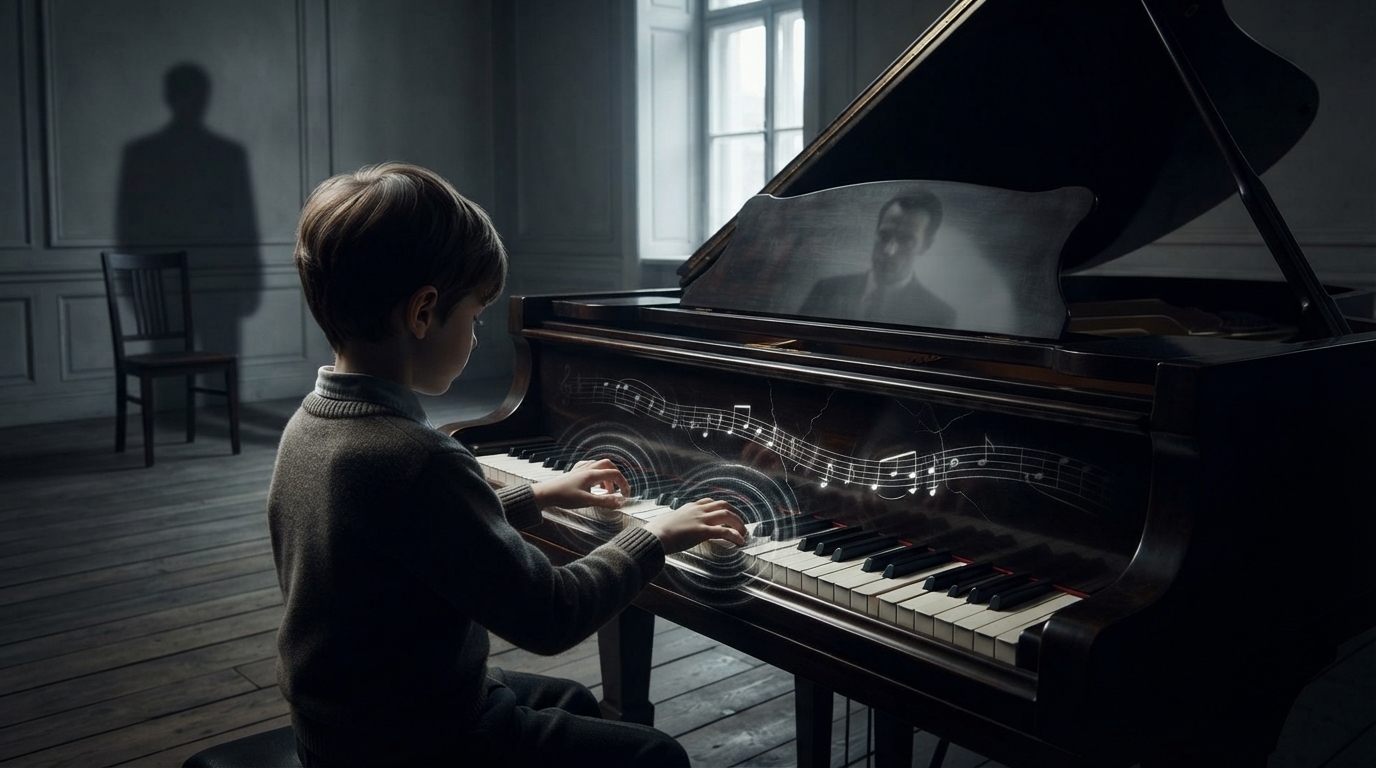
I sat down behind the screen. I raised my hands above the keys, and my wrists arranged themselves into the correct position on their own, without a single command from me, as though my body had signed a contract I had never been informed of, but whose terms suited me entirely.
I began to play.
The étude played itself; I merely accompanied it, out of courtesy. Every note released exactly on time — not an instant longer than its due, no sentimental attachment to a sound that had already finished its service. A perfect, disciplined, flawlessly selfish staccato.
I then went out into the corridor, where two categories of people could be found: those who had already played, slack as a rope with the weight lifted off it, and those still waiting, closed in on themselves — one boy, older than me, ran his fingers silently along the wall, rehearsing his own execution one last time. I already belonged to the first category and thought about nothing at all. Waiting with no content to it is a rare and, I confess, rather pleasant state.
An hour later they announced the results.
My name was called first.
VI. My Grandmother's Postscript
My grandmother was waiting at home. She did not need to ask — she read the result in the way the door opened, which proves that certain forms of perceptiveness are passed down solely through experience, and never through explanation.
She took my hands — just as my mother had, in the kitchen, but with a diametrically opposite intention: not to injure, but to heal, which makes the gesture anatomically identical and morally its exact reverse — a rare example of one and the same motion capable of meaning two mutually exclusive things.
"You'll remember us for this, one day," she said.
Not comfort. Not a prophecy. A statement of fact, delivered by someone who had accumulated, over a long life, more than enough personal experience for such statements.
I did not understand it then. I understood it much later — that she did not mean the competition, but the entire construction: the burner, Ragneda Alexeyevna and her economical silence, my mother with her ballerina's spine and her unconditional faith in the rightness of professionals. Everything instilled into a child through pain does not take root at once. Sometimes it takes decades. This is, I note, the only form of investment known to me with a guaranteed, if deferred, and entirely inevitable return.
In music there is a sign — the fermata: hold it longer than its due, do not be in a hurry to leave this sound. I return, in my mind, to that kitchen precisely with a fermata — not because it still hurts (the pain finished its part long ago, and finished it correctly), but because it was there that I first understood with my body what I would later have to spend a long time learning with my mind:
that letting go is also a technique, and one is not taught it any less diligently than holding on.
Every touch, complete. Every departure, instant. No note is obliged to drag behind it one that no longer exists. It is precisely in that short, mercilessly precise touch that a true sound is born — and, I might add, a character capable of, in time, writing this very sentence without shedding a single tear onto the page.
My mother knew this. Ragneda Alexeyevna knew this. Old Europe, which had invented this method long before any committee for the rights of the child came into existence, knew it perfectly well too.
I learned it through my fingertips — a source, I admit, not the most humane, but exceptionally reliable.
Every story begins before birth. But it begins to sound only where it starts to hurt.
And only there, to my own mild regret, does it finally turn into music.
Staccato: a detached articulation of sound, in which the note is cut off before its due time, leaving behind a silence as expressive as the sound itself. I learned this definition at the age of seven. It took me several more months to learn what it was actually made of.
There is a theory that character is formed before birth — in the dark, in the pause between non-being and appearance. I find this theory far too romantic. My character was formed considerably later, at a particular table, in a particular kitchen, and I am prepared to name the exact date, should anyone be interested.
II. Ragneda Alexeyevna, or Silence as a Weapon
Ragneda Alexeyevna was a small woman, armed with the single most devastating pedagogical instrument known to the profession: silence. She never raised her voice — why would she, when a pause works so much more efficiently than a shout? A shout insults. A pause annihilates.
When I made a mistake, she fell silent. Everything fit inside that silence — from polite disappointment to a final verdict on my musical unfitness. I would have preferred that she shout. A shout can be survived actively. Silence can only be submitted to.
Technically I had everything: an ear, fluency, the desire to please — the last of which, I note in passing, is worth considerably more than talent, since talent is lazy and the desire to please works weekends. I lacked exactly one thing: my hands refused to let go of the key on time. They settled onto it and remained there — comfortably, definitively, like guests incapable of taking a hint.
"The hands," Ragneda Alexeyevna would say.
One word. She was economical even in her verdicts.
III. A Visit from My Mother
My mother was summoned to the school — a phrase that sounds like a medical verdict, which, as it turned out, was not far from the truth.
My mother was a former ballerina, and former ballerinas, if one thinks about it, do not exist: the posture remains forever, like a tattoo, only more convincing, since it cannot be removed with a laser. She walked into the office, and the office immediately recognized who was in charge.
Ragneda Alexeyevna laid out the situation with the coolness of a meteorologist announcing a frost: the competition, the screen, the anonymous vote of the judges. The boy's talent was beyond question. His hands were not.
"What should be done?" my mother asked.
Note the phrasing. Not "is there anything that can be done" — the question of the weak, which leaves room for refusal. "What should be done" is the question of someone who has already decided to act, and is asking only for instructions.
Ragneda Alexeyevna gave the instructions. In the same tone she might have used to recite a recipe for a sponge cake.
"There's an old method. They used it in Europe. The hands learn on their own — if you explain it to them properly."
I would like to note the rare elegance of that sentence. "Explain it to them properly" is a euphemism of the very highest order, worthy of its own chapter in a textbook on rhetoric. I did not come to appreciate it until years later. At the moment it was spoken, I suspected nothing, naturally — seven-year-old children rarely suspect euphemisms; it is one of the few genuine shortcomings of childhood.
IV. A Lesson in Anatomy
I was called into the kitchen. I went without hesitation — hesitation, at seven, is not yet part of one's standard equipment.
The burner glowed a blue ring. An ordinary detail of an ordinary kitchen — except for the silence, categorically unlike the silence before supper. The silence before supper smells of onion. This one smelled of a decision, already made, not open to discussion.
"Come here. Give me your hand."
I gave it. Not because I understood — because my mother's tone left no grammatical possibility for refusal. Certain voices are constructed in such a way that disagreeing with them is physically impossible to formulate, the way it is impossible to hide a needle in water.
She took my fingers gently — that is exactly the right word here, and it is exactly that rightness that makes the whole scene so particularly interesting — and brought the tip of the first finger toward the glowing metal. Not to burn it. To touch it.
That proved more than sufficient.
The hand recoiled before I had time to shape a thought into words — the body, it turned out, is considerably more competent in matters of self-preservation than the mind, which still requires time for its paperwork. I screamed. My mother held on. She moved from finger to finger with the methodical care of someone embroidering along counted threads — not one wasted motion, not a shadow of doubt, and, remarkably, not a shadow of pleasure either. Sadism, at least, is honest about its motives. This was worse than sadism. This was faith.
Beyond the wall, my grandmother was crying quietly — quietly enough that no one could officially notice, and loudly enough that I would still remember it, many years later. She did not come in. Certain forms of protest confine themselves to acoustics.
I insist on precision in the wording: my mother was not cruel. Cruelty presupposes pleasure, or at the very least intent to cause harm. She possessed neither — only an impeccable, non-negotiable faith in professionals. Ragneda Alexeyevna had said so — therefore, so it must be. My mother belonged to that rare category of people who do not ask a second question once the first has already been answered. I find this trait simultaneously admirable and entirely unforgivable — a combination which, I fear, is the precise definition of a good upbringing.
The pain was brief and absolute. Exactly as a staccato ought to be. Therein, if you like, lies the whole irony of everything that follows.
V. The Screen
The assembly hall. No names were called — only a lottery number. Parents were not admitted: only the teachers in the hall, and the rest of us, condemned, in the corridor, where the nervousness could almost be smelled.
I drew the first number. Twenty participants. I was to open the parade.
I sat down behind the screen. I raised my hands above the keys, and my wrists arranged themselves into the correct position on their own, without a single command from me, as though my body had signed a contract I had never been informed of, but whose terms suited me entirely.
I began to play.
The étude played itself; I merely accompanied it, out of courtesy. Every note released exactly on time — not an instant longer than its due, no sentimental attachment to a sound that had already finished its service. A perfect, disciplined, flawlessly selfish staccato.
I then went out into the corridor, where two categories of people could be found: those who had already played, slack as a rope with the weight lifted off it, and those still waiting, closed in on themselves — one boy, older than me, ran his fingers silently along the wall, rehearsing his own execution one last time. I already belonged to the first category and thought about nothing at all. Waiting with no content to it is a rare and, I confess, rather pleasant state.
An hour later they announced the results.
My name was called first.
VI. My Grandmother's Postscript
My grandmother was waiting at home. She did not need to ask — she read the result in the way the door opened, which proves that certain forms of perceptiveness are passed down solely through experience, and never through explanation.
She took my hands — just as my mother had, in the kitchen, but with a diametrically opposite intention: not to injure, but to heal, which makes the gesture anatomically identical and morally its exact reverse — a rare example of one and the same motion capable of meaning two mutually exclusive things.
"You'll remember us for this, one day," she said.
Not comfort. Not a prophecy. A statement of fact, delivered by someone who had accumulated, over a long life, more than enough personal experience for such statements.
I did not understand it then. I understood it much later — that she did not mean the competition, but the entire construction: the burner, Ragneda Alexeyevna and her economical silence, my mother with her ballerina's spine and her unconditional faith in the rightness of professionals. Everything instilled into a child through pain does not take root at once. Sometimes it takes decades. This is, I note, the only form of investment known to me with a guaranteed, if deferred, and entirely inevitable return.
In music there is a sign — the fermata: hold it longer than its due, do not be in a hurry to leave this sound. I return, in my mind, to that kitchen precisely with a fermata — not because it still hurts (the pain finished its part long ago, and finished it correctly), but because it was there that I first understood with my body what I would later have to spend a long time learning with my mind:
that letting go is also a technique, and one is not taught it any less diligently than holding on.
Every touch, complete. Every departure, instant. No note is obliged to drag behind it one that no longer exists. It is precisely in that short, mercilessly precise touch that a true sound is born — and, I might add, a character capable of, in time, writing this very sentence without shedding a single tear onto the page.
My mother knew this. Ragneda Alexeyevna knew this. Old Europe, which had invented this method long before any committee for the rights of the child came into existence, knew it perfectly well too.
I learned it through my fingertips — a source, I admit, not the most humane, but exceptionally reliable.
Every story begins before birth. But it begins to sound only where it starts to hurt.
And only there, to my own mild regret, does it finally turn into music.
Literary Passport
1. Documentary prose: "True Stories"
2. Author: Iskandar Kadyrov
3. Age rating: 18+
4. Novella: "Staccato"
5. Genre: Documentary prose · Autobiographical novella · Psychological drama
6. Tagline: "The Price of Sound"
7. Blurb: True sound is born only where everything stands on the edge of collapse. But how much can be lost for one perfect moment?
2026 © Iskandar Kadyrov • All rights reserved • RU / EN (18+)
See also